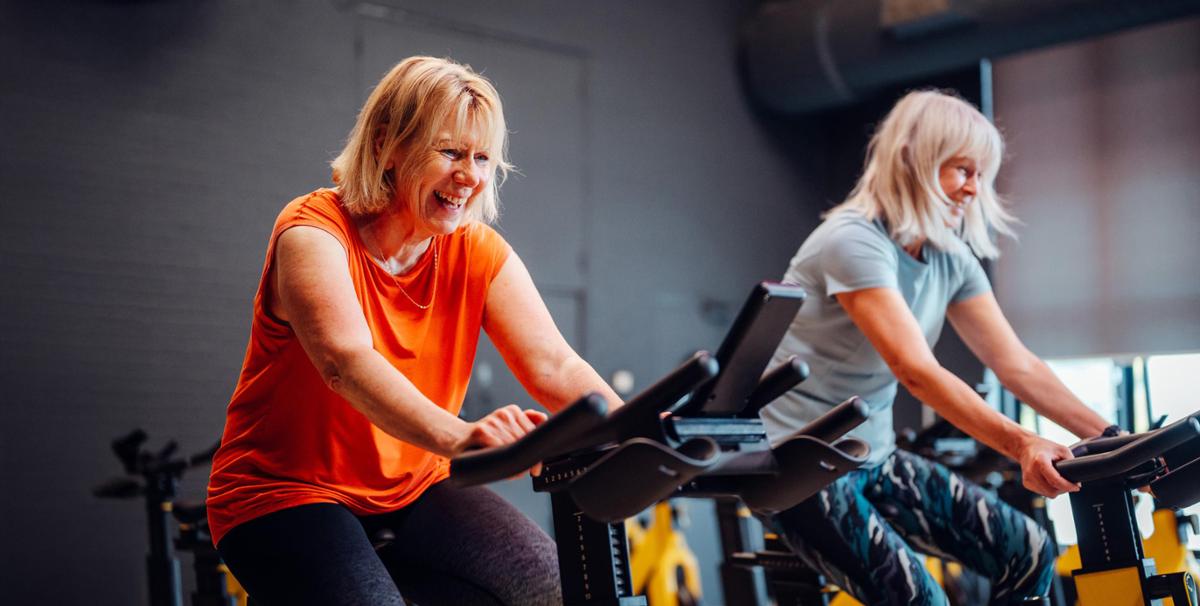
Indoor cycling is an effective way to treat hip osteoarthritis / photo: Bournemouth University
Indoor cycling is an effective and low-cost way of treating hip osteoarthritis and could save health services millions, while empowering consumers, according to a study.
Published in Lancet Rheumatology, the research was undertaken by Bournemouth University (BU) and University Hospitals Dorset (UHD).
The university launched a CHAIN (Cycling against Hip Pain) programme in 2013, targeting people with hip osteoarthritis and other forms of hip pain and worked with 96 patients referred by their doctor.
After eight one-hour weekly static cycling group classes, participants reported improvements in pain, function and quality of life, as well as more confidence, knowledge and motivation to exercise.
A second programme with 167 people also showed improvements and a five-year follow-up found the majority were still self-managing their hip pain, with 57 per cent not having pursued surgery.
More impact than physiotherapy In 2020, the CLEAT trial was launched to compare the CHAIN programme with standard physiotherapy. Participants attended Active Littledown in Bournemouth – operated by BH Live – once a week for eight weeks. Each session involved 30 minutes’ education from a physiotherapist about how to manage their arthritis and a 30 minute cycling session, led by an exercise specialist. The control group received the usual physiotherapy at the local hospital. The study was funded by the National Institute for Health Research.
Researchers discovered that participants who took part in the weekly cycling and education sessions reported better recovery outcomes when compared to participants who undertook regular physiotherapy.
Proven outcomes Tom Wainwright, professor of orthopaedics at BU and a physiotherapist at UHD, was the chief investigator, he says: “For the time it takes to treat one patient using standard physiotherapy, we can treat multiple patients in a group session and provide them with better outcomes. This has proven to be more cost-effective than standard treatment and we hope it will contribute to reducing waiting times for physiotherapy.”
The goal now is a national rollout, providing clinical teams across the UK with the knowledge and skills to set up their own interventions.
The BU team has also developed a virtual course on its app, allowing individuals to follow the intervention programme from their home or gym using a static bike.
Active Blackpool is deploying Cornerstone Connect, a new digital interface allowing
disparate information from multiple systems to be aggregated into one dataset, to support
its focus on reducing health inequalities and improving healthy life expectancy. [more...]
CoverMe, the global leader in fitness workforce management, today launches CoverMe PT, an
on-demand personal training platform that connects the right personal trainer to the right
client in under 10 seconds. [more...]
Indoor cycling is an effective way to treat hip osteoarthritis / photo: Bournemouth University
Indoor cycling is an effective and low-cost way of treating hip osteoarthritis and could save health services millions, while empowering consumers, according to a study.
Published in Lancet Rheumatology, the research was undertaken by Bournemouth University (BU) and University Hospitals Dorset (UHD).
The university launched a CHAIN (Cycling against Hip Pain) programme in 2013, targeting people with hip osteoarthritis and other forms of hip pain and worked with 96 patients referred by their doctor.
After eight one-hour weekly static cycling group classes, participants reported improvements in pain, function and quality of life, as well as more confidence, knowledge and motivation to exercise.
A second programme with 167 people also showed improvements and a five-year follow-up found the majority were still self-managing their hip pain, with 57 per cent not having pursued surgery.
More impact than physiotherapy In 2020, the CLEAT trial was launched to compare the CHAIN programme with standard physiotherapy. Participants attended Active Littledown in Bournemouth – operated by BH Live – once a week for eight weeks. Each session involved 30 minutes’ education from a physiotherapist about how to manage their arthritis and a 30 minute cycling session, led by an exercise specialist. The control group received the usual physiotherapy at the local hospital. The study was funded by the National Institute for Health Research.
Researchers discovered that participants who took part in the weekly cycling and education sessions reported better recovery outcomes when compared to participants who undertook regular physiotherapy.
Proven outcomes Tom Wainwright, professor of orthopaedics at BU and a physiotherapist at UHD, was the chief investigator, he says: “For the time it takes to treat one patient using standard physiotherapy, we can treat multiple patients in a group session and provide them with better outcomes. This has proven to be more cost-effective than standard treatment and we hope it will contribute to reducing waiting times for physiotherapy.”
The goal now is a national rollout, providing clinical teams across the UK with the knowledge and skills to set up their own interventions.
The BU team has also developed a virtual course on its app, allowing individuals to follow the intervention programme from their home or gym using a static bike.
An ambitious women’s-only strength and lifting studio concept is set to launch in Dallas this
September, with a wider US rollout already in active development.
Finnish outdoor fitness equipment specialist, Omnigym, has partnered with charity, Emmaüs
Solidarité, to launch an outdoor gym installation at a homeless shelter in Paris.
People taking GLP-1 weight loss medications such as Ozempic, Wegovy, Mounjaro and Zepbound
may be losing weight, but they’re also becoming less physically active, according to new
research presented at the ENDO 2026 annual meeting of the Endocrine Society
Active Blackpool is deploying Cornerstone Connect, a new digital interface allowing
disparate information from multiple systems to be aggregated into one dataset, to support
its focus on reducing health inequalities and improving healthy life expectancy. [more...]
CoverMe, the global leader in fitness workforce management, today launches CoverMe PT, an
on-demand personal training platform that connects the right personal trainer to the right
client in under 10 seconds. [more...]