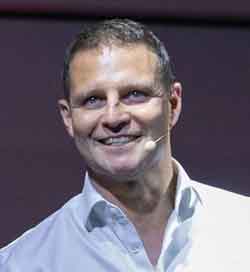
Duncan Wood-Allum explores how the public leisure
sector can pivot into a sustainable model focused on active
wellbeing in the upcoming local government reorganisation
Hold onto your hats
because this is
not going to be a
smooth transition / photo: Sport England / Duncan Nicholls
Since 2020, the public leisure, sport, and physical activity sector has faced three major challenges: rising utility prices, higher National Insurance contributions and COVID-19.
These shocks have tested the resilience of local authorities and their operating partners.
More recently, spiralling construction costs have reduced potential returns on investment from renewing facilities and when you add in workforce recruitment and retention challenges, the sector has been seriously challenged.
Despite this, recent years have seen a bounce-back in usage and financial performance, helping many operators stay afloat. Larger operators with economies of scale and those using cost-saving models (such as the VAT-efficient Agency Model) have fared better, but the fundamental problem remains: according to Sport England’s Active Lives survey, levels of participation in physical activity have barely improved – especially among inactive groups – and so stubborn inequalities persist.
Sport England has invested £250m in its Place Expansion initiative under the Uniting the Movement Strategy and while this is gathering momentum for the 100 or so places awarded, it pales in comparison when it comes to the broader £1bn spent annually across the UK on public sector leisure – including open spaces, pitches, community and indoor facilities.
So why hasn’t this investment sparked more significant change? I believe a major factor is the way many services are structured and delivered, as this is often outdated, fragmented and disconnected from broader health and wellbeing ambitions.
Enter local government reorganisation Local government reorganisation will see multiple local authorities merge into larger entities over the next four years, removing district and borough councils.
This process has been designed to decentralise power, streamline bureaucracy and better align services such as health and social care.
When seeking to predict the impact of such fundamental change, a critical question arises: is this the end of traditional leisure services, or a once-in-a-generation chance to reinvent them?
If mishandled, local government reorganisation could lead to mismanagement, neglected facilities or even service loss. Portfolios of inherited leisure assets could end up being the responsibility of new unitary authorities in a bizarre game of ‘pass the overly complex parcel’.
With the risk of a vacuum of leadership in these new organisations, there’s the potential for the future to be challenging, however, let’s not dwell on this, none of us is interested in seeing an erosion of services and physical activity participation levels – particularly amongst those who are less active or inactive.
On a more positive note, local government reorganisation offers a unique opportunity to reimagine the sector as delivering an active wellbeing service that is inclusive, sustainable and aligned with local health priorities.
Change as a catalyst There are three compelling opportunities for public leisure services to transform into an active wellbeing service through the catalyst of local government reorganisation. These can be framed at local political level and executive level, where the real influence sits.
Firstly, we have the opportunity to create an active wellbeing service, secondly, to fund this from existing resources and thirdly, to increase participation levels, particularly among less active populations.
With the renewed focus on addressing health inequalities and social care, traditional leisure services are unlikely to be seen as a core service.
Creation of an active wellbeing service The idea of reimagining leisure services, adapting and pivoting them to become active wellbeing services is gaining real traction across the country.
In our work at SLC, at the vanguard of this pivot – alongside other progressive organisations – we’re finding it gets real support from elected members and system partners in health and adult social care, as well as the voluntary sector.
Active wellbeing services go way beyond health club and gym memberships and swimming pools. They’re integrated, collaborative systems designed to support community health through physical activity.
While there’s ‘no one size fits all’ solution, an active wellbeing service is likely to have some or all of the following elements:
Key components could include:
■ A commissioning team to coordinate across health and leisure sectors.
■ Data and insight functions to support the co-design of services.
■ Commercial leisure activities that generate income.
■ Integration with adult social care to support independent living.
■ Allied health professionals working alongside leisure staff.
■ Influence over local planning to embed active design and support more active communities.
■ A programme to support workforce transformation, to better support people with complex health needs.
■ Outreach and enabling support to schools, clubs and voluntary groups.
■ Strong programming and communications to activate local spaces and coordinate local resources.
This service would be outward-facing, enabling place-based working and featuring the delivery of commercial and inclusive facility-based provision, outreach and community engagement. It would be embedded, serving as a key delivery partner across multiple functions of the new local authority.
Financial sustainability is key One thing is clear, future services must be financially sustainable. Reliance on health sector funding, while ideal in theory, is not realistic in the short-term. Instead, economies of scale will be essential.
In our experience, the merging of multiple councils’ leisure services can generate significant savings – up to £1.5 million-plus annually for a single authority. If scaled across larger new authorities, surpluses of £3-5 million per year are possible. These funds could be reinvested in outreach, health and social care alignment and addressing inequalities in participation.
There’s still a need to support operators in better understanding the potential of combining these roles and working more collaboratively. Encouragingly, we’re already seeing some of these behaviours through the partnerships we’ve supported in places such as Sheffield and Northumberland.
With the right commercial and place-based mindset, active wellbeing services can be both self-funding and socially impactful.
Active wellbeing services will need to generate the value themselves, combining an unapologetically commercial focus with a place-based and wider systems mindset.
Closing the participation gap Despite billions invested, physical activity levels haven’t significantly improved, particularly among the least active populations. The collective potential of public and private sector leisure, facilities, pitches, parks and community spaces remains largely untapped. Addressing it is within our gift through designing this collaborative approach into governance, learning and workforce development, service models and organisational cultures, partnerships and specifications.
We suggest a stronger focus on:
■ Targeted investment into inclusive, revenue-generating activities.
■ Planning policy that supports active design and play.
■ Better data, monitoring and evaluation, using tools such as the Wellby social value measure.
■ Optimising local networks and infrastructure.
■ Reinvesting in sports development, particularly for young people.
■ Supporting voluntary and grassroots organisations.
■ Cultural changes that embed activity into public services, such as workplace wellness.
These steps can bridge the participation gap if backed by leadership, collaboration and a clear strategy.
So what should local authorities be doing now? Some councils are already on this journey, but all local authorities – especially those forming new unitary authorities – need to act now.
Key steps:
1. Create an active wellbeing commissioning function: this team should influence strategy, connect with political leaders and link across public health, adult care, planning and more.
2. Develop a compelling, co-produced vision: show how active wellbeing improves lives and supports local priorities.
3. Influence and secure a seat of influence in the shadow unitary authority and seek to shape thinking around active wellbeing.
4. Protect local knowledge and memory: staff changes during reorganisation can lead to lost insights, so document and share what works.
5. Audit your assets: know what services and facilities you’ll inherit and assess their suitability.
6. Map local networks: identify potential partners and build collaborative plans.
7. Get involved early: position public leisure assets and your active wellbeing service at the centre of shadow authority discussions.
The road ahead Hold onto your hats because this is not going to be a smooth transition. It’s time to harness the collective potential of our existing assets, services and partnerships. The future is bright for those prepared to step forward to embrace and shape the opportunity that local government reorganisation presents.
Is this the end of public leisure services as we know it? Yes, but active wellbeing is our collective future – let’s win the argument for sustainable active wellbeing and then get on and deliver it.
CoverMe, the global leader in fitness workforce management, today launches CoverMe PT, an
on-demand personal training platform that connects the right personal trainer to the right
client in under 10 seconds. [more...]
Active Blackpool is deploying Cornerstone Connect, a new digital interface allowing
disparate information from multiple systems to be aggregated into one dataset, to support
its focus on reducing health inequalities and improving healthy life expectancy. [more...]
Duncan Wood-Allum explores how the public leisure
sector can pivot into a sustainable model focused on active
wellbeing in the upcoming local government reorganisation
Hold onto your hats
because this is
not going to be a
smooth transition / photo: Sport England / Duncan Nicholls
Since 2020, the public leisure, sport, and physical activity sector has faced three major challenges: rising utility prices, higher National Insurance contributions and COVID-19.
These shocks have tested the resilience of local authorities and their operating partners.
More recently, spiralling construction costs have reduced potential returns on investment from renewing facilities and when you add in workforce recruitment and retention challenges, the sector has been seriously challenged.
Despite this, recent years have seen a bounce-back in usage and financial performance, helping many operators stay afloat. Larger operators with economies of scale and those using cost-saving models (such as the VAT-efficient Agency Model) have fared better, but the fundamental problem remains: according to Sport England’s Active Lives survey, levels of participation in physical activity have barely improved – especially among inactive groups – and so stubborn inequalities persist.
Sport England has invested £250m in its Place Expansion initiative under the Uniting the Movement Strategy and while this is gathering momentum for the 100 or so places awarded, it pales in comparison when it comes to the broader £1bn spent annually across the UK on public sector leisure – including open spaces, pitches, community and indoor facilities.
So why hasn’t this investment sparked more significant change? I believe a major factor is the way many services are structured and delivered, as this is often outdated, fragmented and disconnected from broader health and wellbeing ambitions.
Enter local government reorganisation Local government reorganisation will see multiple local authorities merge into larger entities over the next four years, removing district and borough councils.
This process has been designed to decentralise power, streamline bureaucracy and better align services such as health and social care.
When seeking to predict the impact of such fundamental change, a critical question arises: is this the end of traditional leisure services, or a once-in-a-generation chance to reinvent them?
If mishandled, local government reorganisation could lead to mismanagement, neglected facilities or even service loss. Portfolios of inherited leisure assets could end up being the responsibility of new unitary authorities in a bizarre game of ‘pass the overly complex parcel’.
With the risk of a vacuum of leadership in these new organisations, there’s the potential for the future to be challenging, however, let’s not dwell on this, none of us is interested in seeing an erosion of services and physical activity participation levels – particularly amongst those who are less active or inactive.
On a more positive note, local government reorganisation offers a unique opportunity to reimagine the sector as delivering an active wellbeing service that is inclusive, sustainable and aligned with local health priorities.
Change as a catalyst There are three compelling opportunities for public leisure services to transform into an active wellbeing service through the catalyst of local government reorganisation. These can be framed at local political level and executive level, where the real influence sits.
Firstly, we have the opportunity to create an active wellbeing service, secondly, to fund this from existing resources and thirdly, to increase participation levels, particularly among less active populations.
With the renewed focus on addressing health inequalities and social care, traditional leisure services are unlikely to be seen as a core service.
Creation of an active wellbeing service The idea of reimagining leisure services, adapting and pivoting them to become active wellbeing services is gaining real traction across the country.
In our work at SLC, at the vanguard of this pivot – alongside other progressive organisations – we’re finding it gets real support from elected members and system partners in health and adult social care, as well as the voluntary sector.
Active wellbeing services go way beyond health club and gym memberships and swimming pools. They’re integrated, collaborative systems designed to support community health through physical activity.
While there’s ‘no one size fits all’ solution, an active wellbeing service is likely to have some or all of the following elements:
Key components could include:
■ A commissioning team to coordinate across health and leisure sectors.
■ Data and insight functions to support the co-design of services.
■ Commercial leisure activities that generate income.
■ Integration with adult social care to support independent living.
■ Allied health professionals working alongside leisure staff.
■ Influence over local planning to embed active design and support more active communities.
■ A programme to support workforce transformation, to better support people with complex health needs.
■ Outreach and enabling support to schools, clubs and voluntary groups.
■ Strong programming and communications to activate local spaces and coordinate local resources.
This service would be outward-facing, enabling place-based working and featuring the delivery of commercial and inclusive facility-based provision, outreach and community engagement. It would be embedded, serving as a key delivery partner across multiple functions of the new local authority.
Financial sustainability is key One thing is clear, future services must be financially sustainable. Reliance on health sector funding, while ideal in theory, is not realistic in the short-term. Instead, economies of scale will be essential.
In our experience, the merging of multiple councils’ leisure services can generate significant savings – up to £1.5 million-plus annually for a single authority. If scaled across larger new authorities, surpluses of £3-5 million per year are possible. These funds could be reinvested in outreach, health and social care alignment and addressing inequalities in participation.
There’s still a need to support operators in better understanding the potential of combining these roles and working more collaboratively. Encouragingly, we’re already seeing some of these behaviours through the partnerships we’ve supported in places such as Sheffield and Northumberland.
With the right commercial and place-based mindset, active wellbeing services can be both self-funding and socially impactful.
Active wellbeing services will need to generate the value themselves, combining an unapologetically commercial focus with a place-based and wider systems mindset.
Closing the participation gap Despite billions invested, physical activity levels haven’t significantly improved, particularly among the least active populations. The collective potential of public and private sector leisure, facilities, pitches, parks and community spaces remains largely untapped. Addressing it is within our gift through designing this collaborative approach into governance, learning and workforce development, service models and organisational cultures, partnerships and specifications.
We suggest a stronger focus on:
■ Targeted investment into inclusive, revenue-generating activities.
■ Planning policy that supports active design and play.
■ Better data, monitoring and evaluation, using tools such as the Wellby social value measure.
■ Optimising local networks and infrastructure.
■ Reinvesting in sports development, particularly for young people.
■ Supporting voluntary and grassroots organisations.
■ Cultural changes that embed activity into public services, such as workplace wellness.
These steps can bridge the participation gap if backed by leadership, collaboration and a clear strategy.
So what should local authorities be doing now? Some councils are already on this journey, but all local authorities – especially those forming new unitary authorities – need to act now.
Key steps:
1. Create an active wellbeing commissioning function: this team should influence strategy, connect with political leaders and link across public health, adult care, planning and more.
2. Develop a compelling, co-produced vision: show how active wellbeing improves lives and supports local priorities.
3. Influence and secure a seat of influence in the shadow unitary authority and seek to shape thinking around active wellbeing.
4. Protect local knowledge and memory: staff changes during reorganisation can lead to lost insights, so document and share what works.
5. Audit your assets: know what services and facilities you’ll inherit and assess their suitability.
6. Map local networks: identify potential partners and build collaborative plans.
7. Get involved early: position public leisure assets and your active wellbeing service at the centre of shadow authority discussions.
The road ahead Hold onto your hats because this is not going to be a smooth transition. It’s time to harness the collective potential of our existing assets, services and partnerships. The future is bright for those prepared to step forward to embrace and shape the opportunity that local government reorganisation presents.
Is this the end of public leisure services as we know it? Yes, but active wellbeing is our collective future – let’s win the argument for sustainable active wellbeing and then get on and deliver it.
An ambitious women’s-only strength and lifting studio concept is set to launch in Dallas this
September, with a wider US rollout already in active development.
Finnish outdoor fitness equipment specialist, Omnigym, has partnered with charity, Emmaüs
Solidarité, to launch an outdoor gym installation at a homeless shelter in Paris.
People taking GLP-1 weight loss medications such as Ozempic, Wegovy, Mounjaro and Zepbound
may be losing weight, but they’re also becoming less physically active, according to new
research presented at the ENDO 2026 annual meeting of the Endocrine Society
CoverMe, the global leader in fitness workforce management, today launches CoverMe PT, an
on-demand personal training platform that connects the right personal trainer to the right
client in under 10 seconds. [more...]
Active Blackpool is deploying Cornerstone Connect, a new digital interface allowing
disparate information from multiple systems to be aggregated into one dataset, to support
its focus on reducing health inequalities and improving healthy life expectancy. [more...]