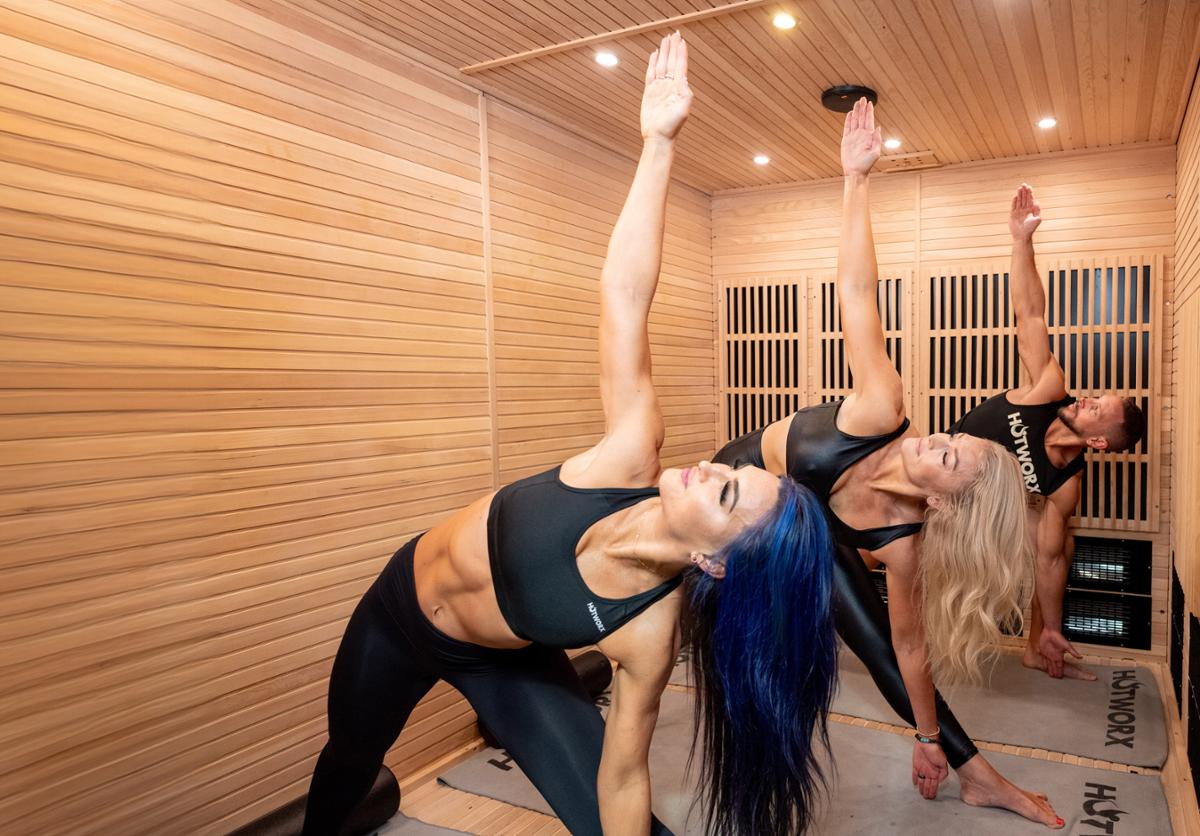
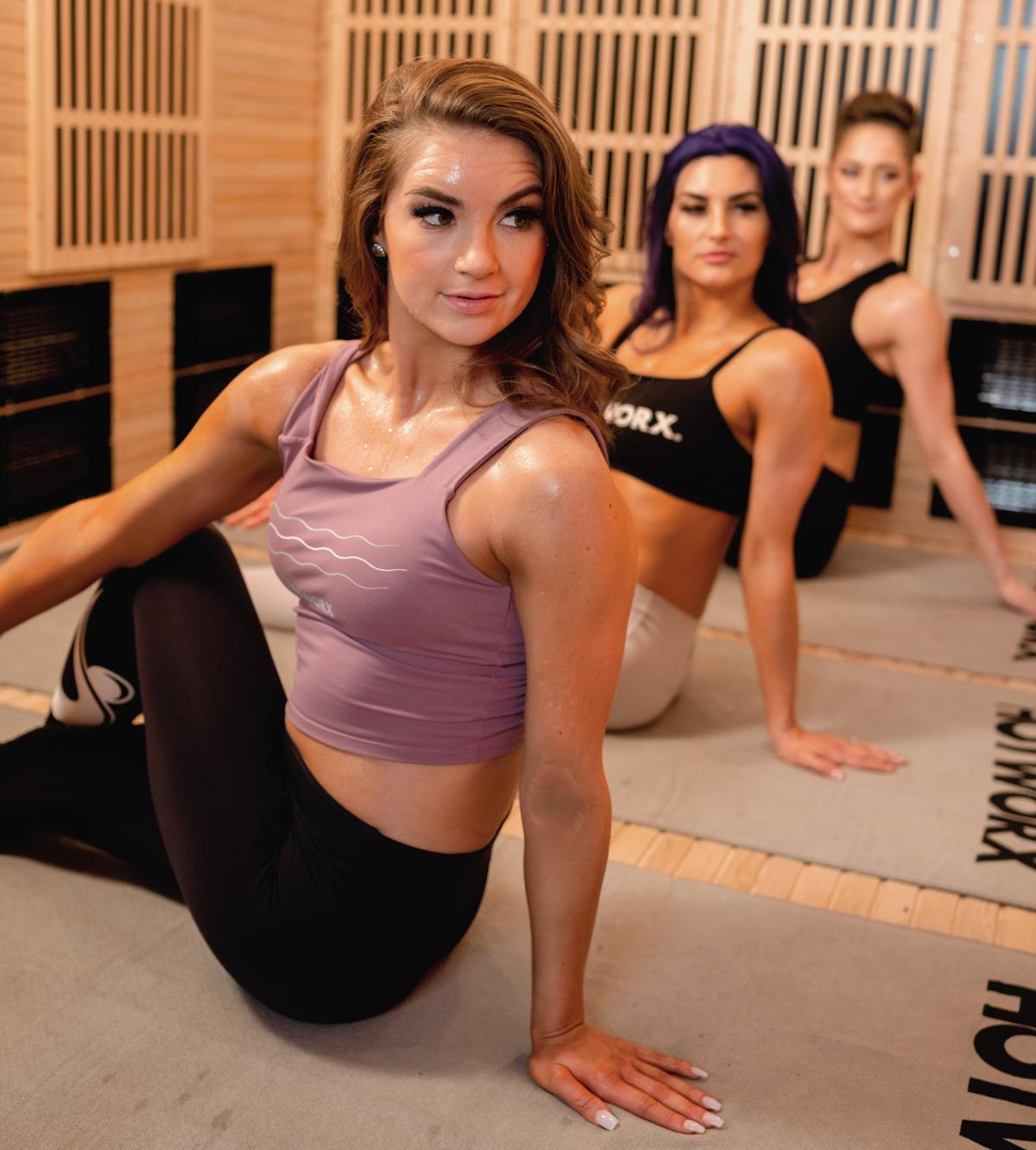
Hotworx started as hot yoga and is female-centric as a result, although men are welcomed / photo: Hotworx
Tell us about Hotworx We offer 24/7 workouts in an infra-red sauna for up to three people. The saunas are designed for the heaters to be close enough to the client for them to get infrared energy absorption.
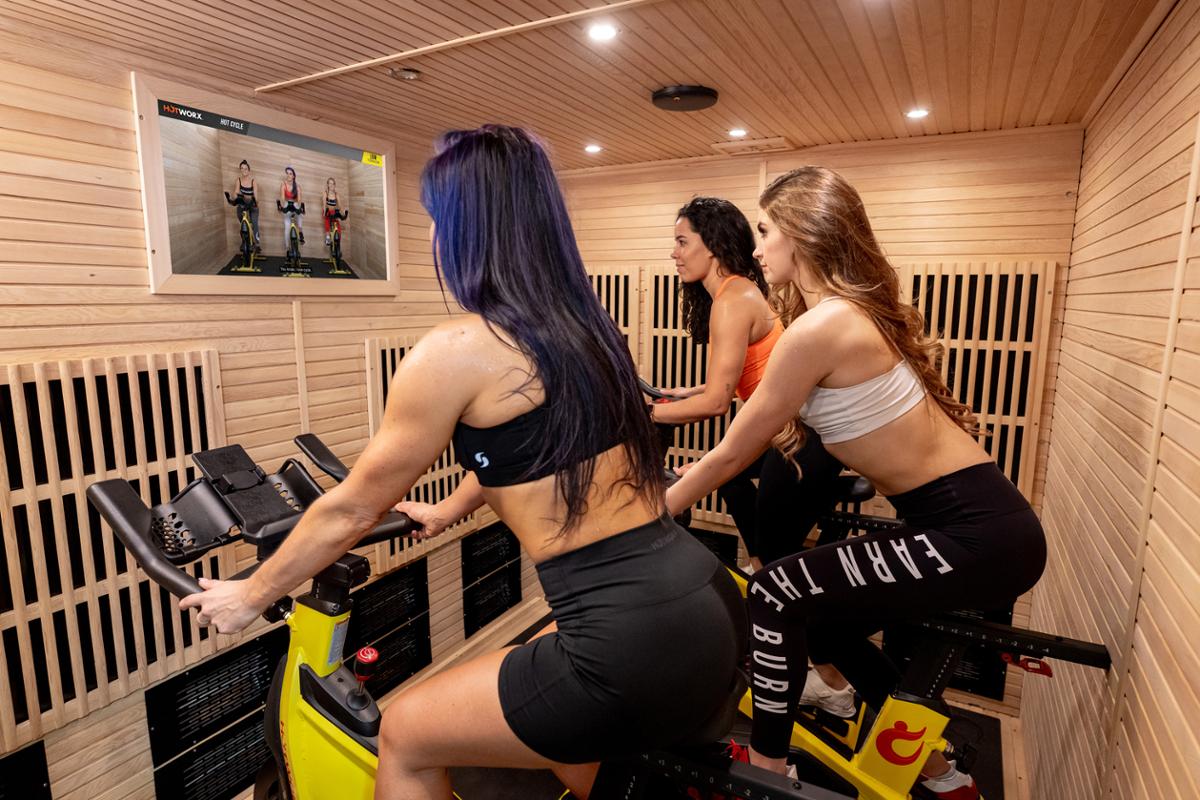
Led by a virtual instructor, the 30-minute classes include a choice of rowing, cycling and other isometric and HIIT workouts, as well as yoga, Pilates and barre.
We encourage all our clients to try everything to keep interest high and train all the muscles in different ways to become holistically stronger.
The studios also have a resistance training area that’s not heated, called the FX Zone, with a range of equipment such as dumbbells, benches, resistance straps, Bosu Balls, kettlebells and battle ropes.
We’re a tech-forward fitness company and own all our own software, email marketing platform and CRM. We also have a patent and developed our own app and choreograph all the workouts based on solid training principles.
How did the idea come about? The concept came to me on a holiday to Jamaica in 2014. I was talking to a friend about my journey with Bikram yoga and he said I should do yoga in a sauna. It was a lightbulb moment and when I got home I started work to develop the business.
There were a lot of moving parts that had to come together on the software and the mechanical side, as well as manufacturing a newly-designed technology. It took us about nine months from having the idea to taking the first prototype to market.
When did the first site open? We opened the first location in Oxford, Mississippi in 2017. The first few sites were in independent spas and our own Planet Beach franchise, but it was an instant hit so I soon made the decision that it needed to be its own business. Now all the sites are standalone and are typically 2,000 square feet, in locations such as shopping centres.
We now have 673 locations and should reach 700 locations by September this year. Only five are corporately managed, the rest are franchises.
Our first overseas location is in Galway, Ireland. We’re currently in talks with a group that wants to take the concept to the UK and Germany, so I expect we’ll have traction in Europe in the coming years.
How much did the pandemic get in the way of the rollout? During the lockdowns we didn’t reduce our advertising, we just changed the messaging to a more sympathetic tone and invited folks to get on the waiting lists and sign up for discounts once we opened.
That worked like a charm. When we opened up we had a flood of clients and then we had the good fortune of being the COVID ‘place to go’ because we could reduce the number of clients down to only one person, then we went up to two with social distancing. Because we own our software we can turn it on a dime like this to adjust numbers and the clients loved it because they had the heat and heat in theory was not good for the COVID virus.
How much does a session cost? You can pay per session, pay for multiple sessions on one day or pay for an entire year all up front. However, 95 per cent of our customers get on the monthly plan for US$59 for unlimited sessions at a single location. For US$79 a month they can use any location.
What’s the science behind it? Let me shamelessly plug my book, Hot Exercise, which collates all the science on heated exercise – specifically infra-red light exposure – that’s available from scientific medical journals.
In a nutshell, the infra-red creates heat, speeding up the metabolism while you’re exercising. It also dilates the capillaries, so you’re increasing the supply of oxygen. By virtue of that process you’re accelerating wound healing and potentially decreasing inflammation, depending on other health indicators. It’s extremely beneficial for most people.
Who are your customers? We build our messaging around women in their 30s and we’re able to create a massive ripple effect from that messaging which draws in a wider audience. About 17 per cent of our members are guys. We welcome them into our studios as well, but since it’s a business that began out of hot yoga, it appeals mainly to females.
Tell us about your growth plans We have a very disciplined strategy and want to develop into all of the markets and neighbourhoods in the US. Our rule of thumb in the US and Canada is one location for every 100,000 people. Planet Fitness stated in its annual report this year that it believes it can have 5,000 sites in the United States, which is one location for every 70,000 people. So we feel that our aspiration to have one location for every 100,000 people is very reasonable and a solid move forward.
I’ve identified about 2,300 small towns in the United States with a population of 10,000 to 50,000 where I believe the concept can work. We have one franchise owner in Seminole, Texas who runs a profitable business in a town of 7,000, proving it can work in an area with a low density population.
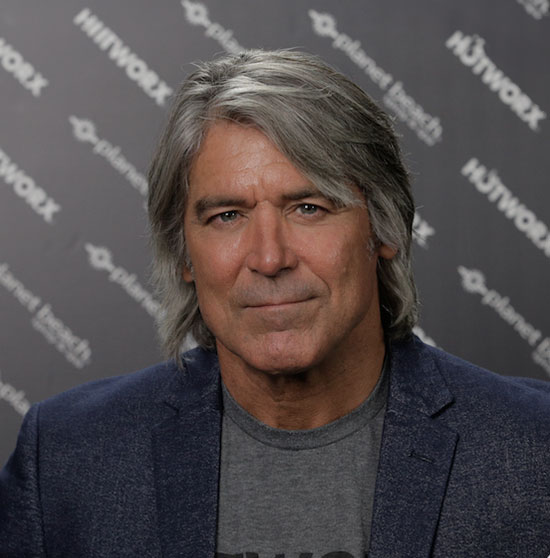
"We want to develop
into all the markets and
neighbourhoods in the US,
right down to places with
a population of 10,000" – Stephen P Smith,
Founder, Hotworx
Six+ modalities are on offer, including cycling and HIIT / photo: Hotworx
Hotworx is expanding into Ireland, Germany and the UK / photo: Hotworx
CoverMe, the global leader in fitness workforce management, today launches CoverMe PT, an
on-demand personal training platform that connects the right personal trainer to the right
client in under 10 seconds. [more...]
Active Blackpool is deploying Cornerstone Connect, a new digital interface allowing
disparate information from multiple systems to be aggregated into one dataset, to support
its focus on reducing health inequalities and improving healthy life expectancy. [more...]
Hotworx started as hot yoga and is female-centric as a result, although men are welcomed / photo: Hotworx
Tell us about Hotworx We offer 24/7 workouts in an infra-red sauna for up to three people. The saunas are designed for the heaters to be close enough to the client for them to get infrared energy absorption.
Led by a virtual instructor, the 30-minute classes include a choice of rowing, cycling and other isometric and HIIT workouts, as well as yoga, Pilates and barre.
We encourage all our clients to try everything to keep interest high and train all the muscles in different ways to become holistically stronger.
The studios also have a resistance training area that’s not heated, called the FX Zone, with a range of equipment such as dumbbells, benches, resistance straps, Bosu Balls, kettlebells and battle ropes.
We’re a tech-forward fitness company and own all our own software, email marketing platform and CRM. We also have a patent and developed our own app and choreograph all the workouts based on solid training principles.
How did the idea come about? The concept came to me on a holiday to Jamaica in 2014. I was talking to a friend about my journey with Bikram yoga and he said I should do yoga in a sauna. It was a lightbulb moment and when I got home I started work to develop the business.
There were a lot of moving parts that had to come together on the software and the mechanical side, as well as manufacturing a newly-designed technology. It took us about nine months from having the idea to taking the first prototype to market.
When did the first site open? We opened the first location in Oxford, Mississippi in 2017. The first few sites were in independent spas and our own Planet Beach franchise, but it was an instant hit so I soon made the decision that it needed to be its own business. Now all the sites are standalone and are typically 2,000 square feet, in locations such as shopping centres.
We now have 673 locations and should reach 700 locations by September this year. Only five are corporately managed, the rest are franchises.
Our first overseas location is in Galway, Ireland. We’re currently in talks with a group that wants to take the concept to the UK and Germany, so I expect we’ll have traction in Europe in the coming years.
How much did the pandemic get in the way of the rollout? During the lockdowns we didn’t reduce our advertising, we just changed the messaging to a more sympathetic tone and invited folks to get on the waiting lists and sign up for discounts once we opened.
That worked like a charm. When we opened up we had a flood of clients and then we had the good fortune of being the COVID ‘place to go’ because we could reduce the number of clients down to only one person, then we went up to two with social distancing. Because we own our software we can turn it on a dime like this to adjust numbers and the clients loved it because they had the heat and heat in theory was not good for the COVID virus.
How much does a session cost? You can pay per session, pay for multiple sessions on one day or pay for an entire year all up front. However, 95 per cent of our customers get on the monthly plan for US$59 for unlimited sessions at a single location. For US$79 a month they can use any location.
What’s the science behind it? Let me shamelessly plug my book, Hot Exercise, which collates all the science on heated exercise – specifically infra-red light exposure – that’s available from scientific medical journals.
In a nutshell, the infra-red creates heat, speeding up the metabolism while you’re exercising. It also dilates the capillaries, so you’re increasing the supply of oxygen. By virtue of that process you’re accelerating wound healing and potentially decreasing inflammation, depending on other health indicators. It’s extremely beneficial for most people.
Who are your customers? We build our messaging around women in their 30s and we’re able to create a massive ripple effect from that messaging which draws in a wider audience. About 17 per cent of our members are guys. We welcome them into our studios as well, but since it’s a business that began out of hot yoga, it appeals mainly to females.
Tell us about your growth plans We have a very disciplined strategy and want to develop into all of the markets and neighbourhoods in the US. Our rule of thumb in the US and Canada is one location for every 100,000 people. Planet Fitness stated in its annual report this year that it believes it can have 5,000 sites in the United States, which is one location for every 70,000 people. So we feel that our aspiration to have one location for every 100,000 people is very reasonable and a solid move forward.
I’ve identified about 2,300 small towns in the United States with a population of 10,000 to 50,000 where I believe the concept can work. We have one franchise owner in Seminole, Texas who runs a profitable business in a town of 7,000, proving it can work in an area with a low density population.
"We want to develop
into all the markets and
neighbourhoods in the US,
right down to places with
a population of 10,000" – Stephen P Smith,
Founder, Hotworx
Six+ modalities are on offer, including cycling and HIIT / photo: Hotworx
Hotworx is expanding into Ireland, Germany and the UK / photo: Hotworx
An ambitious women’s-only strength and lifting studio concept is set to launch in Dallas this
September, with a wider US rollout already in active development.
Finnish outdoor fitness equipment specialist, Omnigym, has partnered with charity, Emmaüs
Solidarité, to launch an outdoor gym installation at a homeless shelter in Paris.
People taking GLP-1 weight loss medications such as Ozempic, Wegovy, Mounjaro and Zepbound
may be losing weight, but they’re also becoming less physically active, according to new
research presented at the ENDO 2026 annual meeting of the Endocrine Society
CoverMe, the global leader in fitness workforce management, today launches CoverMe PT, an
on-demand personal training platform that connects the right personal trainer to the right
client in under 10 seconds. [more...]
Active Blackpool is deploying Cornerstone Connect, a new digital interface allowing
disparate information from multiple systems to be aggregated into one dataset, to support
its focus on reducing health inequalities and improving healthy life expectancy. [more...]