Fitronics worked with YouGov and Dr Melvyn Hillsdon to understand non-members / photo: shutterstock/BGStock72
In recent focus groups, health and fitness operators said they wanted to understand growth opportunities in the market.
As a result, Fitronics commissioned YouGov and Dr Melvyn Hillsdon to carry out a landmark study into non-members to better understand the growth potential of the sector.
A survey of over 2,000 adults was undertaken, designed as a representative sample of the UK population. Research questions focused on gaining insight into important areas, such as the potential for growth, audience size, and the proportion of active and inactive non-members.
Breaking down the sample, 55 per cent had never been a member of a health club, while 30 per cent were lapsed members and 14 per cent were current members.
In addition, 45 per cent were active at or above the recommended government level, 42 per cent were active, but at lower levels than recommended and 13 per cent were inactive.
Key findings The findings revealed a substantial opportunity to increase membership in the UK fitness market by 10.9m members, taking market penetration from the current level of 14 per cent up to 35 per cent.
For some years, the industry has been focused on attracting the 85 per cent of the UK population who are not yet members of a health club, however, this new research suggests the greatest potential for growth lies in targeting people who are already active but are not members of a gym, health club or leisure centre.
Priorities Attracting active non-members requires persuading them away from their existing ways of being active and represents a new marketing challenge, especially if the activities they’re engaged with are free.
Within the target group of active non-members, researchers found those who’ve never been a member would be harder to reach than lapsed members, as those who’ve never joined see fewer reasons to do so.
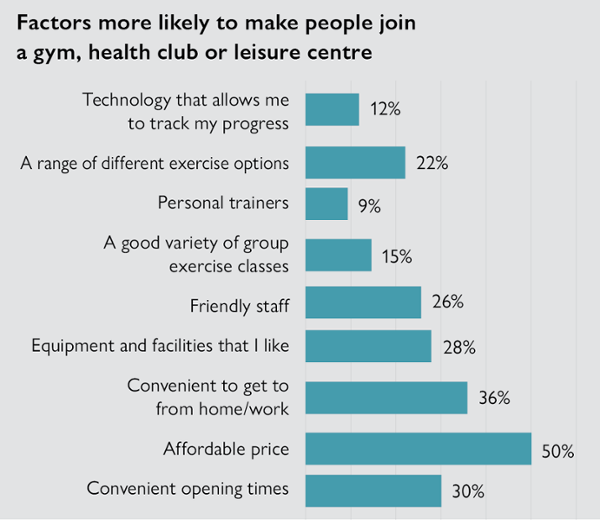
Motivation Across the entire sample, the main factors that people said would increase the probability of them joining a club were cost and access. However, friendly staff, a range of exercise offerings and peoples’ preferred equipment were also ranked as important.
Across the active non-member sample, people were nine times more likely to say membership was important to them if they thought there would be friendly staff, whereas affordability only doubled the likelihood of them saying membership was important.
Finding a balance With the growing movement within the industry to reach and nurture inactive non-members, there is –of course – a balance to be struck between delivering social and community value and commercial gains and deliverables.
There is, therefore, an opportunity to focus on, to onboard and to attract active non-members, alongside people in the harder-to-reach non-active market.
Panatta brought together four of the most influential figures in bodybuilding history on the
stage of RiminiWellness 2026: Phil Heath, Lee Haney, Ronnie Coleman and Hany Rambod. [more...]
Fitronics worked with YouGov and Dr Melvyn Hillsdon to understand non-members / photo: shutterstock/BGStock72
In recent focus groups, health and fitness operators said they wanted to understand growth opportunities in the market.
As a result, Fitronics commissioned YouGov and Dr Melvyn Hillsdon to carry out a landmark study into non-members to better understand the growth potential of the sector.
A survey of over 2,000 adults was undertaken, designed as a representative sample of the UK population. Research questions focused on gaining insight into important areas, such as the potential for growth, audience size, and the proportion of active and inactive non-members.
Breaking down the sample, 55 per cent had never been a member of a health club, while 30 per cent were lapsed members and 14 per cent were current members.
In addition, 45 per cent were active at or above the recommended government level, 42 per cent were active, but at lower levels than recommended and 13 per cent were inactive.
Key findings The findings revealed a substantial opportunity to increase membership in the UK fitness market by 10.9m members, taking market penetration from the current level of 14 per cent up to 35 per cent.
For some years, the industry has been focused on attracting the 85 per cent of the UK population who are not yet members of a health club, however, this new research suggests the greatest potential for growth lies in targeting people who are already active but are not members of a gym, health club or leisure centre.
Priorities Attracting active non-members requires persuading them away from their existing ways of being active and represents a new marketing challenge, especially if the activities they’re engaged with are free.
Within the target group of active non-members, researchers found those who’ve never been a member would be harder to reach than lapsed members, as those who’ve never joined see fewer reasons to do so.
Motivation Across the entire sample, the main factors that people said would increase the probability of them joining a club were cost and access. However, friendly staff, a range of exercise offerings and peoples’ preferred equipment were also ranked as important.
Across the active non-member sample, people were nine times more likely to say membership was important to them if they thought there would be friendly staff, whereas affordability only doubled the likelihood of them saying membership was important.
Finding a balance With the growing movement within the industry to reach and nurture inactive non-members, there is –of course – a balance to be struck between delivering social and community value and commercial gains and deliverables.
There is, therefore, an opportunity to focus on, to onboard and to attract active non-members, alongside people in the harder-to-reach non-active market.
It’s been five years since the fitness industry reopened after the last lockdown – long enough
to look back on the impact the pandemic had on the sector and what might come next.
Wattbike has announced a new integration with EGYM, which enables the bikes to contribute to
the Cardio BioAge score of individuals via a VO2 max result.
Les Mills has launched a reformer Pilates workout. The 45-minute workout blends traditional
reformer movements and more contemporary exercises, choreographed to music.
According to research which tracked more than 147,000 people for 30 years, 90-120 minutes
of strength training a week may deliver some of the biggest long-term health rewards.
The UK's four Chief Medical Officers have published a refreshed edition of Physical activity
guidelines: UK Chief Medical Officers' report, updating the evidence that underpins the nation's
physical activity recommendations and placing greater emphasis on strength, balance, reducing
sedentary behaviour and, for the first time, supporting people taking weight loss medications.
Places Leisure has exchanged contracts to build and operate a flagship £60m water and leisure
destination on behalf of Basingstoke and Deane Borough Council.
The Republic of Ireland will become the latest market in PureGym’s expanding international
portfolio, with the first launch planned for Dublin in 2027.
Anytime Fitness opened more than one club a day in 2025 and is on track to maintain this rate
of growth this year, as parent company Purpose Brands targets further international expansion.
Panatta brought together four of the most influential figures in bodybuilding history on the
stage of RiminiWellness 2026: Phil Heath, Lee Haney, Ronnie Coleman and Hany Rambod. [more...]