Get HCM digital magazine and ezines FREE
Sign up here ▸
Jobs   News   Features   Products   Magazine      Advertise  
Industry insights
IHRSA: Asia-Pacific

The Asia-Pacific health club market is now worth US$16.8 billion, according to an exceptional new report. IHRSA’s Kristen Walsh shares some of the highlights

By Kristen Walsh | Published in Health Club Handbook 2019 issue 1


The second edition of the IHRSA Asia-Pacific Health Club Report was released recently in collaboration with Deloitte.

It demonstrates that the health and fitness industry in the Asia-Pacific region is in good shape – fueled by growing economies and with significant potential for continued growth.

Deloitte says only two markets in the region are considered mature, these being Australia and New Zealand, which have the highest penetration rates at 15.3 per cent and 13.6 per cent, respectively.

While the fitness market shows signs of rapid growth and professionalisation in terms of penetration rates in Hong Kong (5.85 per cent), Singapore (5.8 per cent), and Japan (3.3 per cent), significant opportunities for growth still remain in less developmed markets, such as the Philippines (0.53 per cent), Thailand (0.5 per cent), Indonesia (0.18 per cent) and India (0.15 per cent).

Along with such growth opportunities come challenges. Real estate costs, limited rental availability, infrastructure underdevelopment, lack of professionalised services and increasing competition are just some of the realities club operators face when working in Asia-Pacific markets. However, a favourable economic outlook, along with increasing health awareness and demand for group exercise and personalised training, are expected to spur expansion.

“Driven by the momentum of economic prosperity, the fitness market in the Asia-Pacific region has shown steady growth, with a positive outlook going forward,” says Alan MacCharles, partner at Deloitte China. “Overall market penetration is on an upward trajectory, reflecting an increasing awareness of the importance of good health and the role a club membership can play in this.”

According to MacCharles, the region’s fitness market remains stratified due to varying stages of development, which can be categorised into three tiers.

Tier 1: Australia & New Zealand
Market penetration rates
Australia: 15.3 per cent
New Zealand: 13.6 per cent

These are relatively established markets, with higher penetration rates than their neighbours. However, the mature and professionalised markets in these countries indicate limited growth potential; labour and real estate costs have also constrained growth here.

Tier 2: Hong Kong, Singapore, Japan & Taiwan
Market penetration rates
Hong Kong: 5.85 per cent
Singapore: 5.8 per cent
Japan: 3.3 per cent
Taiwan: 3.0 per cent

These locations belong to the fast-expanding and maturing second-tier markets. This segment features gradually professionalising services, expanding consumer bases, and a high concentration of leading players.

With room for growth, already fierce competition is expected to continue in future in the Tier 2 region.

Tier 3: Rest of Asia-Pacific
Market penetration rates
Malaysia: 1.04 per cent
China’s top 10 cities: 0.97 per cent
Philippines: 0.53 per cent
Thailand: 0.5 per cent
Vietnam: 0.5 per cent
Indonesia: 0.18 per cent
India: 0.15 per cent

The remaining seven Asia-Pacific markets assessed by Deloitte are still in a comparatively early stage in their lifecycle, as a result of slower economic development and low awareness of personal health as a priority.

The fitness industry in these countries is typically concentrated in the respective capital cities and also the first-tier cities, where markets are mainly led by the larger, commercial fitness club chains.

The markets in second-tier cities are dominated by standalone players; mostly lower-end single site, independently owned operators – due to infrastructure underdevelopment, low purchasing power and low awareness of personalised training.

Underdeveloped regions in these countries demonstrate high growth potential, especially as rapid infrastructure development improves their accessibility and connectivity. Laws relating to the way gym contracts are configured also have an impact on the way each market develops. For example, in New Zealand (Tier 1) up-front payment for a long-term membership is forbidden by law, while in Singapore (Tier 2) some clubs collect one- and two-year contracts up-front.
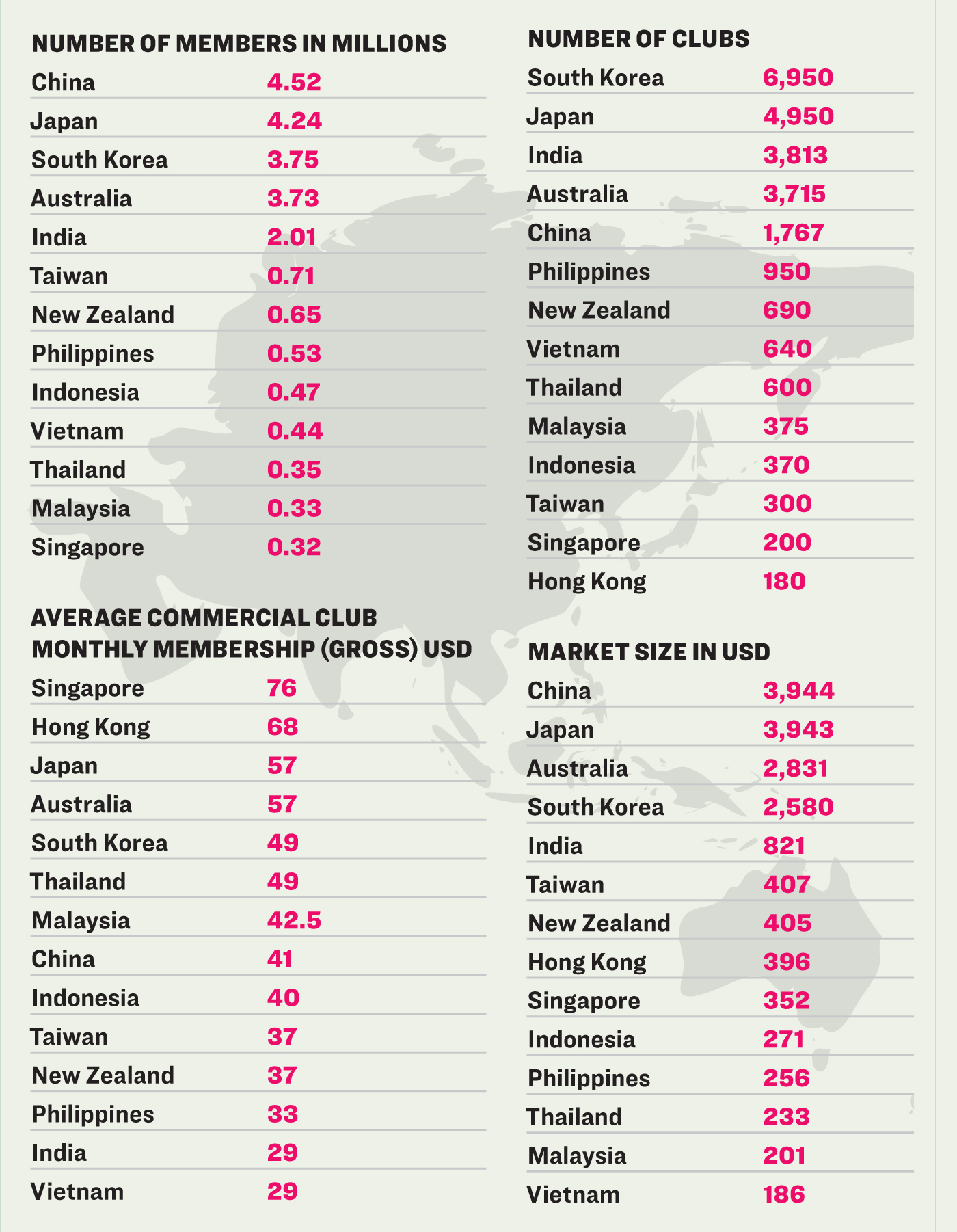
ASIA-PACIFIC IN NUMBERS
Access the report

The full report is available at a price of US$299 for IHRSA members and US$599 for non-members from: www.ihrsa.org/publications

Contact: [email protected] with questions.

Perfect Gym sponsored the report.

KEY TRENDS IN ASIA-PACIFIC

Australia
"The Australian fitness market has experienced rapid expansion in the past three years, led primarily by the growth of fitness franchises. F45 has opened 200 new clubs; Anytime Fitness has added 70; Jetts Fitness has added 60; and Plus Fitness has increased by 45 clubs.”

China
"Independent market research indicates that less than 20 per cent of all clubs in China are profitable, while at least 60 per cent are experiencing losses."

India
"Retention rates are low in the Indian fitness club market. From a cultural standpoint, members treat fitness as a goal to be achieved and have yet to see it as a lifestyle to be maintained or to act on this as an aspiration."

Indonesia
"Because the provision of sidewalks is limited in Jakarta, running outdoors is not a fitness option for people in the city, so fitness centres have become lifestyle destinations for people who want to exercise in safety."

Japan
"The ratio of public to commercial gyms is close to 50:50. In spite of this, public gyms are not seen as competitors to commercial gyms and the two co-exist."

Malaysia
"Fitness activities are typically male-focused in Malaysia, largely for cultural reasons. An estimated 60 per cent of fitness members are male in the capital, Kuala Lumpur, while the level is at least 70 per cent elsewhere."

New Zealand
"Growing awareness of the importance of healthy living has led to an increase in the penetration rate, up from 1.38 per cent in 2014 to 13.6 per cent in 2017. 24-hour gyms are the fastest-growing sector."

The Philippines
"The Philippines has achieved one of the highest increases in fitness club penetration over the past three years, due primarily to the rise of affordable gyms which have opened up the market."

Singapore
"Bulky equipment is being replaced by open space and group exercise is becoming popular. A medium to small gym size suits the cost-saving strategy for operators and also better fits customers’ needs."

South Korea
"Due to high rental costs, fitness clubs are generally smaller in size in South Korea compared to most of the counterparts in other Asia-Pacific countries, excluding Hong Kong and Japan."

Taiwan
"The top five players claim 77 per cent of the overall market in terms of number of gyms."

Thailand
"Most Thais still prefer to exercise in public parks, at home, or not at all."

Vietnam
"The fitness club market was worth US$186m in 2017, and is expected to expand rapidly in the next three years as Vietnamese investors start focusing on the industry."

China has tremendous capacity for growth in both participation and profitability
FEATURED SUPPLIERS

W3Fit EMEA celebrates its fifth anniversary
Celebrating its milestone 5th anniversary, W3Fit EMEA returns in 2026 with an unmissable gathering of the Health & Fitness industry’s most influential leaders. [more...]

Supporting long-term health: why whole body vibration belongs in clinical settings
As healthcare continues to shift towards prevention, there’s a growing focus on helping people stay active, independent and feeling good for longer. [more...]
+ More featured suppliers  
COMPANY PROFILES
Precor

Precor promises precision-quality products with steadfast reliability that are inspired by exerciser [more...]
Safe Space Lockers

We provide a full turn-key solution for clients from design and consultation, through to bespoke man [more...]
+ More profiles  
CATALOGUE GALLERY
 
+ More catalogues  

DIRECTORY
+ More directory  
DIARY


09-12 Jun 2026

W3Spa EMEA

Hotel Cascais Miragem Health & Spa, Portugal
13-13 Jun 2026

Global Wellness Day

Worldwide, Various,
+ More diary  
 
ABOUT LEISURE MEDIA
LEISURE MEDIA MAGAZINES
LEISURE MEDIA HANDBOOKS
LEISURE MEDIA WEBSITES
LEISURE MEDIA PRODUCT SEARCH
 
HCM
LEISURE OPPORTUNITIES
HEALTH CLUB HANDBOOK
PRINT SUBSCRIPTIONS
FREE DIGITAL SUBSCRIPTIONS
ADVERTISE . CONTACT US

Leisure Media
Tel: +44 (0)1462 431385

©Cybertrek 2026
Get HCM digital magazine and ezines FREE
Sign up here ▸
Jobs    News   Products   Magazine
Industry insights
IHRSA: Asia-Pacific

The Asia-Pacific health club market is now worth US$16.8 billion, according to an exceptional new report. IHRSA’s Kristen Walsh shares some of the highlights

By Kristen Walsh | Published in Health Club Handbook 2019 issue 1


The second edition of the IHRSA Asia-Pacific Health Club Report was released recently in collaboration with Deloitte.

It demonstrates that the health and fitness industry in the Asia-Pacific region is in good shape – fueled by growing economies and with significant potential for continued growth.

Deloitte says only two markets in the region are considered mature, these being Australia and New Zealand, which have the highest penetration rates at 15.3 per cent and 13.6 per cent, respectively.

While the fitness market shows signs of rapid growth and professionalisation in terms of penetration rates in Hong Kong (5.85 per cent), Singapore (5.8 per cent), and Japan (3.3 per cent), significant opportunities for growth still remain in less developmed markets, such as the Philippines (0.53 per cent), Thailand (0.5 per cent), Indonesia (0.18 per cent) and India (0.15 per cent).

Along with such growth opportunities come challenges. Real estate costs, limited rental availability, infrastructure underdevelopment, lack of professionalised services and increasing competition are just some of the realities club operators face when working in Asia-Pacific markets. However, a favourable economic outlook, along with increasing health awareness and demand for group exercise and personalised training, are expected to spur expansion.

“Driven by the momentum of economic prosperity, the fitness market in the Asia-Pacific region has shown steady growth, with a positive outlook going forward,” says Alan MacCharles, partner at Deloitte China. “Overall market penetration is on an upward trajectory, reflecting an increasing awareness of the importance of good health and the role a club membership can play in this.”

According to MacCharles, the region’s fitness market remains stratified due to varying stages of development, which can be categorised into three tiers.

Tier 1: Australia & New Zealand
Market penetration rates
Australia: 15.3 per cent
New Zealand: 13.6 per cent

These are relatively established markets, with higher penetration rates than their neighbours. However, the mature and professionalised markets in these countries indicate limited growth potential; labour and real estate costs have also constrained growth here.

Tier 2: Hong Kong, Singapore, Japan & Taiwan
Market penetration rates
Hong Kong: 5.85 per cent
Singapore: 5.8 per cent
Japan: 3.3 per cent
Taiwan: 3.0 per cent

These locations belong to the fast-expanding and maturing second-tier markets. This segment features gradually professionalising services, expanding consumer bases, and a high concentration of leading players.

With room for growth, already fierce competition is expected to continue in future in the Tier 2 region.

Tier 3: Rest of Asia-Pacific
Market penetration rates
Malaysia: 1.04 per cent
China’s top 10 cities: 0.97 per cent
Philippines: 0.53 per cent
Thailand: 0.5 per cent
Vietnam: 0.5 per cent
Indonesia: 0.18 per cent
India: 0.15 per cent

The remaining seven Asia-Pacific markets assessed by Deloitte are still in a comparatively early stage in their lifecycle, as a result of slower economic development and low awareness of personal health as a priority.

The fitness industry in these countries is typically concentrated in the respective capital cities and also the first-tier cities, where markets are mainly led by the larger, commercial fitness club chains.

The markets in second-tier cities are dominated by standalone players; mostly lower-end single site, independently owned operators – due to infrastructure underdevelopment, low purchasing power and low awareness of personalised training.

Underdeveloped regions in these countries demonstrate high growth potential, especially as rapid infrastructure development improves their accessibility and connectivity. Laws relating to the way gym contracts are configured also have an impact on the way each market develops. For example, in New Zealand (Tier 1) up-front payment for a long-term membership is forbidden by law, while in Singapore (Tier 2) some clubs collect one- and two-year contracts up-front.
ASIA-PACIFIC IN NUMBERS
Access the report

The full report is available at a price of US$299 for IHRSA members and US$599 for non-members from: www.ihrsa.org/publications

Contact: [email protected] with questions.

Perfect Gym sponsored the report.

KEY TRENDS IN ASIA-PACIFIC

Australia
"The Australian fitness market has experienced rapid expansion in the past three years, led primarily by the growth of fitness franchises. F45 has opened 200 new clubs; Anytime Fitness has added 70; Jetts Fitness has added 60; and Plus Fitness has increased by 45 clubs.”

China
"Independent market research indicates that less than 20 per cent of all clubs in China are profitable, while at least 60 per cent are experiencing losses."

India
"Retention rates are low in the Indian fitness club market. From a cultural standpoint, members treat fitness as a goal to be achieved and have yet to see it as a lifestyle to be maintained or to act on this as an aspiration."

Indonesia
"Because the provision of sidewalks is limited in Jakarta, running outdoors is not a fitness option for people in the city, so fitness centres have become lifestyle destinations for people who want to exercise in safety."

Japan
"The ratio of public to commercial gyms is close to 50:50. In spite of this, public gyms are not seen as competitors to commercial gyms and the two co-exist."

Malaysia
"Fitness activities are typically male-focused in Malaysia, largely for cultural reasons. An estimated 60 per cent of fitness members are male in the capital, Kuala Lumpur, while the level is at least 70 per cent elsewhere."

New Zealand
"Growing awareness of the importance of healthy living has led to an increase in the penetration rate, up from 1.38 per cent in 2014 to 13.6 per cent in 2017. 24-hour gyms are the fastest-growing sector."

The Philippines
"The Philippines has achieved one of the highest increases in fitness club penetration over the past three years, due primarily to the rise of affordable gyms which have opened up the market."

Singapore
"Bulky equipment is being replaced by open space and group exercise is becoming popular. A medium to small gym size suits the cost-saving strategy for operators and also better fits customers’ needs."

South Korea
"Due to high rental costs, fitness clubs are generally smaller in size in South Korea compared to most of the counterparts in other Asia-Pacific countries, excluding Hong Kong and Japan."

Taiwan
"The top five players claim 77 per cent of the overall market in terms of number of gyms."

Thailand
"Most Thais still prefer to exercise in public parks, at home, or not at all."

Vietnam
"The fitness club market was worth US$186m in 2017, and is expected to expand rapidly in the next three years as Vietnamese investors start focusing on the industry."

China has tremendous capacity for growth in both participation and profitability
LATEST NEWS
Les Mills calls on the industry to support UNICEF
Global group exercise specialist, Les Mills, is inviting operators to sign up to its Workout for the World event on 20 June, in support of UNICEF.
HUM2N opens longevity clinic at Six Senses London
Global luxury hospitality brand, Six Senses, has partnered with longevity healthcare provider, HUM2N, to launch a clinic at Six Senses London, at The Whiteley.
KX Chelsea invests £15 million to upgrade its wellness offering
Premium London health club, KX Chelsea, will imminently unveil its most significant redevelopment since its launch in 2002 to create an integrated wellness model combining training, recovery and relaxation.
Researchers identify a drug which reduces muscle loss when using GLP-1 medications
Researchers in the US have identified an antibody which could greatly reduce the loss of lean muscle mass in people who are taking weight-loss medications.
Peloton signals potential move into reformer Pilates with Skop acquisition
Peloton has made the strategic acquisition of the Pilates start-up, Skōp, to support the expansion of its strength ecosystem.
Crunch Fitness creates more affordable reformer Pilates concept
Crunch Fitness has announced the launch of Crunch Reform Pilates – its own reformer concept designed to bring this fast growing, but rather expensive, modality into the mainstream.
As the 20th State of the Industry Report is released, LeisureDB rebrands to Evolve
The 20th State of the Industry Report reveals a resilient, expanding and competitive sector, the importance of differentiation and the ongoing challenge of tackling inequalities.
Orangetheory set for Italian expansion and Technogym tie-up
Purpose Brands has announced its entry into the Italian market, having sold the franchise rights for four Orangetheory Studios to Icon Palestre.
Fitness First adds red light therapy to relaxation classes
Fitness First UK is integrating red light therapy into yoga and Pilates classes through a partnership with Bon Charge.
Nuffield Health says it will appeal after losing at employment tribunal
Nuffield Health has told HCM that it takes its responsibilities towards its colleagues seriously and is committed to meeting all legal obligations after news of a tribunal has made national headlines.
Technogym and World Athletics team up to launch the Run X World Treadmill Championships
Technogym has announced the launch of the Run X World Treadmill Championship, the first world championship for running on connected treadmills over five kilometres.
Charitable trust, Mytime Active, tackles loneliness
Shocked by the UK loneliness statistics, charitable trust Mytime Active has been doubling down on its community outreach projects.
+ More news   
 
FEATURED SUPPLIERS

W3Fit EMEA celebrates its fifth anniversary
Celebrating its milestone 5th anniversary, W3Fit EMEA returns in 2026 with an unmissable gathering of the Health & Fitness industry’s most influential leaders. [more...]

Supporting long-term health: why whole body vibration belongs in clinical settings
As healthcare continues to shift towards prevention, there’s a growing focus on helping people stay active, independent and feeling good for longer. [more...]
+ More featured suppliers  
COMPANY PROFILES
Precor

Precor promises precision-quality products with steadfast reliability that are inspired by exerciser [more...]
+ More profiles  
CATALOGUE GALLERY
+ More catalogues  

DIRECTORY
+ More directory  
DIARY


09-12 Jun 2026

W3Spa EMEA

Hotel Cascais Miragem Health & Spa, Portugal
13-13 Jun 2026

Global Wellness Day

Worldwide, Various,
+ More diary  


ADVERTISE . CONTACT US

Leisure Media
Tel: +44 (0)1462 431385

©Cybertrek 2026

ABOUT LEISURE MEDIA
LEISURE MEDIA MAGAZINES
LEISURE MEDIA HANDBOOKS
LEISURE MEDIA WEBSITES
LEISURE MEDIA PRODUCT SEARCH
PRINT SUBSCRIPTIONS
FREE DIGITAL SUBSCRIPTIONS