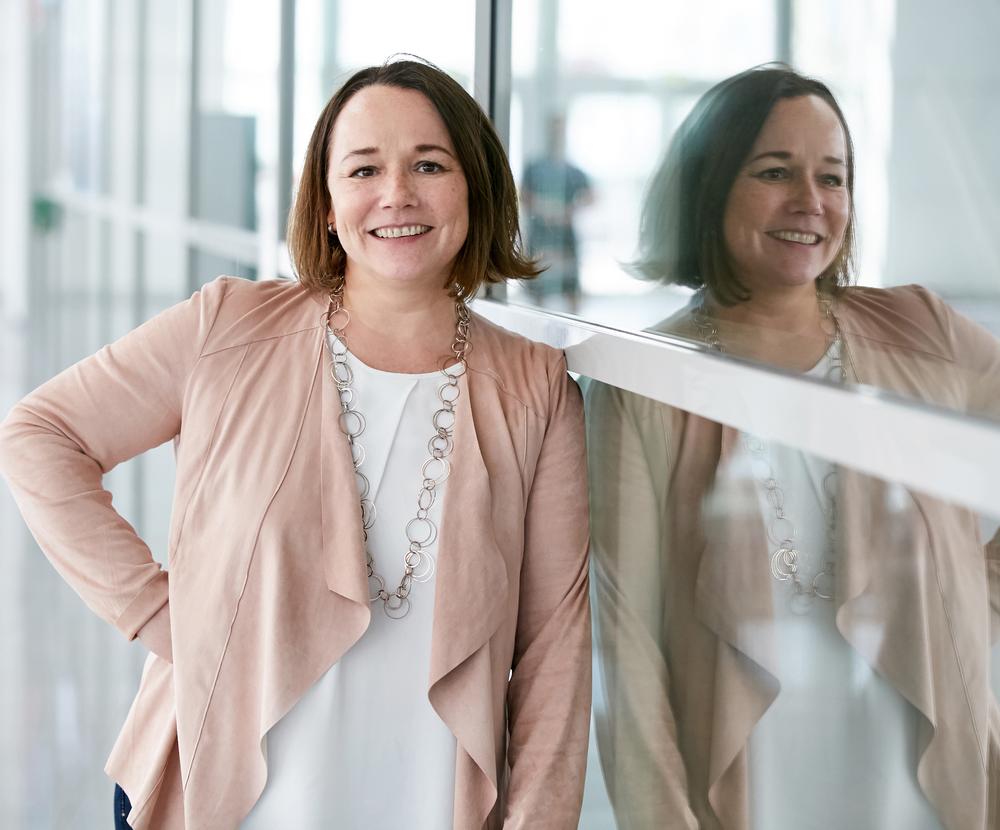
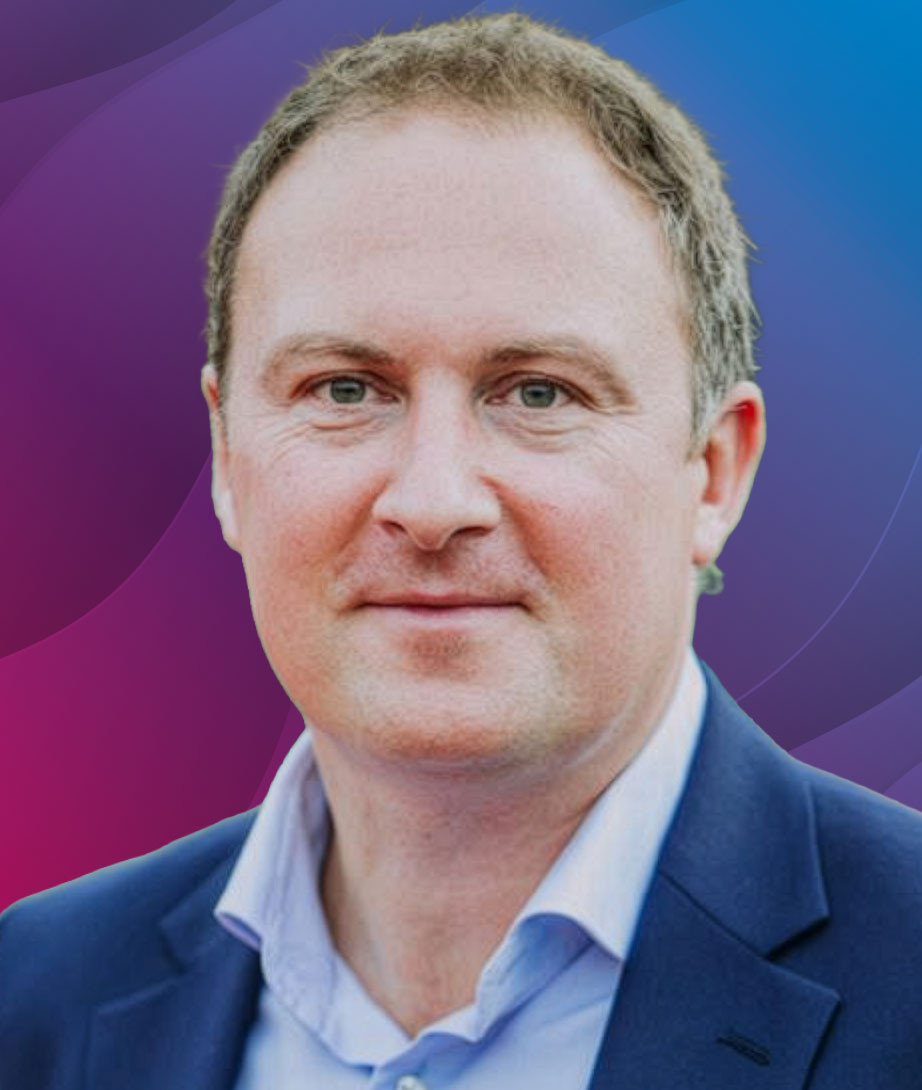
Frank says that, for the first time, there will be guided tours to help visitors find their way around
FIBO 2019
Last year was your first as director of FIBO. What did you learn, and what impact has that had on FIBO 2019? FIBO is a great event. Being the world’s largest trade show for fitness, wellness and health, it’s unique in terms of international reach and relevance. This year we again expect visitors from over 120 nations. However, a trade show of this magnitude is of course also a challenge for visitors who have to find their bearings. Especially in the training and continuous education programme, where the choice is very wide.
In 2018 there were numerous suppliers, ticket types and rooms. This year we have worked on this and pooled all lectures in one place – at the Congress Centrum East of Koelnmesse.
The new FIBO CAMPUS will have 13 themed sessions, ranging from fitness and health through personnel management to digitisation, offering a line-up for visitors – be they gym operators, physiotherapists or trainers. And now they only need one ticket for everything.
To improve the service for our trade visitors, we’re introducing a Business Weekend this year, with a wider programme offered for trade visitors over the weekend.
Furthermore, there will be fast lanes at the South and North entrances, as well as parking spaces especially reserved for trade visitors, in order to make their visit as pleasant as possible.
What can we expect from FIBO 2019? For the first time, we’ll be offering guided tours of the themed areas to help visitors find their way around.
Health training will be a focal theme again – a focus that is just as important for fitness clubs as it is for the physiotherapy and medical professions.
We also want to be available for visitors who are still working to get a foot in the door of the fitness industry, who are undergoing training or seeking to build a new business – in the New Business Area they can get in touch with start-up advisers or be inspired by other start-up companies.
Here franchising also plays a major role. Successful franchisees will be presenting their concepts.
How has the industry progressed over the past year? New growth drivers have emerged, such as the growth in numbers of boutique clubs, especially in the area of HIIT training and – in Germany – in the field of EMS training.
Digitisation is changing this industry and people’s everyday training. It can make training more effective, giving customers access to optimum support and boosting the fun factor – for instance by using VR – as fitness and entertainment grow closer.
Clubs are also gearing up to offer body measurements because people working out want measurable results. This trend is visible at FIBO. A case in point is Bodytracking in 3D, one of the winners of the FIBO Innovation Awards 2018.
The sector clearly also focuses on the competition concept – be this in real small group training sessions and competitions like the Ninja League or purely on a digital level. This way fitness training provides social added value.
What should the industry focus on at this point in time? To continue the course that’s charted over the past few years: addressing all segments of the population and focusing on health training.
Therapy and training will continue growing together and to really make it happen people must be addressed and supported personally.
Corporate health should not be underestimated as a growing area. This field is primarily about preventive healthcare. Due to demographic changes and skilled labour shortages employees will have to work for longer on the one hand, and on the other, physical fitness is almost a precondition for lasting professional success.
The fitness sector is in a position to give companies helpful options to counteract disorders that are typically associated with office work.
The health and fitness industry should secure this market as a source of revenue and increasingly cooperate with the business community.
What are you most excited about at FIBO 2019? FIBO brings people together. This is the most important thing. I look forward to meeting a variety of industry professionals from all over the world.
Trade shows are very emotional for me. FIBO creates huge energy and everything revolves around international networking, inspiration and innovation.
At FIBO you can see the directions that the sector is headed.
For us as the FIBO team it is vital to absorb all of the valuable feedback. It’s really only by understanding all the expectations and needs of our exhibitors and visitors that we are able to respond to them in a targeted manner, year after year, to continuously develop the event.
Frank is proud that FIBO is the place for international networking, innovation and inspiration
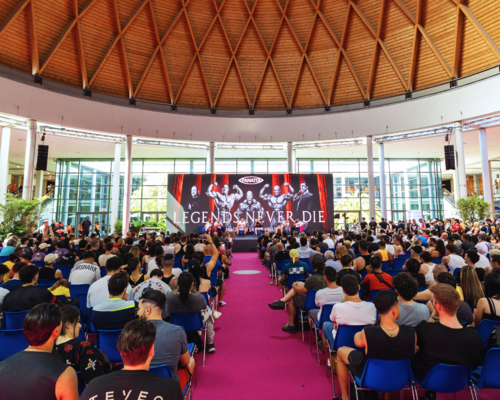
Panatta brought together four of the most influential figures in bodybuilding history on the
stage of RiminiWellness 2026: Phil Heath, Lee Haney, Ronnie Coleman and Hany Rambod. [more...]
Frank says that, for the first time, there will be guided tours to help visitors find their way around
FIBO 2019
Last year was your first as director of FIBO. What did you learn, and what impact has that had on FIBO 2019? FIBO is a great event. Being the world’s largest trade show for fitness, wellness and health, it’s unique in terms of international reach and relevance. This year we again expect visitors from over 120 nations. However, a trade show of this magnitude is of course also a challenge for visitors who have to find their bearings. Especially in the training and continuous education programme, where the choice is very wide.
In 2018 there were numerous suppliers, ticket types and rooms. This year we have worked on this and pooled all lectures in one place – at the Congress Centrum East of Koelnmesse.
The new FIBO CAMPUS will have 13 themed sessions, ranging from fitness and health through personnel management to digitisation, offering a line-up for visitors – be they gym operators, physiotherapists or trainers. And now they only need one ticket for everything.
To improve the service for our trade visitors, we’re introducing a Business Weekend this year, with a wider programme offered for trade visitors over the weekend.
Furthermore, there will be fast lanes at the South and North entrances, as well as parking spaces especially reserved for trade visitors, in order to make their visit as pleasant as possible.
What can we expect from FIBO 2019? For the first time, we’ll be offering guided tours of the themed areas to help visitors find their way around.
Health training will be a focal theme again – a focus that is just as important for fitness clubs as it is for the physiotherapy and medical professions.
We also want to be available for visitors who are still working to get a foot in the door of the fitness industry, who are undergoing training or seeking to build a new business – in the New Business Area they can get in touch with start-up advisers or be inspired by other start-up companies.
Here franchising also plays a major role. Successful franchisees will be presenting their concepts.
How has the industry progressed over the past year? New growth drivers have emerged, such as the growth in numbers of boutique clubs, especially in the area of HIIT training and – in Germany – in the field of EMS training.
Digitisation is changing this industry and people’s everyday training. It can make training more effective, giving customers access to optimum support and boosting the fun factor – for instance by using VR – as fitness and entertainment grow closer.
Clubs are also gearing up to offer body measurements because people working out want measurable results. This trend is visible at FIBO. A case in point is Bodytracking in 3D, one of the winners of the FIBO Innovation Awards 2018.
The sector clearly also focuses on the competition concept – be this in real small group training sessions and competitions like the Ninja League or purely on a digital level. This way fitness training provides social added value.
What should the industry focus on at this point in time? To continue the course that’s charted over the past few years: addressing all segments of the population and focusing on health training.
Therapy and training will continue growing together and to really make it happen people must be addressed and supported personally.
Corporate health should not be underestimated as a growing area. This field is primarily about preventive healthcare. Due to demographic changes and skilled labour shortages employees will have to work for longer on the one hand, and on the other, physical fitness is almost a precondition for lasting professional success.
The fitness sector is in a position to give companies helpful options to counteract disorders that are typically associated with office work.
The health and fitness industry should secure this market as a source of revenue and increasingly cooperate with the business community.
What are you most excited about at FIBO 2019? FIBO brings people together. This is the most important thing. I look forward to meeting a variety of industry professionals from all over the world.
Trade shows are very emotional for me. FIBO creates huge energy and everything revolves around international networking, inspiration and innovation.
At FIBO you can see the directions that the sector is headed.
For us as the FIBO team it is vital to absorb all of the valuable feedback. It’s really only by understanding all the expectations and needs of our exhibitors and visitors that we are able to respond to them in a targeted manner, year after year, to continuously develop the event.
Frank is proud that FIBO is the place for international networking, innovation and inspiration
According to research which tracked more than 147,000 people for 30 years, 90-120 minutes
of strength training a week may deliver some of the biggest long-term health rewards.
The UK's four Chief Medical Officers have published a refreshed edition of Physical activity
guidelines: UK Chief Medical Officers' report, updating the evidence that underpins the nation's
physical activity recommendations and placing greater emphasis on strength, balance, reducing
sedentary behaviour and, for the first time, supporting people taking weight loss medications.
Places Leisure has exchanged contracts to build and operate a flagship £60m water and leisure
destination on behalf of Basingstoke and Deane Borough Council.
The Republic of Ireland will become the latest market in PureGym’s expanding international
portfolio, with the first launch planned for Dublin in 2027.
Anytime Fitness opened more than one club a day in 2025 and is on track to maintain this rate
of growth this year, as parent company Purpose Brands targets further international expansion.
The £33.9 million Leighton Leisure and Community Centre has opened in Leighton Buzzard, UK,
creating a next-generation public leisure, health and wellbeing hub for the local community.
Walnuts Leisure Centre in Orpington, in the London Borough of Bromley, has reopened following
a £17m transformation designed to secure the long-term future of the public leisure asset and
reposition it as a community wellbeing hub.
The Gym Group, has announced that it's sustained positive trading momentum has continued
through the first half of 2026 and the company remains confident about the outlook.
Panatta brought together four of the most influential figures in bodybuilding history on the
stage of RiminiWellness 2026: Phil Heath, Lee Haney, Ronnie Coleman and Hany Rambod. [more...]