Many people’s experience of sport lacks joined-up support from sports clubs, governing bodies, schools and colleges and local authority and trust facilities. It’s time for that to change
Exciting new initiatives promise to unlock more potential across the sports and activity markets by harnessing the power of collaboration for the greater good.
In our news pages this issue, we report on a new partnership which has been agreed between a number of the larger sports governing bodies and the leisure sector (see page 14).
Five organisations – Badminton England, British Gymnastics, British Weightlifting, British Tennis and Swim England – have all become members of ukactive, the not-for-profit body which represents the activity sector, with a view to broadening their engagement with the wider sports, fitness and activity market.
The aim is for the governing bodies to work more closely with the sector to increase participation.
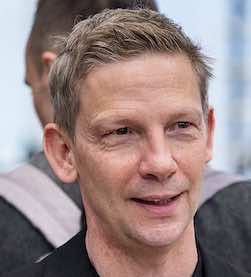
In announcing the tie ups, ukactive’s public affairs director, Huw Edwards, said: “Together with Sport England, we want to work with NGBs, leisure centre operators, gym and health club operators and other community facility owners and operators to bring sports and services to more people in more locations.”
This kind of joined-up thinking is exactly what we need in these times of reduced budgets.
Governing bodies, sports clubs, schools, colleges and local authorities have long skirted around each other, with there being very little true, deep and enduring collaboration between them.
It’s all part of an old order, where each established its own power base and hierarchy and then defended it.
It’s taken austerity to open the door to this kind of joined-up thinkingand to create a climate where we can finally start to overcome these old barriers.
It’s to be hoped that this ukactive initiative will lead us into a new era where each plays to its strengths for the greater good, rather than simply fighting to protect its patch and ringfence resources.
Austerity has hit parts of the sports sector hard and there are – no doubt – further tough times ahead as we grapple with the beast that Brexit has become.
However, in the longer-term, if we can take a philosophical view and use these lean times to remake the industry in a more streamlined and collaborative vein, then when good times come again, we’ll be in a far more powerful position to be a force for good in the world and to offer people of all ages a more joined-up experience of sport and activity – from the youngest age and throughout their lives.
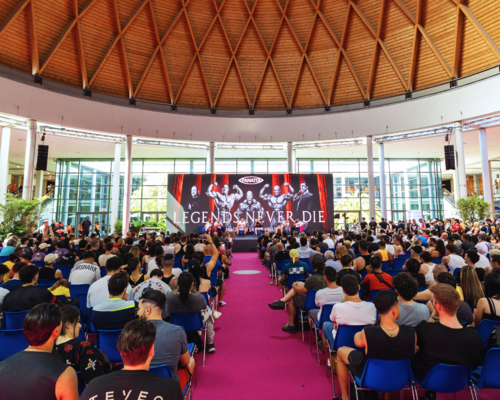
Panatta brought together four of the most influential figures in bodybuilding history on the
stage of RiminiWellness 2026: Phil Heath, Lee Haney, Ronnie Coleman and Hany Rambod. [more...]
Many people’s experience of sport lacks joined-up support from sports clubs, governing bodies, schools and colleges and local authority and trust facilities. It’s time for that to change
Exciting new initiatives promise to unlock more potential across the sports and activity markets by harnessing the power of collaboration for the greater good.
In our news pages this issue, we report on a new partnership which has been agreed between a number of the larger sports governing bodies and the leisure sector (see page 14).
Five organisations – Badminton England, British Gymnastics, British Weightlifting, British Tennis and Swim England – have all become members of ukactive, the not-for-profit body which represents the activity sector, with a view to broadening their engagement with the wider sports, fitness and activity market.
The aim is for the governing bodies to work more closely with the sector to increase participation.
In announcing the tie ups, ukactive’s public affairs director, Huw Edwards, said: “Together with Sport England, we want to work with NGBs, leisure centre operators, gym and health club operators and other community facility owners and operators to bring sports and services to more people in more locations.”
This kind of joined-up thinking is exactly what we need in these times of reduced budgets.
Governing bodies, sports clubs, schools, colleges and local authorities have long skirted around each other, with there being very little true, deep and enduring collaboration between them.
It’s all part of an old order, where each established its own power base and hierarchy and then defended it.
It’s taken austerity to open the door to this kind of joined-up thinkingand to create a climate where we can finally start to overcome these old barriers.
It’s to be hoped that this ukactive initiative will lead us into a new era where each plays to its strengths for the greater good, rather than simply fighting to protect its patch and ringfence resources.
Austerity has hit parts of the sports sector hard and there are – no doubt – further tough times ahead as we grapple with the beast that Brexit has become.
However, in the longer-term, if we can take a philosophical view and use these lean times to remake the industry in a more streamlined and collaborative vein, then when good times come again, we’ll be in a far more powerful position to be a force for good in the world and to offer people of all ages a more joined-up experience of sport and activity – from the youngest age and throughout their lives.
In response to customer demand, Gymnation has unveiled a muscle thobe and ghutra range
for Saudi men that celebrates Saudi culture as well as the region’s growing interest in fitness.
Italian Exhibition Group – the organiser behind industry events Dubai Active and Dubai Muscle
Show – has been appointed to deliver the Health and Wellness Expo and Fire and Safety Expo at
the 16th World Firefighters Games.
It’s been five years since the fitness industry reopened after the last lockdown – long enough
to look back on the impact the pandemic had on the sector and what might come next.
Wattbike has announced a new integration with EGYM, which enables the bikes to contribute to
the Cardio BioAge score of individuals via a VO2 max result.
Les Mills has launched a reformer Pilates workout. The 45-minute workout blends traditional
reformer movements and more contemporary exercises, choreographed to music.
According to research which tracked more than 147,000 people for 30 years, 90-120 minutes
of strength training a week may deliver some of the biggest long-term health rewards.
The UK's four Chief Medical Officers have published a refreshed edition of Physical activity
guidelines: UK Chief Medical Officers' report, updating the evidence that underpins the nation's
physical activity recommendations and placing greater emphasis on strength, balance, reducing
sedentary behaviour and, for the first time, supporting people taking weight loss medications.
Places Leisure has exchanged contracts to build and operate a flagship £60m water and leisure
destination on behalf of Basingstoke and Deane Borough Council.
Panatta brought together four of the most influential figures in bodybuilding history on the
stage of RiminiWellness 2026: Phil Heath, Lee Haney, Ronnie Coleman and Hany Rambod. [more...]