What role can sport and physical activity play in preventing crime and anti-social behaviour – and are our prisons making the most of this opportunity to change lives? Kate Cracknell reports
By Kate Cracknell | Published in Health Club Management 2018 issue 10
In prisons, just as in our communities, the impact of exercise and sport can be far-reaching. Participation can not only improve health and behaviour but can directly contribute to efforts to tackle re-offending, reduce violence and conflict, develop communication skills, and in particular provide a meaningful route into education and employment.”
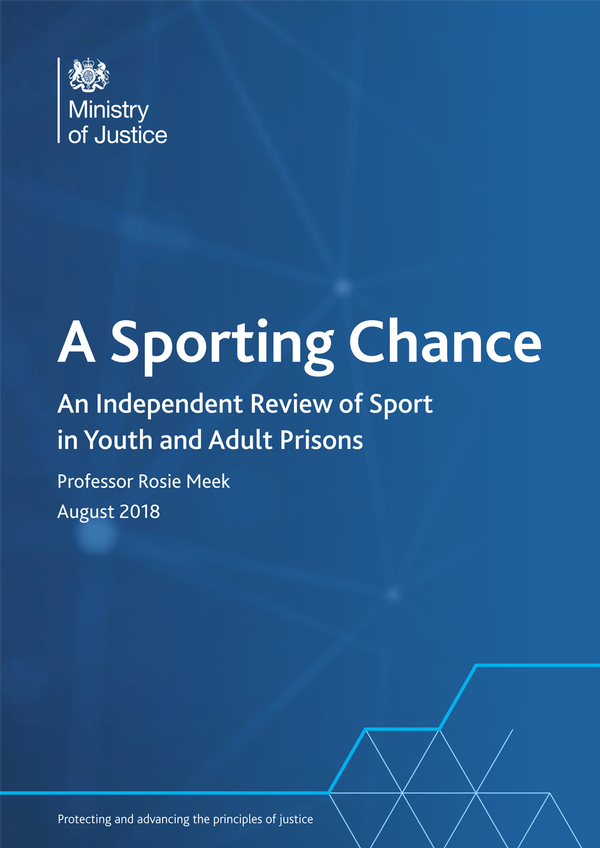
These are the words of Rosie Meek, professor of psychology at Royal Holloway University in London; author of the book Sport in Prison; the expert behind August’s government-commissioned report, A Sporting Chance: An independent review of sport in justice; and part of a panel exploring the role of physical activity in preventing crime and anti-social behaviour which took place at the recent ukactive National Summit.
Meek was joined on the panel by Dr Phillip Lee MP who, in his former role as Minister for Youth Justice, had commissioned the report from Meek – specifically, a review of existing sport provision in the justice system, with a particular focus on health, re-offending and youth custody.
“When I started at the Justice Department in July 2016, there was an appalling recidivism rate among young people of around 70 per cent,” Lee explained. “When you’re spending the best part of £230–240m on youth justice each year, that cannot be seen as a success.”
He continued: “We investigated the typical day for young offenders in prison and found they were often locked up and inactive.” Indeed, over one-third of 18- to 21-year-old inmates report being locked up for at least 22 hours a day.
“Lacking positive, responsible role models in their lives, they were also regularly in and out of prison,” Lee added.
“I therefore thought it sensible to commission a report into the value of sport in the justice system, through the process of which I met remarkable people who are already doing great things, as well as hearing remarkable stories from those whose lives have been turned around by sport.”
And not only are the stories heart-warming, but the results speak for themselves, with plummeting rates of recidivism among participants: some sport-based programmes for young inmates in English prisons report repeat offending rates as low as 6 per cent (the Chelsea FC and RFU rugby academies at HMP & YOI Portland) or 7 per cent (The Street Soccer programme at HMP Forest Bank) among their 18- to 21-year-old participants.
“I’ve since left the Justice Department, but I’m determined to still do whatever I can to shine a light on these projects,” added Lee. “The more of this we can do, the better – both for the individuals and for society.”
Bring back boxing Published in August 2018, the Sporting Chance report – commonly referred to as the Meek Report – outlined 12 recommendations (see briefing box, page 46) to give prisoners “a sporting chance”, each with a weight of evidence and case studies behind them.
Overall, the report has been well received: the government responded in favour of 11 of Meek’s 12 recommendations, pledging £1.8m a year to enhance educational and physical activity opportunities across the justice system, including “new education and sports-based projects, community partnerships, and upskilling staff to facilitate a broader education curriculum”.
But there is currently one sticking point, namely recommendation #7 – re-introducing boxing and martial arts as physical activity options for prison inmates – which the government pushed back with a strong, some might argue short-sighted, ‘no’.
It is, said co-panellist and former pro boxer Barry McGuigan, “a crying shame”, as he named numerous examples of famous boxers – from Mike Tyson to Anthony Joshua – whose lives were turned around by taking up boxing. Indeed, it’s for exactly this reason that McGuigan now runs boxing academies for troubled youths across some of the more deprived areas of London.
Meek agreed: “We’ve seen the power of boxing when it comes to working with disengaged, disenfranchised and often violent young people. We’ve seen the evidence. My argument is that we should at least pilot some carefully designed boxing programmes in prison.”
Yet the government is as yet unwavering in its response: it has “no plans to make boxing or martial arts based activities permissible” in a custodial environment.
This may change, suggested Lee in defence of the Ministry of Justice (MoJ). “I think it will come,” he said. But the problem for now, he explained, searching for a diplomatic way to describe the obstacle, is that it “requires some people higher in government to understand the value of sport, full stop”.
Active rehabilitation Nevertheless, with a positive response to the lion’s share of this report, the momentum would now seem to be behind the Active Justice agenda.
The now Minister of Justice, Edward Argar MP, shared the following observations in his response to the Meek Report: “Emerging evidence from programmes being delivered in custody is building a picture of the rehabilitative value of physical activity. These programmes provide young people with access to positive role models, mentors and team-mates, as well as opportunities to gain qualifications to develop their own career in sport.
“Whether or not offenders choose to pursue sport or coaching as a career themselves, the skills they learn enhance their prospects for getting jobs, increasing the likelihood that they will turn their backs on crime for good.”
He added: “Sport on its own does not provide all the answers, but if it is harnessed in the right way then it can have transformative effects on the lives of young offenders. It can help them to realise their potential and recognise skills they never knew they had – leadership, teamwork, communication and discipline.
“Many of these young people will have had challenging educational experiences, but a positive one with sport can give them the confidence to engage again with education; it can change their self-perception, helping them see themselves as successful, talented and hard-working people. If we are to make rehabilitation really work, then this is a key step.”
Towards collaboration However, as Meek stressed in her Guardian article published a few days before the ukactive Summit: “Promises from the MoJ of supporting an already stretched prison service will only go so far. We need more collaboration with our physical activity sector and other community partners, who must now get behind the recommendations and activate the plan.”
She echoed this sentiment at the Summit, urging the fitness sector to make it happen and to get involved.
But it won’t be easy, not least because the typical health club or leisure centre simply doesn’t appeal to this group. As Claire Dhami of the West Midlands Combined Authority – which is exploring the positive impact of physical activity in early intervention – explained: “One size does not fit all: these young people won’t just turn up at a mainstream gym or health club, sign a form and engage.”
Indeed, she said, the people are more important than the place or the programme when it comes to engaging these young people: “What’s really needed are individuals who can relate to their experiences and also inspire and engage them.”
But this in itself can be seen as an opportunity, said McGuigan: “Most programmes start with just one or two really passionate people. If you have that commitment, it will rocket.”
If the fitness and physical activity sector really wants to make a difference, though, collaboration is the answer, said Meek, suggesting an MoJ-facilitated twinning scheme between prisons and local sporting organisations, or prisons and universities, to fuel more outreach programmes. “There are about the same number of prisons as there are universities in England and Wales,” she observed.
It’s already been shown to work. Meek’s review highlights positive sporting achievements that have already taken place in the prison environment, supported by organisations such as parkrun UK: in 2017, HMP Haverigg became the first prison to host a weekly parkrun event, and more have since followed.
Initiatives such as these “have provided the motivation and skills for people to turn their lives around,” says Meek. “But provision of sporting opportunities still remains patchy and under-developed.”
A chance to change lives Certainly the majority of initiatives are still small pilot projects, with consequent challenges around gathering sufficient evidence to justify government expenditure. However, said Meek, collating data sets from a number of projects would better show “what’s working, and for whom” – and with it provide the irrefutable evidence needed to secure the wider-scale roll-out of effective, targeted initiatives.
“It isn’t easy to measure results in this field, with the sensitivity around reoffending data for example, but that isn’t a reason not to try,” she added, pointing to the Alliance for Sport website as one initiative designed to “bring projects together in critical mass”.
Alongside all the above are opportunities for the sport and fitness sector to cater better for women in prison – only a small percentage of inmates, but the least active of all; to recognise the ageing population within prisons and ensure programmes cater for the over-60s; and to drive teaching standards within prisons to help inmates come out with Level 3 – rather than the current Level 1 or Level 2 – qualifications.
There’s also an option to create work placements for those on temporary release, as well as creating job opportunities for former prisoners who have done relevant qualifications while in prison – and the latter is something Virgin Active and Places for People Leisure have already committed to, with pilots scheduled for early next year.
Working with ukactive, CIMSPA, the MoJ and Her Majesty’s Prison & Probation Service, Virgin Active and Places for People will provide training and opportunities for vetted, former Category D offenders [open prisons] to work in various roles, from receptionists to caterers, lifeguards to personal trainers.
“These pilot programmes will seek to make greater use of prison estate facilities and will guarantee job interviews upon the completion of training,” says Meek. “It’s just a start, but this type of joined-up approach could inject new hope into our system and really change lives for everyone involved.”
12 recommendations to give offenders a Sporting Chance Recommendation 1 Every prison, Young Offender Institution, Secure Training Centre and Secure Children’s Home should devise and implement an integrated physical activity and wellbeing strategy.
Recommendation 2 Commissioners and education providers should develop a flexible approach to delivery which enables collaborations and creative delivery.
Recommendation 3 Prisons should offer nutritional advice as part of their physical activity and wellbeing provision, and promote a readily-available range of healthy eating options.
Recommendation 4 Bringing prisoners together for sport can resolve conflict. Governors should revise keep-apart list policies and establishments should include gym staff in keep-apart decision making.
Recommendation 5 Sport provision needs to be responsive to individual needs, with a focus on health, wellbeing and rehabilitation at the heart of practice.
Recommendation 6 The Ministry of Justice should develop a physical activity strategy for women and girls in prison.
Recommendation 7 (not adoped) The Ministry of Justice should re-consider the national martial arts / boxing policy and pilot the introduction of targeted programmes which draw on boxing exercises, qualifications and associated activities.
Recommendation 8 Senior managers and the Ministry of Justice need to monitor physical activity participation and outcomes according to ethnicity, and ensure that any disproportionality is addressed.
Recommendation 9 Senior managers need to encourage partnerships between prisons, communities, sporting groups and bodies.
Recommendation 10 The Ministry of Justice should review Release on Temporary Licence, Mobility and related policies to facilitate meaningful sports-based learning, team-building activities, placements and training.
Recommendation 11 The Ministry of Justice, HM Prison and Probation Service and senior managers need to provide the leadership, staffing, training and facilities required to support a wide-reaching and high-quality sport and physical activity provision.
Recommendation 12 HM Prison and Probation Service should create and implement a dedicated physical activity monitoring and evaluation strategy which supplements existing Ofsted and HM Inspectorate of Prisons monitoring.
Panatta brought together four of the most influential figures in bodybuilding history on the
stage of RiminiWellness 2026: Phil Heath, Lee Haney, Ronnie Coleman and Hany Rambod. [more...]
Active Blackpool is deploying Cornerstone Connect, a new digital interface allowing
disparate information from multiple systems to be aggregated into one dataset, to support
its focus on reducing health inequalities and improving healthy life expectancy. [more...]
+ More featured suppliers
COMPANY PROFILES
Precor
Precor promises precision-quality products with steadfast reliability that are inspired by exerciser [more...]
Serco Leisure
Serco Leisure Operating Limited is one of the UK’s leading national operators of leisure centres, de [more...]
What role can sport and physical activity play in preventing crime and anti-social behaviour – and are our prisons making the most of this opportunity to change lives? Kate Cracknell reports
By Kate Cracknell | Published in Health Club Management 2018 issue 10
In prisons, just as in our communities, the impact of exercise and sport can be far-reaching. Participation can not only improve health and behaviour but can directly contribute to efforts to tackle re-offending, reduce violence and conflict, develop communication skills, and in particular provide a meaningful route into education and employment.”
These are the words of Rosie Meek, professor of psychology at Royal Holloway University in London; author of the book Sport in Prison; the expert behind August’s government-commissioned report, A Sporting Chance: An independent review of sport in justice; and part of a panel exploring the role of physical activity in preventing crime and anti-social behaviour which took place at the recent ukactive National Summit.
Meek was joined on the panel by Dr Phillip Lee MP who, in his former role as Minister for Youth Justice, had commissioned the report from Meek – specifically, a review of existing sport provision in the justice system, with a particular focus on health, re-offending and youth custody.
“When I started at the Justice Department in July 2016, there was an appalling recidivism rate among young people of around 70 per cent,” Lee explained. “When you’re spending the best part of £230–240m on youth justice each year, that cannot be seen as a success.”
He continued: “We investigated the typical day for young offenders in prison and found they were often locked up and inactive.” Indeed, over one-third of 18- to 21-year-old inmates report being locked up for at least 22 hours a day.
“Lacking positive, responsible role models in their lives, they were also regularly in and out of prison,” Lee added.
“I therefore thought it sensible to commission a report into the value of sport in the justice system, through the process of which I met remarkable people who are already doing great things, as well as hearing remarkable stories from those whose lives have been turned around by sport.”
And not only are the stories heart-warming, but the results speak for themselves, with plummeting rates of recidivism among participants: some sport-based programmes for young inmates in English prisons report repeat offending rates as low as 6 per cent (the Chelsea FC and RFU rugby academies at HMP & YOI Portland) or 7 per cent (The Street Soccer programme at HMP Forest Bank) among their 18- to 21-year-old participants.
“I’ve since left the Justice Department, but I’m determined to still do whatever I can to shine a light on these projects,” added Lee. “The more of this we can do, the better – both for the individuals and for society.”
Bring back boxing Published in August 2018, the Sporting Chance report – commonly referred to as the Meek Report – outlined 12 recommendations (see briefing box, page 46) to give prisoners “a sporting chance”, each with a weight of evidence and case studies behind them.
Overall, the report has been well received: the government responded in favour of 11 of Meek’s 12 recommendations, pledging £1.8m a year to enhance educational and physical activity opportunities across the justice system, including “new education and sports-based projects, community partnerships, and upskilling staff to facilitate a broader education curriculum”.
But there is currently one sticking point, namely recommendation #7 – re-introducing boxing and martial arts as physical activity options for prison inmates – which the government pushed back with a strong, some might argue short-sighted, ‘no’.
It is, said co-panellist and former pro boxer Barry McGuigan, “a crying shame”, as he named numerous examples of famous boxers – from Mike Tyson to Anthony Joshua – whose lives were turned around by taking up boxing. Indeed, it’s for exactly this reason that McGuigan now runs boxing academies for troubled youths across some of the more deprived areas of London.
Meek agreed: “We’ve seen the power of boxing when it comes to working with disengaged, disenfranchised and often violent young people. We’ve seen the evidence. My argument is that we should at least pilot some carefully designed boxing programmes in prison.”
Yet the government is as yet unwavering in its response: it has “no plans to make boxing or martial arts based activities permissible” in a custodial environment.
This may change, suggested Lee in defence of the Ministry of Justice (MoJ). “I think it will come,” he said. But the problem for now, he explained, searching for a diplomatic way to describe the obstacle, is that it “requires some people higher in government to understand the value of sport, full stop”.
Active rehabilitation Nevertheless, with a positive response to the lion’s share of this report, the momentum would now seem to be behind the Active Justice agenda.
The now Minister of Justice, Edward Argar MP, shared the following observations in his response to the Meek Report: “Emerging evidence from programmes being delivered in custody is building a picture of the rehabilitative value of physical activity. These programmes provide young people with access to positive role models, mentors and team-mates, as well as opportunities to gain qualifications to develop their own career in sport.
“Whether or not offenders choose to pursue sport or coaching as a career themselves, the skills they learn enhance their prospects for getting jobs, increasing the likelihood that they will turn their backs on crime for good.”
He added: “Sport on its own does not provide all the answers, but if it is harnessed in the right way then it can have transformative effects on the lives of young offenders. It can help them to realise their potential and recognise skills they never knew they had – leadership, teamwork, communication and discipline.
“Many of these young people will have had challenging educational experiences, but a positive one with sport can give them the confidence to engage again with education; it can change their self-perception, helping them see themselves as successful, talented and hard-working people. If we are to make rehabilitation really work, then this is a key step.”
Towards collaboration However, as Meek stressed in her Guardian article published a few days before the ukactive Summit: “Promises from the MoJ of supporting an already stretched prison service will only go so far. We need more collaboration with our physical activity sector and other community partners, who must now get behind the recommendations and activate the plan.”
She echoed this sentiment at the Summit, urging the fitness sector to make it happen and to get involved.
But it won’t be easy, not least because the typical health club or leisure centre simply doesn’t appeal to this group. As Claire Dhami of the West Midlands Combined Authority – which is exploring the positive impact of physical activity in early intervention – explained: “One size does not fit all: these young people won’t just turn up at a mainstream gym or health club, sign a form and engage.”
Indeed, she said, the people are more important than the place or the programme when it comes to engaging these young people: “What’s really needed are individuals who can relate to their experiences and also inspire and engage them.”
But this in itself can be seen as an opportunity, said McGuigan: “Most programmes start with just one or two really passionate people. If you have that commitment, it will rocket.”
If the fitness and physical activity sector really wants to make a difference, though, collaboration is the answer, said Meek, suggesting an MoJ-facilitated twinning scheme between prisons and local sporting organisations, or prisons and universities, to fuel more outreach programmes. “There are about the same number of prisons as there are universities in England and Wales,” she observed.
It’s already been shown to work. Meek’s review highlights positive sporting achievements that have already taken place in the prison environment, supported by organisations such as parkrun UK: in 2017, HMP Haverigg became the first prison to host a weekly parkrun event, and more have since followed.
Initiatives such as these “have provided the motivation and skills for people to turn their lives around,” says Meek. “But provision of sporting opportunities still remains patchy and under-developed.”
A chance to change lives Certainly the majority of initiatives are still small pilot projects, with consequent challenges around gathering sufficient evidence to justify government expenditure. However, said Meek, collating data sets from a number of projects would better show “what’s working, and for whom” – and with it provide the irrefutable evidence needed to secure the wider-scale roll-out of effective, targeted initiatives.
“It isn’t easy to measure results in this field, with the sensitivity around reoffending data for example, but that isn’t a reason not to try,” she added, pointing to the Alliance for Sport website as one initiative designed to “bring projects together in critical mass”.
Alongside all the above are opportunities for the sport and fitness sector to cater better for women in prison – only a small percentage of inmates, but the least active of all; to recognise the ageing population within prisons and ensure programmes cater for the over-60s; and to drive teaching standards within prisons to help inmates come out with Level 3 – rather than the current Level 1 or Level 2 – qualifications.
There’s also an option to create work placements for those on temporary release, as well as creating job opportunities for former prisoners who have done relevant qualifications while in prison – and the latter is something Virgin Active and Places for People Leisure have already committed to, with pilots scheduled for early next year.
Working with ukactive, CIMSPA, the MoJ and Her Majesty’s Prison & Probation Service, Virgin Active and Places for People will provide training and opportunities for vetted, former Category D offenders [open prisons] to work in various roles, from receptionists to caterers, lifeguards to personal trainers.
“These pilot programmes will seek to make greater use of prison estate facilities and will guarantee job interviews upon the completion of training,” says Meek. “It’s just a start, but this type of joined-up approach could inject new hope into our system and really change lives for everyone involved.”
12 recommendations to give offenders a Sporting Chance Recommendation 1 Every prison, Young Offender Institution, Secure Training Centre and Secure Children’s Home should devise and implement an integrated physical activity and wellbeing strategy.
Recommendation 2 Commissioners and education providers should develop a flexible approach to delivery which enables collaborations and creative delivery.
Recommendation 3 Prisons should offer nutritional advice as part of their physical activity and wellbeing provision, and promote a readily-available range of healthy eating options.
Recommendation 4 Bringing prisoners together for sport can resolve conflict. Governors should revise keep-apart list policies and establishments should include gym staff in keep-apart decision making.
Recommendation 5 Sport provision needs to be responsive to individual needs, with a focus on health, wellbeing and rehabilitation at the heart of practice.
Recommendation 6 The Ministry of Justice should develop a physical activity strategy for women and girls in prison.
Recommendation 7 (not adoped) The Ministry of Justice should re-consider the national martial arts / boxing policy and pilot the introduction of targeted programmes which draw on boxing exercises, qualifications and associated activities.
Recommendation 8 Senior managers and the Ministry of Justice need to monitor physical activity participation and outcomes according to ethnicity, and ensure that any disproportionality is addressed.
Recommendation 9 Senior managers need to encourage partnerships between prisons, communities, sporting groups and bodies.
Recommendation 10 The Ministry of Justice should review Release on Temporary Licence, Mobility and related policies to facilitate meaningful sports-based learning, team-building activities, placements and training.
Recommendation 11 The Ministry of Justice, HM Prison and Probation Service and senior managers need to provide the leadership, staffing, training and facilities required to support a wide-reaching and high-quality sport and physical activity provision.
Recommendation 12 HM Prison and Probation Service should create and implement a dedicated physical activity monitoring and evaluation strategy which supplements existing Ofsted and HM Inspectorate of Prisons monitoring.
According to research which tracked more than 147,000 people for 30 years, 90-120 minutes
of strength training a week may deliver some of the biggest long-term health rewards.
The UK's four Chief Medical Officers have published a refreshed edition of Physical activity
guidelines: UK Chief Medical Officers' report, updating the evidence that underpins the nation's
physical activity recommendations and placing greater emphasis on strength, balance, reducing
sedentary behaviour and, for the first time, supporting people taking weight loss medications.
Places Leisure has exchanged contracts to build and operate a flagship £60m water and leisure
destination on behalf of Basingstoke and Deane Borough Council.
The Republic of Ireland will become the latest market in PureGym’s expanding international
portfolio, with the first launch planned for Dublin in 2027.
Anytime Fitness opened more than one club a day in 2025 and is on track to maintain this rate
of growth this year, as parent company Purpose Brands targets further international expansion.
The £33.9 million Leighton Leisure and Community Centre has opened in Leighton Buzzard, UK,
creating a next-generation public leisure, health and wellbeing hub for the local community.
Walnuts Leisure Centre in Orpington, in the London Borough of Bromley, has reopened following
a £17m transformation designed to secure the long-term future of the public leisure asset and
reposition it as a community wellbeing hub.
The Gym Group, has announced that it's sustained positive trading momentum has continued
through the first half of 2026 and the company remains confident about the outlook.
Panatta brought together four of the most influential figures in bodybuilding history on the
stage of RiminiWellness 2026: Phil Heath, Lee Haney, Ronnie Coleman and Hany Rambod. [more...]
Active Blackpool is deploying Cornerstone Connect, a new digital interface allowing
disparate information from multiple systems to be aggregated into one dataset, to support
its focus on reducing health inequalities and improving healthy life expectancy. [more...]
+ More featured suppliers
COMPANY PROFILES
Precor Precor promises precision-quality products with steadfast reliability that are inspired by exerciser [more...]