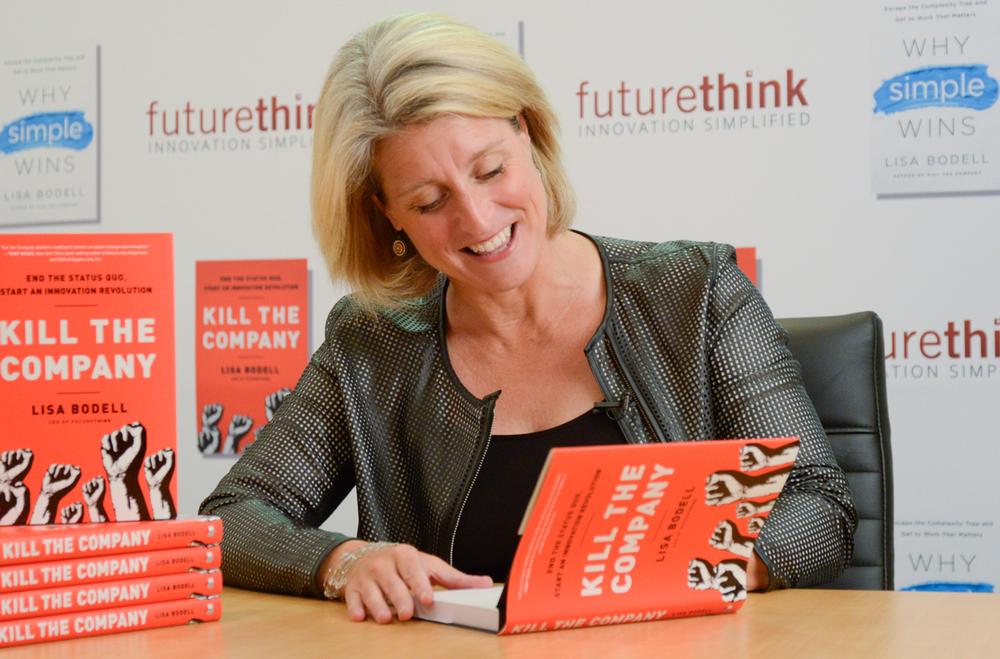
Bodell has written two books on workplace simplification and innovation
Your book is titled Kill the Company. What does that mean? In many companies, we often stress the need to ‘think outside the box’ and ‘embrace change’. Despite this, few efforts actually manage to transform an organisation into an innovative success. In the end, we revert to the status quo.
Despite our best intentions, most efforts at innovation fall flat simply because the business itself was designed to prevent it. While we encourage creativity, we exist within a system that’s built to discourage it. This is the paradox I bring to light in my book.
The majority of companies, particularly those struggling with innovation, tend to exhibit negative or simply complacent cultures. These are places where bureaucracy, politics and red tape are prominent, and where scepticism has become second nature. These are all red flags of a status-quo environment, which can kill a business.
What solution do you propose? Kill the Company helps organisations step outside themselves and be free to think creatively about what their needs are. Instead of pondering how to beat the competition, companies should look at how the competition can beat them. This kind of outside-in approach gets rid of what’s not working, and instead creates space for transformation.
Why are innovation and simplification key? What my book recommends is simple: get rid of things first, rather than building on what doesn’t work. It’s a form of corporate spring-cleaning. The idea is to question assumptions and challenge rules that have outlived their usefulness. Killing these status-quo attitudes makes room for more value-added work, such as thinking.
Too many change initiatives simply add another layer of processes to the to-do lists of already overwhelmed and tired employees. Not this one! Innovation is supposed to make things better and easier, not worse and more complicated. Kill the Company is a guide to simplifying and streamlining, and then building and maintaining a place where everyone’s innovative spirit and energy fuel the firm’s common, long-term goals.
A company that empowers its people to think critically, question relentlessly and act boldly will own the future.
Do you think that innovation can sometimes impose greater complexity? I don’t think that innovation presupposes complexity. I think that complexity, in fact, can very often interfere with our ability to move forward.
Complexity is actually killing companies’ ability to adapt and innovate, and simplicity is fast becoming the competitive advantage of our time.
By learning how to eliminate redundancies, communicate with clarity and make simplification a habit, individuals and organisations can begin to recognise which activities waste time and which create lasting value. By eliminating the low-value work, individuals feel less overwhelmed and more empowered, and are able to spend more time each day doing things that really matter – such as innovating.
What aspects of people’s attitudes need to change? Change is hard because it’s often rooted in fear – essentially, fear of the unknown. When someone asks or forces us to change, we naturally resist.
In business, when most leaders are confronted with a big new idea, they push back and ask for more explanations, more financials, etc. They’re worried about taking a risk. However, an evolved leader gets comfortable with the unknown and learns about their tolerance for risk. This approach activates creative problem solving and inventive thinking instead of fear and doubt.
Can you tell us about your consultancy, futurethink? futurethink is a global innovation training firm. We have a simple approach for unlocking this potential: our trainers and award-winning resources enable an entire organisation to think differently, drive change and achieve innovation success. We empower companies even in highly regulated industries – such as Pfizer, JPMorgan and Lockheed Martin – to solve big problems in uncommon, long-term and transformative ways.
Our facilitated and on-demand learning approach helps to transform the status quo into an invigorated mindset – with measurable results.
What do you think of the fitness industry’s approach? The thing I like about this industry is that it’s focused on transformation – transforming our health, our bodies, our minds and our outlook. It’s innovative at its core. People who get involved with clubs are typically ready to change.
However, I think the industry can be prone to pursuing short-term trends instead of focusing on long-term innovation. There are a lot of trends, fads and ‘what’s hot’ lists at present. However, true innovation is longer lasting than these passing fads. I’d say that the real change agents in the fitness industry are the ones who are currently coming up with novel ideas that are centred on solving big problems rather than fads that will outlive their appeal.
The road to simplicity Lisa Bodell is convinced that everyone has the power to innovate – if they simply know how. She’s the founder and CEO of futurethink, an innovation research and training firm based in New York City, which helps companies eliminate barriers in order for them to innovate successfully. Among her firm’s clients are corporate giants such as 3M, GE, Pfizer, JP Morgan, Lockheed Martin and Johnson & Johnson.
After earning a business degree at the University of Michigan, in Ann Arbor, Bodell began her career at Leo Burnett, a global advertising agency based in Chicago. She subsequently left Burnett to found a strategic planning firm, then a marketing and branding firm before moving to New York and creating futurethink.
She’s the author of two books, the best-seller, Kill the Company: End the Status Quo, Start an Innovation Revolution and Why Simple Wins.
Lisa Bodell
Killing the company
Lisa Bodell, the author, futurist and founder of futurethink, an innovation research and training firm based in New York City, will speak at the IHRSA 2018 convention in San Diego, California.
Her presentation, ‘Kill the Company: End the Status Quo, Start an Innovation Revolution’, is on Wednesday 21 March, from 10.30 am to 12.00 pm. For more information or to register, please go to: www.ihrsa.org/convention.
Active Blackpool is deploying Cornerstone Connect, a new digital interface allowing
disparate information from multiple systems to be aggregated into one dataset, to support
its focus on reducing health inequalities and improving healthy life expectancy. [more...]
Panatta brought together four of the most influential figures in bodybuilding history on the
stage of RiminiWellness 2026: Phil Heath, Lee Haney, Ronnie Coleman and Hany Rambod. [more...]
+ More featured suppliers
COMPANY PROFILES
Precor
Precor promises precision-quality products with steadfast reliability that are inspired by exerciser [more...]
Alliance Leisure
Alliance Leisure Services was specifically
established to respond to the changing
development need [more...]
Bodell has written two books on workplace simplification and innovation
Your book is titled Kill the Company. What does that mean? In many companies, we often stress the need to ‘think outside the box’ and ‘embrace change’. Despite this, few efforts actually manage to transform an organisation into an innovative success. In the end, we revert to the status quo.
Despite our best intentions, most efforts at innovation fall flat simply because the business itself was designed to prevent it. While we encourage creativity, we exist within a system that’s built to discourage it. This is the paradox I bring to light in my book.
The majority of companies, particularly those struggling with innovation, tend to exhibit negative or simply complacent cultures. These are places where bureaucracy, politics and red tape are prominent, and where scepticism has become second nature. These are all red flags of a status-quo environment, which can kill a business.
What solution do you propose? Kill the Company helps organisations step outside themselves and be free to think creatively about what their needs are. Instead of pondering how to beat the competition, companies should look at how the competition can beat them. This kind of outside-in approach gets rid of what’s not working, and instead creates space for transformation.
Why are innovation and simplification key? What my book recommends is simple: get rid of things first, rather than building on what doesn’t work. It’s a form of corporate spring-cleaning. The idea is to question assumptions and challenge rules that have outlived their usefulness. Killing these status-quo attitudes makes room for more value-added work, such as thinking.
Too many change initiatives simply add another layer of processes to the to-do lists of already overwhelmed and tired employees. Not this one! Innovation is supposed to make things better and easier, not worse and more complicated. Kill the Company is a guide to simplifying and streamlining, and then building and maintaining a place where everyone’s innovative spirit and energy fuel the firm’s common, long-term goals.
A company that empowers its people to think critically, question relentlessly and act boldly will own the future.
Do you think that innovation can sometimes impose greater complexity? I don’t think that innovation presupposes complexity. I think that complexity, in fact, can very often interfere with our ability to move forward.
Complexity is actually killing companies’ ability to adapt and innovate, and simplicity is fast becoming the competitive advantage of our time.
By learning how to eliminate redundancies, communicate with clarity and make simplification a habit, individuals and organisations can begin to recognise which activities waste time and which create lasting value. By eliminating the low-value work, individuals feel less overwhelmed and more empowered, and are able to spend more time each day doing things that really matter – such as innovating.
What aspects of people’s attitudes need to change? Change is hard because it’s often rooted in fear – essentially, fear of the unknown. When someone asks or forces us to change, we naturally resist.
In business, when most leaders are confronted with a big new idea, they push back and ask for more explanations, more financials, etc. They’re worried about taking a risk. However, an evolved leader gets comfortable with the unknown and learns about their tolerance for risk. This approach activates creative problem solving and inventive thinking instead of fear and doubt.
Can you tell us about your consultancy, futurethink? futurethink is a global innovation training firm. We have a simple approach for unlocking this potential: our trainers and award-winning resources enable an entire organisation to think differently, drive change and achieve innovation success. We empower companies even in highly regulated industries – such as Pfizer, JPMorgan and Lockheed Martin – to solve big problems in uncommon, long-term and transformative ways.
Our facilitated and on-demand learning approach helps to transform the status quo into an invigorated mindset – with measurable results.
What do you think of the fitness industry’s approach? The thing I like about this industry is that it’s focused on transformation – transforming our health, our bodies, our minds and our outlook. It’s innovative at its core. People who get involved with clubs are typically ready to change.
However, I think the industry can be prone to pursuing short-term trends instead of focusing on long-term innovation. There are a lot of trends, fads and ‘what’s hot’ lists at present. However, true innovation is longer lasting than these passing fads. I’d say that the real change agents in the fitness industry are the ones who are currently coming up with novel ideas that are centred on solving big problems rather than fads that will outlive their appeal.
The road to simplicity Lisa Bodell is convinced that everyone has the power to innovate – if they simply know how. She’s the founder and CEO of futurethink, an innovation research and training firm based in New York City, which helps companies eliminate barriers in order for them to innovate successfully. Among her firm’s clients are corporate giants such as 3M, GE, Pfizer, JP Morgan, Lockheed Martin and Johnson & Johnson.
After earning a business degree at the University of Michigan, in Ann Arbor, Bodell began her career at Leo Burnett, a global advertising agency based in Chicago. She subsequently left Burnett to found a strategic planning firm, then a marketing and branding firm before moving to New York and creating futurethink.
She’s the author of two books, the best-seller, Kill the Company: End the Status Quo, Start an Innovation Revolution and Why Simple Wins.
Lisa Bodell
Killing the company
Lisa Bodell, the author, futurist and founder of futurethink, an innovation research and training firm based in New York City, will speak at the IHRSA 2018 convention in San Diego, California.
Her presentation, ‘Kill the Company: End the Status Quo, Start an Innovation Revolution’, is on Wednesday 21 March, from 10.30 am to 12.00 pm. For more information or to register, please go to: www.ihrsa.org/convention.
According to research which tracked more than 147,000 people for 30 years, 90-120 minutes
of strength training a week may deliver some of the biggest long-term health rewards.
The UK's four Chief Medical Officers have published a refreshed edition of Physical activity
guidelines: UK Chief Medical Officers' report, updating the evidence that underpins the nation's
physical activity recommendations and placing greater emphasis on strength, balance, reducing
sedentary behaviour and, for the first time, supporting people taking weight loss medications.
Places Leisure has exchanged contracts to build and operate a flagship £60m water and leisure
destination on behalf of Basingstoke and Deane Borough Council.
The Republic of Ireland will become the latest market in PureGym’s expanding international
portfolio, with the first launch planned for Dublin in 2027.
Anytime Fitness opened more than one club a day in 2025 and is on track to maintain this rate
of growth this year, as parent company Purpose Brands targets further international expansion.
The £33.9 million Leighton Leisure and Community Centre has opened in Leighton Buzzard, UK,
creating a next-generation public leisure, health and wellbeing hub for the local community.
Walnuts Leisure Centre in Orpington, in the London Borough of Bromley, has reopened following
a £17m transformation designed to secure the long-term future of the public leisure asset and
reposition it as a community wellbeing hub.
The Gym Group, has announced that it's sustained positive trading momentum has continued
through the first half of 2026 and the company remains confident about the outlook.
Active Blackpool is deploying Cornerstone Connect, a new digital interface allowing
disparate information from multiple systems to be aggregated into one dataset, to support
its focus on reducing health inequalities and improving healthy life expectancy. [more...]
Panatta brought together four of the most influential figures in bodybuilding history on the
stage of RiminiWellness 2026: Phil Heath, Lee Haney, Ronnie Coleman and Hany Rambod. [more...]
+ More featured suppliers
COMPANY PROFILES
Precor Precor promises precision-quality products with steadfast reliability that are inspired by exerciser [more...]