Get HCM digital magazine and ezines FREE
Sign up here ▸
Jobs   News   Features   Products   Magazine      Advertise  
NEWS
Inactive young adults at ‘greater risk of mid-life dementia’
POSTED 21 Jul 2015 . BY Jak Phillips
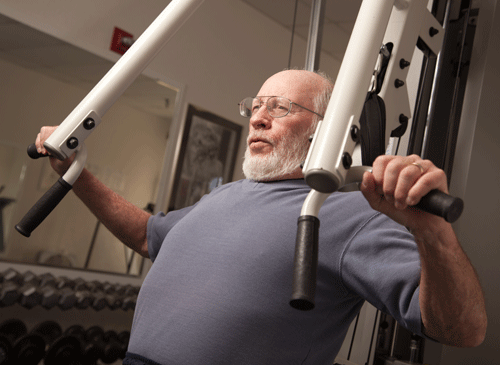
The risk of cognitive decline by middle age is greatly increased if adults fail to embrace a healthy lifestyle from the ages of 18 to 30 Credit: Shutterstock.com
Young adults who shun exercise and spend large amounts of time in front of screens are twice as likely to have poor cognitive function in mid-life, according to a study.

The risk of cognitive decline by middle age, leading to Alzheimer’s and other forms of dementia, is greatly increased if adults fail to embrace a healthy lifestyle from the ages of 18 to 30, found researchers who presented their work at the Alzheimer’s Association International Conference 2015 in Washington, D.C.

Although physical activity is known to help guard against dementia in later life, little is known about the role it plays in early adulthood.

“Understanding this relationship in early adulthood may be particularly important because global data suggests levels of physical inactivity and sedentary behaviour are increasing,” said Tina Hoang of the Northern California Institute of Research and Education (NCIRE).

Hoang worked with her mentor – Kristine Yaffe, MD, of the University of California – and colleagues to investigate the association of long-term patterns of low physical activity and high television viewing time over 25 years with cognitive function at mid-life.

The researchers reported that study participants with low levels of physical activity over 25 years had significantly worse cognition in mid-life, adjusting for age, race, sex, education, smoking, alcohol, BMI, and hypertension. Similarly, participants with high levels of TV watching over 25 years also had significantly worse mid-life cognitive function. Study participants with both long-term low physical activity and high television viewing were almost two times more likely to have poor cognitive function in mid-life.

“Our findings demonstrate that even early- and mid-adulthood may be critical periods for promotion of physical activity for healthy cognitive ageing,” Hoang said.

“Sedentary behaviours, like TV viewing, could be especially relevant for future generations of adults due to the growing use of screen-based technologies. Because research indicates that Alzheimer’s and other dementias develop over several decades, increasing physical activity and reducing sedentary behaviour beginning in early adulthood may have a significant public health impact.”

RELATED STORIES
  Being overweight 'cuts risk of dementia'


Contrary to current health advice, being overweight cuts the risk of dementia – according to an analysis of nearly two million British people in the Lancet Diabetes & Endocrinology.
  Growing body of research for instant impact of exercise in combating dementia


A series of recent studies have added credence to the notion that physical activity is far more effective than mental exercises, such as crosswords or puzzles, in staving off dementia.
  Funding given to help research impact of exercise on dementia


Health researchers have been granted £124m funding to help challenge major health issues, including work on how to reduce the risk of dementia through exercise.
  Physical exercise 'prevents dementia'


Physical exercise may reduce the risk of dementia and slow the development of the illness even after a patient has been diagnosed with the ailment.
MORE NEWS
Les Mills calls on the industry to support UNICEF
Global group exercise specialist, Les Mills, is inviting operators to sign up to its Workout for the World event on 20 June, in support of UNICEF.
HUM2N opens longevity clinic at Six Senses London
Global luxury hospitality brand, Six Senses, has partnered with longevity healthcare provider, HUM2N, to launch a clinic at Six Senses London, at The Whiteley.
KX Chelsea invests £15 million to upgrade its wellness offering
Premium London health club, KX Chelsea, will imminently unveil its most significant redevelopment since its launch in 2002 to create an integrated wellness model combining training, recovery and relaxation.
Researchers identify a drug which reduces muscle loss when using GLP-1 medications
Researchers in the US have identified an antibody which could greatly reduce the loss of lean muscle mass in people who are taking weight-loss medications.
+ More news   
LATEST JOBS
GP Exercise Referral Instructor
Everyone Active
Salary: £33,000pa + benefits
Job location: Harrow, Middlesex , United Kingdom
Self Employed Personal Trainer
Everyone Active
Salary: Competitive
Job location: Enderby
+ More jobs  

FEATURED SUPPLIERS

Elevate 2026 to mark 10-year anniversary with biggest ever waterfront drinks reception
Elevate is set to celebrate its 10th anniversary in style this June, with organisers confirming the event’s largest-ever drinks reception as registrations continue to run more than 10% ahead of last year. [more...]

W3Fit EMEA celebrates its fifth anniversary
Celebrating its milestone 5th anniversary, W3Fit EMEA returns in 2026 with an unmissable gathering of the Health & Fitness industry’s most influential leaders. [more...]
+ More featured suppliers  
COMPANY PROFILES
Life Fitness/Hammer Strength

Life Fitness / Hammer Strength works with some of the world’s most recognised hospitality brands, su [more...]
Safe Space Lockers

We provide a full turn-key solution for clients from design and consultation, through to bespoke man [more...]
+ More profiles  
CATALOGUE GALLERY
 
+ More catalogues  

DIRECTORY
+ More directory  
DIARY


09-12 Jun 2026

W3Spa EMEA

Hotel Cascais Miragem Health & Spa, Portugal
13-13 Jun 2026

Global Wellness Day

Worldwide, Various,
+ More diary  
 
ABOUT LEISURE MEDIA
LEISURE MEDIA MAGAZINES
LEISURE MEDIA HANDBOOKS
LEISURE MEDIA WEBSITES
LEISURE MEDIA PRODUCT SEARCH
 
HCM
LEISURE OPPORTUNITIES
HEALTH CLUB HANDBOOK
PRINT SUBSCRIPTIONS
FREE DIGITAL SUBSCRIPTIONS
ADVERTISE . CONTACT US

Leisure Media
Tel: +44 (0)1462 431385

©Cybertrek 2026
Get HCM digital magazine and ezines FREE
Sign up here ▸
Jobs    News   Products   Magazine
NEWS
Inactive young adults at ‘greater risk of mid-life dementia’
POSTED 21 Jul 2015 . BY Jak Phillips
The risk of cognitive decline by middle age is greatly increased if adults fail to embrace a healthy lifestyle from the ages of 18 to 30 Credit: Shutterstock.com
Young adults who shun exercise and spend large amounts of time in front of screens are twice as likely to have poor cognitive function in mid-life, according to a study.

The risk of cognitive decline by middle age, leading to Alzheimer’s and other forms of dementia, is greatly increased if adults fail to embrace a healthy lifestyle from the ages of 18 to 30, found researchers who presented their work at the Alzheimer’s Association International Conference 2015 in Washington, D.C.

Although physical activity is known to help guard against dementia in later life, little is known about the role it plays in early adulthood.

“Understanding this relationship in early adulthood may be particularly important because global data suggests levels of physical inactivity and sedentary behaviour are increasing,” said Tina Hoang of the Northern California Institute of Research and Education (NCIRE).

Hoang worked with her mentor – Kristine Yaffe, MD, of the University of California – and colleagues to investigate the association of long-term patterns of low physical activity and high television viewing time over 25 years with cognitive function at mid-life.

The researchers reported that study participants with low levels of physical activity over 25 years had significantly worse cognition in mid-life, adjusting for age, race, sex, education, smoking, alcohol, BMI, and hypertension. Similarly, participants with high levels of TV watching over 25 years also had significantly worse mid-life cognitive function. Study participants with both long-term low physical activity and high television viewing were almost two times more likely to have poor cognitive function in mid-life.

“Our findings demonstrate that even early- and mid-adulthood may be critical periods for promotion of physical activity for healthy cognitive ageing,” Hoang said.

“Sedentary behaviours, like TV viewing, could be especially relevant for future generations of adults due to the growing use of screen-based technologies. Because research indicates that Alzheimer’s and other dementias develop over several decades, increasing physical activity and reducing sedentary behaviour beginning in early adulthood may have a significant public health impact.”
RELATED STORIES
Being overweight 'cuts risk of dementia'


Contrary to current health advice, being overweight cuts the risk of dementia – according to an analysis of nearly two million British people in the Lancet Diabetes & Endocrinology.
Growing body of research for instant impact of exercise in combating dementia


A series of recent studies have added credence to the notion that physical activity is far more effective than mental exercises, such as crosswords or puzzles, in staving off dementia.
Funding given to help research impact of exercise on dementia


Health researchers have been granted £124m funding to help challenge major health issues, including work on how to reduce the risk of dementia through exercise.
Physical exercise 'prevents dementia'


Physical exercise may reduce the risk of dementia and slow the development of the illness even after a patient has been diagnosed with the ailment.
MORE NEWS
Les Mills calls on the industry to support UNICEF
Global group exercise specialist, Les Mills, is inviting operators to sign up to its Workout for the World event on 20 June, in support of UNICEF.
HUM2N opens longevity clinic at Six Senses London
Global luxury hospitality brand, Six Senses, has partnered with longevity healthcare provider, HUM2N, to launch a clinic at Six Senses London, at The Whiteley.
KX Chelsea invests £15 million to upgrade its wellness offering
Premium London health club, KX Chelsea, will imminently unveil its most significant redevelopment since its launch in 2002 to create an integrated wellness model combining training, recovery and relaxation.
Researchers identify a drug which reduces muscle loss when using GLP-1 medications
Researchers in the US have identified an antibody which could greatly reduce the loss of lean muscle mass in people who are taking weight-loss medications.
Peloton signals potential move into reformer Pilates with Skop acquisition
Peloton has made the strategic acquisition of the Pilates start-up, Skōp, to support the expansion of its strength ecosystem.
Crunch Fitness creates more affordable reformer Pilates concept
Crunch Fitness has announced the launch of Crunch Reform Pilates – its own reformer concept designed to bring this fast growing, but rather expensive, modality into the mainstream.
+ More news   
 
FEATURED SUPPLIERS

Elevate 2026 to mark 10-year anniversary with biggest ever waterfront drinks reception
Elevate is set to celebrate its 10th anniversary in style this June, with organisers confirming the event’s largest-ever drinks reception as registrations continue to run more than 10% ahead of last year. [more...]

W3Fit EMEA celebrates its fifth anniversary
Celebrating its milestone 5th anniversary, W3Fit EMEA returns in 2026 with an unmissable gathering of the Health & Fitness industry’s most influential leaders. [more...]
+ More featured suppliers  
COMPANY PROFILES
Life Fitness/Hammer Strength

Life Fitness / Hammer Strength works with some of the world’s most recognised hospitality brands, su [more...]
+ More profiles  
CATALOGUE GALLERY
+ More catalogues  

DIRECTORY
+ More directory  
DIARY


09-12 Jun 2026

W3Spa EMEA

Hotel Cascais Miragem Health & Spa, Portugal
13-13 Jun 2026

Global Wellness Day

Worldwide, Various,
+ More diary  


ADVERTISE . CONTACT US

Leisure Media
Tel: +44 (0)1462 431385

©Cybertrek 2026

ABOUT LEISURE MEDIA
LEISURE MEDIA MAGAZINES
LEISURE MEDIA HANDBOOKS
LEISURE MEDIA WEBSITES
LEISURE MEDIA PRODUCT SEARCH
PRINT SUBSCRIPTIONS
FREE DIGITAL SUBSCRIPTIONS