If your employees are passionate about their jobs and committed to your organisation, it has a direct impact on the profitability of your business. John Coldicutt explains why – and how you can drive engagement levels
Listen to your employees and incorporate their opinions in any strategies / shutterstock
Having an engaged workforce intuitively sounds like a good thing. Who wouldn’t like to go to work every day and see their employees happily getting stuck into the tasks at hand?
Engaged employees are more than just a nice-to-have. They’re also more productive, more innovative, more invested in the outcome of their work, more interested in providing a satisfying experience for customers – all of which means they’re more profitable for businesses.
Meanwhile, disengaged employees are the ones too busy texting to stock any shelves, or who are there but aren’t really there, zombie-ing their way through their days. When an employee is actively disengaged, they can become bitter and resentful, responding rudely to customers, negatively influencing other employees and actively undermining the business.
Let’s take a deeper look at why engagement is so important to business profitability, and how you can encourage deeper engagement at your workplace.
Engagement pays CustomInsight defines employee engagement as the “extent to which employees feel passionate about their jobs, are committed to the organisation, and put discretionary effort into their work”. It also goes on to clarify that “employee engagement is not the same as employee satisfaction”. Ostensibly, an employee could be satisfied with their job if it required sitting around watching Netflix and eating chocolate all day, but that wouldn’t mean they were engaged.
Forbes defines employee engagement using an emotional framework. It says: “Employee engagement is the emotional commitment the employee has to the organisation and its goals. Engaged employees use discretionary effort.”
In a recent Harvard Business Review survey of leading executives, 71 per cent ranked employee engagement as critical to employee success, with 72 per cent adding that recognising high performers had a positive impact. Of those that put a high priority on measuring employee engagement, 77 per cent found that employee engagement had an impact on customer satisfaction.
However, only 24 per cent reported employees in their organisation as being engaged. Meanwhile, the Gallup Employee Engagement Insights Report concluded that 93 per cent of highly engaged employees experienced 147 per cent higher earnings than their less engaged counterparts. Those who ranked in the top half of employee engagement scores also produced 22 per cent more profit, were 21 per cent more productive, and experienced 37 per cent less absenteeism than those in the bottom half.
The business case doesn’t stop there. According to a 2014 AoN study, companies rated as great places to work had considerably higher growth and share return, while those that ranked poorly experienced the opposite.
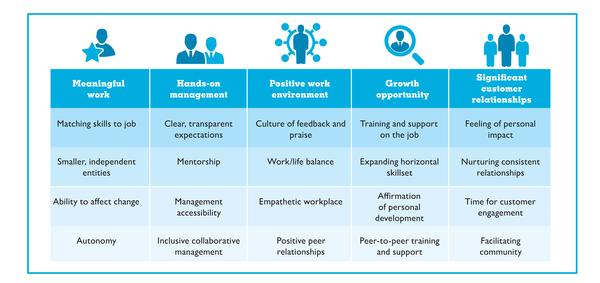
It’s clear that employee engagement is worth investing in. But where to start? We’ve put together a comprehensive employee engagement framework (see Fig 1), as well as a list of key questions to ask your employees to help boost engagement.
Meaningful work The first part of the framework involves creating meaningful work for employees: matching their skills to their job; making them feel they have the ability to bring about change; and making them feel like individual, creative entities – part of a team perhaps, but with autonomy in what they do.
To further your efforts in this area, you might consider asking your employees: • Do you have the opportunity to do what you do best every day?? • Do you feel your team can take the course of action that makes the most sense for you?? • Do you feel that you can make changes at work?? • Do you feel your manager trusts you to get work done on your own?
Hands-on management Just as you’d like your employees to be engaged, they’d like you to be engaged too – a supportive manager who cares about the outcome of their work, as well as their day-to-day happiness.
A hands-on manager will offer clear, transparent expectations. They’ll provide mentorship and will be easily accessible to employees. Perhaps most importantly, they’ll be inclusive and collaborative in decision-making. This doesn’t mean giving the vote over to the mob, but it does mean listening to employees, trying your best to incorporate their thoughts into any plans moving forward.
A few questions you might ask staff: • Do you know exactly what’s expected of you at work? • Do you feel that your manager cares about your personal and professional development? • How available is your manager for meetings and catch-ups? • Do you feel your manager asks for and values your input?
Positive environment Unsurprisingly, a positive work environment is also key to engagement. Make sure there’s positive feedback and praise, especially when an employee has gone out on a limb and tackled something challenging. Offer work-life balance, with plenty of understanding for external demands on an employee’s time, whether that’s family or childcare, or any second job they might have. Don’t forget their need for time off to recharge and live a fully rounded life.
Ensure the workplace is an empathetic one, where employees feel listened to and cared for, no matter what’s happening in their lives. Encourage positive relationships with peers, whether that means having casual pizza Fridays, going to the pub, or simply allowing more time for chit chat.
A few questions you might ask: • How often do you receive feedback or praise when you’re at work? • Do you feel you can fit your personal commitments into your work schedule? • Do you feel your manager and co-workers care about you as a person? • Do you have a best friend at work?
Growth and opportunity Employees are naturally more engaged when they’re regularly challenged with interesting problems, and when they feel they have the opportunity to move up. After all, no-one likes working in a dead-end job.
Provide regular training and offer on-the-job support to implement newly learned skills – and don’t neglect the horizontal skillset, so employees feel they’re growing even within the job they already have. Offer affirmation of personal development.
Encouraging peer-to-peer mentorship – support from the people that they’re working with day-to-day, who can most easily guide them – is also recommended.
A few questions to ask: • Do you feel that you have sufficient opportunity to keep developing your professional skills at work? • Are you encouraged to learn new skills related to your job? • In the last six months, has someone talked to you about your progress? • Do you feel your co-workers teach you new skills and support your growth?
customer relationships Everything we’ve explored so far affects an employee’s relationship to their customers in impactful but roundabout ways. But actively creating positive employee-customer relationships also matters. Employees should feel they have a personal impact on the experiences of their customers.Ideally, employees will nurture relationships with customers who return repeatedly; time should be allowed for customer engagement, rather than putting too much emphasis on efficiency.
To foster these connections, ask your employees the following questions: • Do you feel you make a difference in the lives of your customers? • Do you have the opportunity to develop relationships with consistent customers? • Does your manager give you plenty of time to interact with customers? • Do you feel like you and your customers are part of a community?
Building your business Investing in employee engagement is of the utmost importance, as engaged employees have a direct impact on your bottom line. Make sure that you have all the tools in place to enable your employees to do what they do best on a daily basis.
FIGURE 1: Planday’s Employee Engagement Framework
Figure1
ABOUT THE AUTHOR
John Coldicutt
John Coldicutt is chief marketing officer for staff scheduling software provider Planday.
Active Blackpool is deploying Cornerstone Connect, a new digital interface allowing
disparate information from multiple systems to be aggregated into one dataset, to support
its focus on reducing health inequalities and improving healthy life expectancy. [more...]
Panatta brought together four of the most influential figures in bodybuilding history on the
stage of RiminiWellness 2026: Phil Heath, Lee Haney, Ronnie Coleman and Hany Rambod. [more...]
+ More featured suppliers
COMPANY PROFILES
Alliance Leisure
Alliance Leisure Services was specifically
established to respond to the changing
development need [more...]
IndigoFitness
At IndigoFitness, we create intelligent training spaces that elevate fitness facilities across indus [more...]
If your employees are passionate about their jobs and committed to your organisation, it has a direct impact on the profitability of your business. John Coldicutt explains why – and how you can drive engagement levels
Listen to your employees and incorporate their opinions in any strategies / shutterstock
Having an engaged workforce intuitively sounds like a good thing. Who wouldn’t like to go to work every day and see their employees happily getting stuck into the tasks at hand?
Engaged employees are more than just a nice-to-have. They’re also more productive, more innovative, more invested in the outcome of their work, more interested in providing a satisfying experience for customers – all of which means they’re more profitable for businesses.
Meanwhile, disengaged employees are the ones too busy texting to stock any shelves, or who are there but aren’t really there, zombie-ing their way through their days. When an employee is actively disengaged, they can become bitter and resentful, responding rudely to customers, negatively influencing other employees and actively undermining the business.
Let’s take a deeper look at why engagement is so important to business profitability, and how you can encourage deeper engagement at your workplace.
Engagement pays CustomInsight defines employee engagement as the “extent to which employees feel passionate about their jobs, are committed to the organisation, and put discretionary effort into their work”. It also goes on to clarify that “employee engagement is not the same as employee satisfaction”. Ostensibly, an employee could be satisfied with their job if it required sitting around watching Netflix and eating chocolate all day, but that wouldn’t mean they were engaged.
Forbes defines employee engagement using an emotional framework. It says: “Employee engagement is the emotional commitment the employee has to the organisation and its goals. Engaged employees use discretionary effort.”
In a recent Harvard Business Review survey of leading executives, 71 per cent ranked employee engagement as critical to employee success, with 72 per cent adding that recognising high performers had a positive impact. Of those that put a high priority on measuring employee engagement, 77 per cent found that employee engagement had an impact on customer satisfaction.
However, only 24 per cent reported employees in their organisation as being engaged. Meanwhile, the Gallup Employee Engagement Insights Report concluded that 93 per cent of highly engaged employees experienced 147 per cent higher earnings than their less engaged counterparts. Those who ranked in the top half of employee engagement scores also produced 22 per cent more profit, were 21 per cent more productive, and experienced 37 per cent less absenteeism than those in the bottom half.
The business case doesn’t stop there. According to a 2014 AoN study, companies rated as great places to work had considerably higher growth and share return, while those that ranked poorly experienced the opposite.
It’s clear that employee engagement is worth investing in. But where to start? We’ve put together a comprehensive employee engagement framework (see Fig 1), as well as a list of key questions to ask your employees to help boost engagement.
Meaningful work The first part of the framework involves creating meaningful work for employees: matching their skills to their job; making them feel they have the ability to bring about change; and making them feel like individual, creative entities – part of a team perhaps, but with autonomy in what they do.
To further your efforts in this area, you might consider asking your employees: • Do you have the opportunity to do what you do best every day?? • Do you feel your team can take the course of action that makes the most sense for you?? • Do you feel that you can make changes at work?? • Do you feel your manager trusts you to get work done on your own?
Hands-on management Just as you’d like your employees to be engaged, they’d like you to be engaged too – a supportive manager who cares about the outcome of their work, as well as their day-to-day happiness.
A hands-on manager will offer clear, transparent expectations. They’ll provide mentorship and will be easily accessible to employees. Perhaps most importantly, they’ll be inclusive and collaborative in decision-making. This doesn’t mean giving the vote over to the mob, but it does mean listening to employees, trying your best to incorporate their thoughts into any plans moving forward.
A few questions you might ask staff: • Do you know exactly what’s expected of you at work? • Do you feel that your manager cares about your personal and professional development? • How available is your manager for meetings and catch-ups? • Do you feel your manager asks for and values your input?
Positive environment Unsurprisingly, a positive work environment is also key to engagement. Make sure there’s positive feedback and praise, especially when an employee has gone out on a limb and tackled something challenging. Offer work-life balance, with plenty of understanding for external demands on an employee’s time, whether that’s family or childcare, or any second job they might have. Don’t forget their need for time off to recharge and live a fully rounded life.
Ensure the workplace is an empathetic one, where employees feel listened to and cared for, no matter what’s happening in their lives. Encourage positive relationships with peers, whether that means having casual pizza Fridays, going to the pub, or simply allowing more time for chit chat.
A few questions you might ask: • How often do you receive feedback or praise when you’re at work? • Do you feel you can fit your personal commitments into your work schedule? • Do you feel your manager and co-workers care about you as a person? • Do you have a best friend at work?
Growth and opportunity Employees are naturally more engaged when they’re regularly challenged with interesting problems, and when they feel they have the opportunity to move up. After all, no-one likes working in a dead-end job.
Provide regular training and offer on-the-job support to implement newly learned skills – and don’t neglect the horizontal skillset, so employees feel they’re growing even within the job they already have. Offer affirmation of personal development.
Encouraging peer-to-peer mentorship – support from the people that they’re working with day-to-day, who can most easily guide them – is also recommended.
A few questions to ask: • Do you feel that you have sufficient opportunity to keep developing your professional skills at work? • Are you encouraged to learn new skills related to your job? • In the last six months, has someone talked to you about your progress? • Do you feel your co-workers teach you new skills and support your growth?
customer relationships Everything we’ve explored so far affects an employee’s relationship to their customers in impactful but roundabout ways. But actively creating positive employee-customer relationships also matters. Employees should feel they have a personal impact on the experiences of their customers.Ideally, employees will nurture relationships with customers who return repeatedly; time should be allowed for customer engagement, rather than putting too much emphasis on efficiency.
To foster these connections, ask your employees the following questions: • Do you feel you make a difference in the lives of your customers? • Do you have the opportunity to develop relationships with consistent customers? • Does your manager give you plenty of time to interact with customers? • Do you feel like you and your customers are part of a community?
Building your business Investing in employee engagement is of the utmost importance, as engaged employees have a direct impact on your bottom line. Make sure that you have all the tools in place to enable your employees to do what they do best on a daily basis.
FIGURE 1: Planday’s Employee Engagement Framework
Figure1
ABOUT THE AUTHOR
John Coldicutt
John Coldicutt is chief marketing officer for staff scheduling software provider Planday.
According to research which tracked more than 147,000 people for 30 years, 90-120 minutes
of strength training a week may deliver some of the biggest long-term health rewards.
The UK's four Chief Medical Officers have published a refreshed edition of Physical activity
guidelines: UK Chief Medical Officers' report, updating the evidence that underpins the nation's
physical activity recommendations and placing greater emphasis on strength, balance, reducing
sedentary behaviour and, for the first time, supporting people taking weight loss medications.
Places Leisure has exchanged contracts to build and operate a flagship £60m water and leisure
destination on behalf of Basingstoke and Deane Borough Council.
The Republic of Ireland will become the latest market in PureGym’s expanding international
portfolio, with the first launch planned for Dublin in 2027.
Anytime Fitness opened more than one club a day in 2025 and is on track to maintain this rate
of growth this year, as parent company Purpose Brands targets further international expansion.
The £33.9 million Leighton Leisure and Community Centre has opened in Leighton Buzzard, UK,
creating a next-generation public leisure, health and wellbeing hub for the local community.
Walnuts Leisure Centre in Orpington, in the London Borough of Bromley, has reopened following
a £17m transformation designed to secure the long-term future of the public leisure asset and
reposition it as a community wellbeing hub.
The Gym Group, has announced that it's sustained positive trading momentum has continued
through the first half of 2026 and the company remains confident about the outlook.
Active Blackpool is deploying Cornerstone Connect, a new digital interface allowing
disparate information from multiple systems to be aggregated into one dataset, to support
its focus on reducing health inequalities and improving healthy life expectancy. [more...]
Panatta brought together four of the most influential figures in bodybuilding history on the
stage of RiminiWellness 2026: Phil Heath, Lee Haney, Ronnie Coleman and Hany Rambod. [more...]
+ More featured suppliers
COMPANY PROFILES
Alliance Leisure Alliance Leisure Services was specifically
established to respond to the changing
development need [more...]