Data shows the British public is not yet willing to accept the association between obesity and low levels of physical activity / Photo: SHUTTERSTOCK.COM
There’s a lot of noise about obesity in the UK today – not surprising given health professionals name obesity “the biggest public health crisis facing the UK”, with calls for obesity to be treated as a ‘national risk’ – a significance on a par with terrorism. But obesity not only represents a health crisis; it’s also a significant contributor to the funding crisis, with Simon Stevens, chief executive of NHS England, recently revealing that “we now spend more on obesity than on the police and fire service combined”.
STEM THE EPIDEMIC Getting people active is a crucial step in stemming this epidemic. People in the UK are around 20 per cent less active now than they were in the 1960s, and we’re predicted to be 35 per cent less active by 2030.
Given these declining levels of physical activity, it’s no surprise that one in four UK adults is classified as obese, while almost two in three are considered overweight or obese. The picture is similar on a global level: we’ve reached a point where more people are obese than underweight.
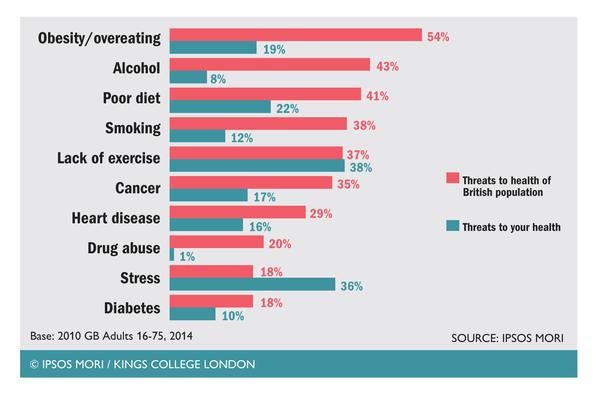
ARE YOU AWARE? Obesity is an issue which is not only widely recognised by policy makers, the NHS and the media but also by the British public who, over the past decade, have consistently named obesity as one of the greatest health threats facing the general population (Figure 1).
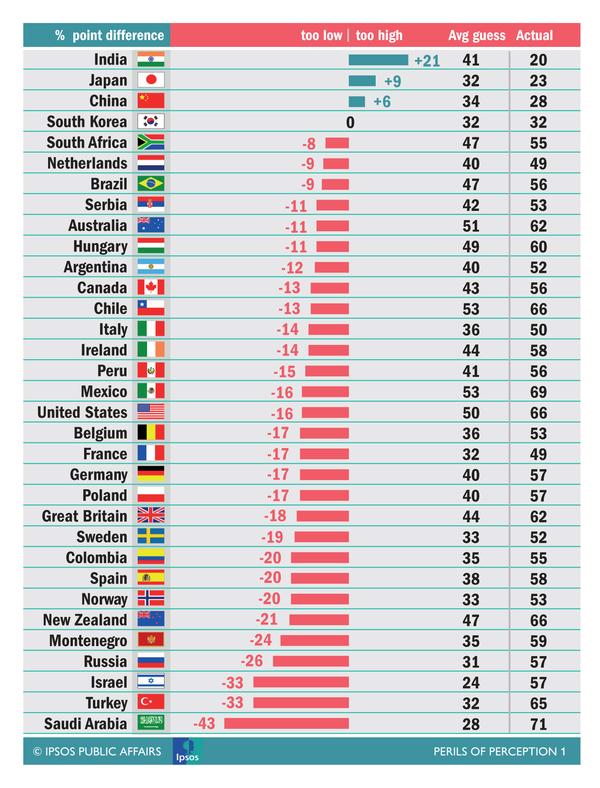
However, there are two problems with the public’s awareness. The first is that they’ve failed to grasp the scale of the issue. The public believes 44 per cent of the population is overweight or obese, when the reality is far greater at 62 per cent. The second is that they don’t believe the issue applies to them. More than half say obesity is one of the greatest threats to the health of the British population (54 per cent), yet only 19 per cent say it’s a threat to their own health.
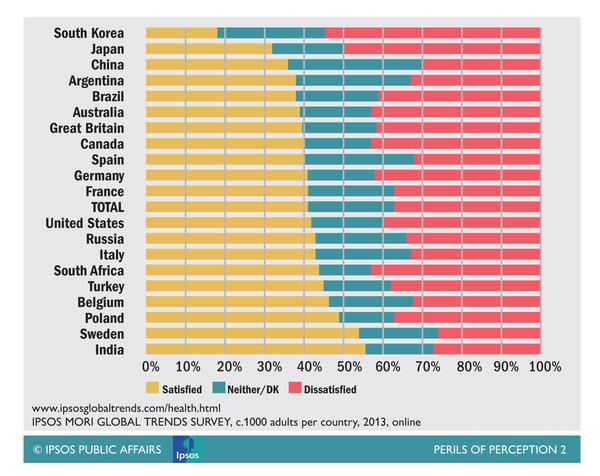
The Brits are not alone in this regard. Most countries underestimate the proportion of their population that is overweight or obese (most notably in Saudi Arabia; Figure 2). And many countries show higher levels of satisfaction with their weight than perhaps they should (Figure 3).
One could argue that the first issue doesn’t matter: in fact, raising awareness of the scale of the issue could be counter-productive, because it could establish being overweight/obese as a social norm. As American psychologist Robert Cialdini has long warned, there are dangers to suggesting that undesirable behaviour (or in this instance, excess weight) is widespread, because it risks normalising that behaviour.
But the second issue does matter – and so far it seems communicators have failed to bring home the personal realities of obesity.
GET THE POINT ACROSS The British public feel differently about physical activity: a lack of exercise is seen as the greatest threat to their own health. This suggests the British public is not yet willing to accept the association between obesity and low levels of physical activity. In some ways it’s encouraging that the public recognise they might not be undertaking as much physical activity as they should. But the question is: How can we more successfully communicate the need to take action if the personal risk of obesity is to be avoided?
CONSIDER THIS Our research points to a number of factors for consideration. The first concerns salience. Often the issue of obesity is discussed in terms of statistics, which are used as a means of conveying the scale of the problem. However, as noted earlier, this has limitations; the use of vivid anecdotes and more emotional messaging concerning the health of friends and family resonates better with the public than the presentation of numerical facts.
Clarity of message is also important. The public complain about receiving a high volume of – at times confusing – messages concerning their diet, weight and levels of physical activity. Confounding advice risks disengagement with the issue. However, communicating unambiguous advice is a challenge when even the experts don’t agree on issues such as dietary guidelines.
Finally, we need to make sure the messaging around obesity and physical activity reflects how the public think about the issue if we want to maximise the impact of any communication.
The approach taken in the Change4life campaign in England and Wales is to convey positive, motivational messages that don’t mention the word ‘obesity’, but instead focus on making healthy behavioural changes. But there’s an alternative to this which makes more explicit reference to body image. We know from our research that people often register their concerns about weight problems in the context
of body image and confidence (rather than worries about distant health problems) – but of course the question then becomes whether this could ever be done sensitively enough to avoid the risk of fat-shaming.
PERSONAL REALITY How to communicate sensitively on what is an emotive subject just adds to the plethora of other risks facing communicators, like how to avoid creating perceptions of a nanny state, and how to ensure that blame for this epidemic isn’t placed squarely at the feet of individuals.
Clearly, raising more informed awareness about obesity is just one lever to be pulled in trying to stem this incredibly complex health issue. However, it certainly seems that better connecting the issue of obesity with the personal realities of individuals’ lives must be a considered part of the response to, and prevention of, obesity.
Figure 1 Which of the following, if any, are the biggest threats to the health of the British population/your health? (Prompted) Top 10 mentioned are shown
Figure 1
Figure 2 Out of every 100 people aged 20+ years, how many do you think are either overweight or obese?
Figure 2
Figure 3 How satisfied or dissatisfied are you with your weight?
Figure 3
About the author
Louise Park
Louise Park is an associate director at Ipsos MORI’s Social Research Institute – a leading UK-based research agency that supports decision-makers through analysis of a range of societally relevant topics, including health. Louise leads on all public health research.
What should you eat? Communicating unambiguous advice is a challenge when even the experts don’t agree on issues such as dietary guidelines / Photo: SHUTTERSTOCK.COM
Panatta brought together four of the most influential figures in bodybuilding history on the
stage of RiminiWellness 2026: Phil Heath, Lee Haney, Ronnie Coleman and Hany Rambod. [more...]
+ More featured suppliers
COMPANY PROFILES
Everyone Active
Everyone Active operates leisure centres in partnership with local councils across the UK. Today, Ev [more...]
Safe Space Lockers
We provide a full turn-key solution for clients from design and consultation, through to bespoke man [more...]
Data shows the British public is not yet willing to accept the association between obesity and low levels of physical activity / Photo: SHUTTERSTOCK.COM
There’s a lot of noise about obesity in the UK today – not surprising given health professionals name obesity “the biggest public health crisis facing the UK”, with calls for obesity to be treated as a ‘national risk’ – a significance on a par with terrorism. But obesity not only represents a health crisis; it’s also a significant contributor to the funding crisis, with Simon Stevens, chief executive of NHS England, recently revealing that “we now spend more on obesity than on the police and fire service combined”.
STEM THE EPIDEMIC Getting people active is a crucial step in stemming this epidemic. People in the UK are around 20 per cent less active now than they were in the 1960s, and we’re predicted to be 35 per cent less active by 2030.
Given these declining levels of physical activity, it’s no surprise that one in four UK adults is classified as obese, while almost two in three are considered overweight or obese. The picture is similar on a global level: we’ve reached a point where more people are obese than underweight.
ARE YOU AWARE? Obesity is an issue which is not only widely recognised by policy makers, the NHS and the media but also by the British public who, over the past decade, have consistently named obesity as one of the greatest health threats facing the general population (Figure 1).
However, there are two problems with the public’s awareness. The first is that they’ve failed to grasp the scale of the issue. The public believes 44 per cent of the population is overweight or obese, when the reality is far greater at 62 per cent. The second is that they don’t believe the issue applies to them. More than half say obesity is one of the greatest threats to the health of the British population (54 per cent), yet only 19 per cent say it’s a threat to their own health.
The Brits are not alone in this regard. Most countries underestimate the proportion of their population that is overweight or obese (most notably in Saudi Arabia; Figure 2). And many countries show higher levels of satisfaction with their weight than perhaps they should (Figure 3).
One could argue that the first issue doesn’t matter: in fact, raising awareness of the scale of the issue could be counter-productive, because it could establish being overweight/obese as a social norm. As American psychologist Robert Cialdini has long warned, there are dangers to suggesting that undesirable behaviour (or in this instance, excess weight) is widespread, because it risks normalising that behaviour.
But the second issue does matter – and so far it seems communicators have failed to bring home the personal realities of obesity.
GET THE POINT ACROSS The British public feel differently about physical activity: a lack of exercise is seen as the greatest threat to their own health. This suggests the British public is not yet willing to accept the association between obesity and low levels of physical activity. In some ways it’s encouraging that the public recognise they might not be undertaking as much physical activity as they should. But the question is: How can we more successfully communicate the need to take action if the personal risk of obesity is to be avoided?
CONSIDER THIS Our research points to a number of factors for consideration. The first concerns salience. Often the issue of obesity is discussed in terms of statistics, which are used as a means of conveying the scale of the problem. However, as noted earlier, this has limitations; the use of vivid anecdotes and more emotional messaging concerning the health of friends and family resonates better with the public than the presentation of numerical facts.
Clarity of message is also important. The public complain about receiving a high volume of – at times confusing – messages concerning their diet, weight and levels of physical activity. Confounding advice risks disengagement with the issue. However, communicating unambiguous advice is a challenge when even the experts don’t agree on issues such as dietary guidelines.
Finally, we need to make sure the messaging around obesity and physical activity reflects how the public think about the issue if we want to maximise the impact of any communication.
The approach taken in the Change4life campaign in England and Wales is to convey positive, motivational messages that don’t mention the word ‘obesity’, but instead focus on making healthy behavioural changes. But there’s an alternative to this which makes more explicit reference to body image. We know from our research that people often register their concerns about weight problems in the context
of body image and confidence (rather than worries about distant health problems) – but of course the question then becomes whether this could ever be done sensitively enough to avoid the risk of fat-shaming.
PERSONAL REALITY How to communicate sensitively on what is an emotive subject just adds to the plethora of other risks facing communicators, like how to avoid creating perceptions of a nanny state, and how to ensure that blame for this epidemic isn’t placed squarely at the feet of individuals.
Clearly, raising more informed awareness about obesity is just one lever to be pulled in trying to stem this incredibly complex health issue. However, it certainly seems that better connecting the issue of obesity with the personal realities of individuals’ lives must be a considered part of the response to, and prevention of, obesity.
Figure 1 Which of the following, if any, are the biggest threats to the health of the British population/your health? (Prompted) Top 10 mentioned are shown
Figure 1
Figure 2 Out of every 100 people aged 20+ years, how many do you think are either overweight or obese?
Figure 2
Figure 3 How satisfied or dissatisfied are you with your weight?
Figure 3
About the author
Louise Park
Louise Park is an associate director at Ipsos MORI’s Social Research Institute – a leading UK-based research agency that supports decision-makers through analysis of a range of societally relevant topics, including health. Louise leads on all public health research.
What should you eat? Communicating unambiguous advice is a challenge when even the experts don’t agree on issues such as dietary guidelines / Photo: SHUTTERSTOCK.COM
Italian Exhibition Group – the organiser behind industry events Dubai Active and Dubai Muscle
Show – has been appointed to deliver the Health and Wellness Expo and Fire and Safety Expo at
the 16th World Firefighters Games.
It’s been five years since the fitness industry reopened after the last lockdown – long enough
to look back on the impact the pandemic had on the sector and what might come next.
Wattbike has announced a new integration with EGYM, which enables the bikes to contribute to
the Cardio BioAge score of individuals via a VO2 max result.
Les Mills has launched a reformer Pilates workout. The 45-minute workout blends traditional
reformer movements and more contemporary exercises, choreographed to music.
According to research which tracked more than 147,000 people for 30 years, 90-120 minutes
of strength training a week may deliver some of the biggest long-term health rewards.
The UK's four Chief Medical Officers have published a refreshed edition of Physical activity
guidelines: UK Chief Medical Officers' report, updating the evidence that underpins the nation's
physical activity recommendations and placing greater emphasis on strength, balance, reducing
sedentary behaviour and, for the first time, supporting people taking weight loss medications.
Places Leisure has exchanged contracts to build and operate a flagship £60m water and leisure
destination on behalf of Basingstoke and Deane Borough Council.
The Republic of Ireland will become the latest market in PureGym’s expanding international
portfolio, with the first launch planned for Dublin in 2027.
Panatta brought together four of the most influential figures in bodybuilding history on the
stage of RiminiWellness 2026: Phil Heath, Lee Haney, Ronnie Coleman and Hany Rambod. [more...]
+ More featured suppliers
COMPANY PROFILES
Everyone Active Everyone Active operates leisure centres in partnership with local councils across the UK. Today, Ev [more...]