Simon Stevens, NHS England CEO, recently challenged the fitness industry to get involved in the prevention of lifestyle diseases. ukactive’s Steven Ward reports
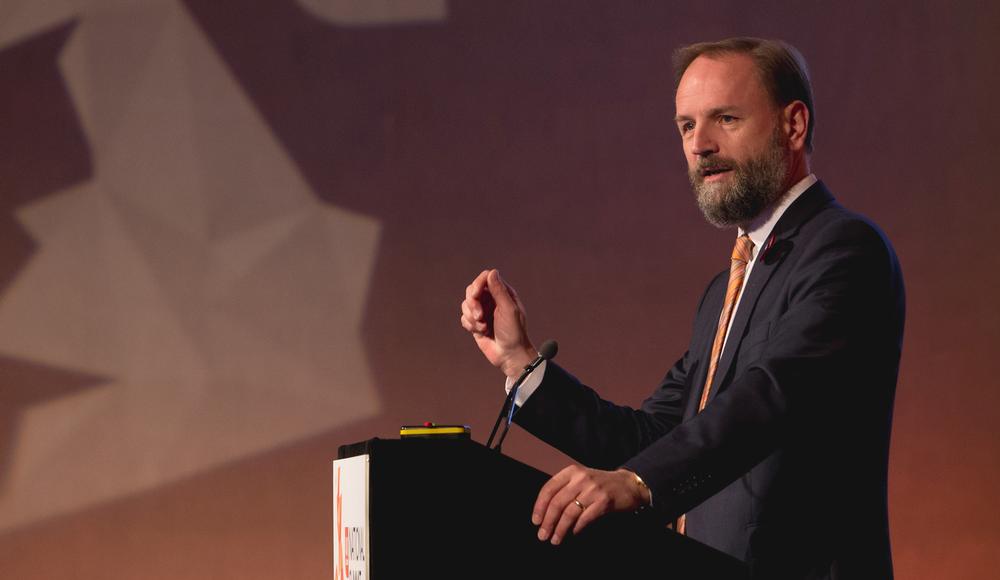
Simon Stevens addresses the activity sector at the recent ukactive Summit / Photograph: SHUTTERSTOCK.COM
Late last year, at the ukactive National Summit in London, Simon Stevens – chief executive of NHS England – stood before leaders of the physical activity sector and began shaking a bottle of pills at them.
This unexpected gesture marked a seminal moment for the physical activity sector. The man responsible for a yearly budget of £120bn was throwing down the gauntlet to our sector.
He noted that the pharmaceutical industry dreams of discovering “a treatment that could cut 3 per cent of strokes, prevent 30 per cent of dementia, 30 per cent of osteoporosis, radically reduce breast cancer and bowel cancer, not to mention prevent depression, reduce stress, eliminate type 2 diabetes and cut the falls that our parents’ generation experience each year.”
He continued: “If you could pack all of that into a magic pill, it would be a worldwide pharmaceutical blockbuster. But the label on the side of this treatment says ‘activity and exercise’.”
The message was clear: the NHS knows the power of your product – now show us how we can use it to its greatest effect.
Stevens’ message – that physical activity is a miracle cure which represents the best chance of saving the NHS from bankruptcy – was nothing new to any of us in the room. What was significant was that he and the rest of the health service are now prepared to listen.
Best practice Two weeks after this speech, ukactive teamed up with the National Centre for Sport and Exercise Medicine (NCSEM) and Public Health England (PHE) to launch Promising Practice 2. This project aims to significantly improve the standard of physical activity programmes in this country. It will identify the most successful schemes so they can be scaled up to have national impact and lighten the load on the NHS. It will also determine best practice.
We know from the inaugural Promising Practice research in 2014, which looked at 952 activity programmes, that there are gaps in routine data collection, evaluation and research around such schemes. Through the Promising Practice 2 report – due in February – we can raise standards and build on the growing case for the wider commissioning of activity programmes.
The report will offer practical guidance on how this sector can consolidate good practice and build an evidence base. It’s essential that we’re able to demonstrate our impact and the return on investment of our services in the same way that other public health services can.
By highlighting effective physical activity initiatives that, if scaled up, could contribute to making ‘everyone active every day’ – PHE’s mission, as well as our own – we can uncover exercise solutions that deliver the associated health, economic and social improvements for communities.
Challenge accepted Concluding his speech, Stevens reiterated his challenge to our sector. “Experts at the Academy of Royal Medical Colleges estimated that more than £18bn of headroom in the NHS national budget could be created if we actually made serious improvements in physical activity across this country,” he said.
“My plea to those of you working in the leisure sector, in gyms or local councils, is to proactively seek out your local hospital, community trust or ambulance service and begin this dialogue with them about how you can help advance this agenda.”
The opportunity is there. Now the onus is on our sector to seize it.
Active Blackpool is deploying Cornerstone Connect, a new digital interface allowing
disparate information from multiple systems to be aggregated into one dataset, to support
its focus on reducing health inequalities and improving healthy life expectancy. [more...]
As healthcare continues to shift towards prevention, there’s a growing focus on helping
people stay active, independent and feeling good for longer. [more...]
+ More featured suppliers
COMPANY PROFILES
PSLT Ltd
PSLT Fitness Solutions manufacture, remanufacture and buy back commercial gym equipment. [more...]
Simon Stevens, NHS England CEO, recently challenged the fitness industry to get involved in the prevention of lifestyle diseases. ukactive’s Steven Ward reports
Simon Stevens addresses the activity sector at the recent ukactive Summit / Photograph: SHUTTERSTOCK.COM
Late last year, at the ukactive National Summit in London, Simon Stevens – chief executive of NHS England – stood before leaders of the physical activity sector and began shaking a bottle of pills at them.
This unexpected gesture marked a seminal moment for the physical activity sector. The man responsible for a yearly budget of £120bn was throwing down the gauntlet to our sector.
He noted that the pharmaceutical industry dreams of discovering “a treatment that could cut 3 per cent of strokes, prevent 30 per cent of dementia, 30 per cent of osteoporosis, radically reduce breast cancer and bowel cancer, not to mention prevent depression, reduce stress, eliminate type 2 diabetes and cut the falls that our parents’ generation experience each year.”
He continued: “If you could pack all of that into a magic pill, it would be a worldwide pharmaceutical blockbuster. But the label on the side of this treatment says ‘activity and exercise’.”
The message was clear: the NHS knows the power of your product – now show us how we can use it to its greatest effect.
Stevens’ message – that physical activity is a miracle cure which represents the best chance of saving the NHS from bankruptcy – was nothing new to any of us in the room. What was significant was that he and the rest of the health service are now prepared to listen.
Best practice Two weeks after this speech, ukactive teamed up with the National Centre for Sport and Exercise Medicine (NCSEM) and Public Health England (PHE) to launch Promising Practice 2. This project aims to significantly improve the standard of physical activity programmes in this country. It will identify the most successful schemes so they can be scaled up to have national impact and lighten the load on the NHS. It will also determine best practice.
We know from the inaugural Promising Practice research in 2014, which looked at 952 activity programmes, that there are gaps in routine data collection, evaluation and research around such schemes. Through the Promising Practice 2 report – due in February – we can raise standards and build on the growing case for the wider commissioning of activity programmes.
The report will offer practical guidance on how this sector can consolidate good practice and build an evidence base. It’s essential that we’re able to demonstrate our impact and the return on investment of our services in the same way that other public health services can.
By highlighting effective physical activity initiatives that, if scaled up, could contribute to making ‘everyone active every day’ – PHE’s mission, as well as our own – we can uncover exercise solutions that deliver the associated health, economic and social improvements for communities.
Challenge accepted Concluding his speech, Stevens reiterated his challenge to our sector. “Experts at the Academy of Royal Medical Colleges estimated that more than £18bn of headroom in the NHS national budget could be created if we actually made serious improvements in physical activity across this country,” he said.
“My plea to those of you working in the leisure sector, in gyms or local councils, is to proactively seek out your local hospital, community trust or ambulance service and begin this dialogue with them about how you can help advance this agenda.”
The opportunity is there. Now the onus is on our sector to seize it.
Global luxury hospitality brand, Six Senses, has partnered with longevity healthcare provider,
HUM2N, to launch a clinic at Six Senses London, at The Whiteley.
Premium London health club, KX Chelsea, will imminently unveil its most significant
redevelopment since its launch in 2002 to create an integrated wellness model combining
training, recovery and relaxation.
Researchers in the US have identified an antibody which could greatly reduce the loss of lean
muscle mass in people who are taking weight-loss medications.
Crunch Fitness has announced the launch of Crunch Reform Pilates – its own reformer concept
designed to bring this fast growing, but rather expensive, modality into the mainstream.
The 20th State of the Industry Report reveals a resilient, expanding and competitive
sector, the
importance of differentiation and the ongoing challenge of tackling inequalities.
Active Blackpool is deploying Cornerstone Connect, a new digital interface allowing
disparate information from multiple systems to be aggregated into one dataset, to support
its focus on reducing health inequalities and improving healthy life expectancy. [more...]
As healthcare continues to shift towards prevention, there’s a growing focus on helping
people stay active, independent and feeling good for longer. [more...]
+ More featured suppliers
COMPANY PROFILES
PSLT Ltd PSLT Fitness Solutions manufacture, remanufacture and buy back commercial gym equipment. [more...]