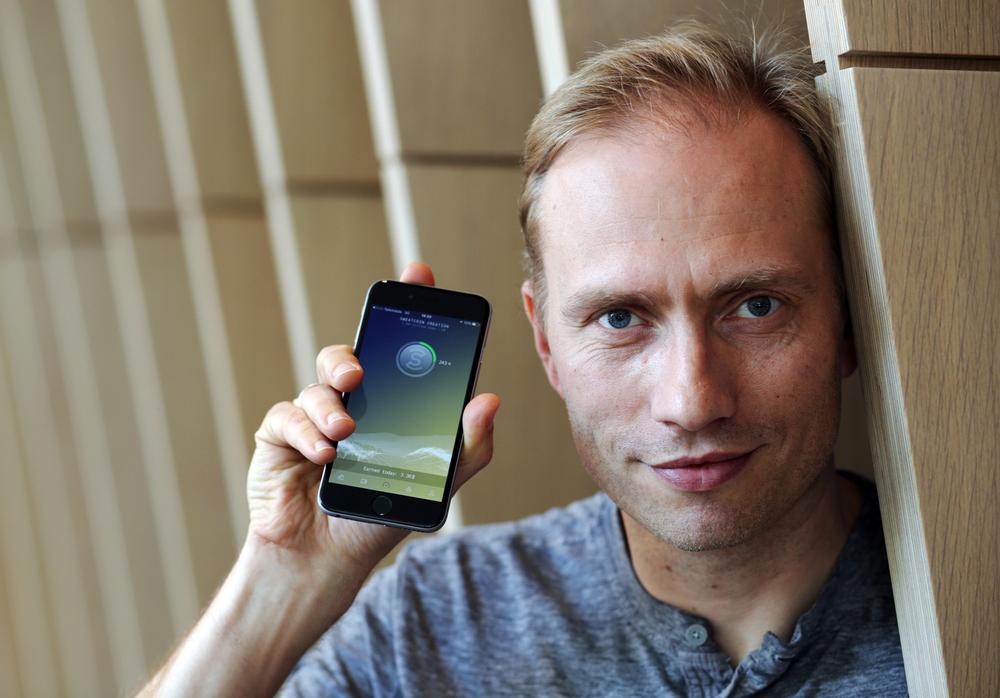
Co-founder Oleg Fomenko
with the Sweatcoin app / PHOTO: REUTERS/Paul Hackett
What is Sweatcoin? Sweatcoin is a free iPhone app, available in the UK, which went live on 5 May 2016. It securely records your outdoor movement and rewards your activity with Sweatcoins – a digital currency – so you’re getting paid to be physically active. The idea is to get people past that initial sense of inertia and give them a reason to be active right now.
How does it work? Every 1,000 steps gives you one Sweatcoin, which can be collected and traded in for rewards – from vouchers for Wonderush or fitness classes at BOOMCycle, to products such as Kymira infra-red clothing and Vivobarefoot running shoes. For example, 45 Sweatcoins – equivalent to 45,000 steps – gets you a free yoga lesson, 200 Sweatcoins gets you a fitness tracker from Fitbug, and 300 gets you 80 per cent off a pair of Vivobarefoot shoes.
We’re also creating a peer-to-peer marketplace where anyone can make an offer of a product and service in exchange for Sweatcoins – i.e. for other people’s movement. Parents can also peg kids’ pocket money to their physical activity levels, so it becomes a whole family affair.
How can you be sure it’s accurate? We’ve used complex software to measure movement and location to prevent cheating, and we tracked 1.5 billion steps to refine our platform and proprietary algorithms.
The digital currency can’t be generated by shaking your iPhone or placing it on top of a washing machine, and we cross-check data on activity and location to verify steps.
What has uptake been like? More than 20,000 people have already installed the app, with more than 10,000 using it daily. We’re now in conversations with a number of businesses to organise corporate wellness trials, where employees can earn benefits and perks like extra days off, subsidised healthy meals or massages.
We’ve also spoken to all the major health insurers, but the first step is to prove Sweatcoin can attract users. In the long run, we’d hope that unique products or lower health insurance premiums could be offered in exchange for verified physical activity in the shape of Sweatcoins.
For now, we aim to encourage Londoners to be active. So far we’re seeing three daily visits per person, with over 70 per cent still active at the end of the first month.
Any plans to further evolve the product? Work has accelerated since we’ve gone live. We’ll continue to improve our movement verification algorithms, and we’re also working on the Android version of the app.
What are your long-term aspirations for Sweatcoin? By making Sweatcoin truly valuable – accepted by many companies for their goods and services, with an exchange rate linked to Sterling – we want to help people realise the value of movement, and become fitter and happier.
It would make a lot of sense for the NHS to start buying Sweatcoins from the public to encourage people to be more active, reducing the cost of inactivity to the NHS.
Panatta brought together four of the most influential figures in bodybuilding history on the
stage of RiminiWellness 2026: Phil Heath, Lee Haney, Ronnie Coleman and Hany Rambod. [more...]
Active Blackpool is deploying Cornerstone Connect, a new digital interface allowing
disparate information from multiple systems to be aggregated into one dataset, to support
its focus on reducing health inequalities and improving healthy life expectancy. [more...]
Co-founder Oleg Fomenko
with the Sweatcoin app / PHOTO: REUTERS/Paul Hackett
What is Sweatcoin? Sweatcoin is a free iPhone app, available in the UK, which went live on 5 May 2016. It securely records your outdoor movement and rewards your activity with Sweatcoins – a digital currency – so you’re getting paid to be physically active. The idea is to get people past that initial sense of inertia and give them a reason to be active right now.
How does it work? Every 1,000 steps gives you one Sweatcoin, which can be collected and traded in for rewards – from vouchers for Wonderush or fitness classes at BOOMCycle, to products such as Kymira infra-red clothing and Vivobarefoot running shoes. For example, 45 Sweatcoins – equivalent to 45,000 steps – gets you a free yoga lesson, 200 Sweatcoins gets you a fitness tracker from Fitbug, and 300 gets you 80 per cent off a pair of Vivobarefoot shoes.
We’re also creating a peer-to-peer marketplace where anyone can make an offer of a product and service in exchange for Sweatcoins – i.e. for other people’s movement. Parents can also peg kids’ pocket money to their physical activity levels, so it becomes a whole family affair.
How can you be sure it’s accurate? We’ve used complex software to measure movement and location to prevent cheating, and we tracked 1.5 billion steps to refine our platform and proprietary algorithms.
The digital currency can’t be generated by shaking your iPhone or placing it on top of a washing machine, and we cross-check data on activity and location to verify steps.
What has uptake been like? More than 20,000 people have already installed the app, with more than 10,000 using it daily. We’re now in conversations with a number of businesses to organise corporate wellness trials, where employees can earn benefits and perks like extra days off, subsidised healthy meals or massages.
We’ve also spoken to all the major health insurers, but the first step is to prove Sweatcoin can attract users. In the long run, we’d hope that unique products or lower health insurance premiums could be offered in exchange for verified physical activity in the shape of Sweatcoins.
For now, we aim to encourage Londoners to be active. So far we’re seeing three daily visits per person, with over 70 per cent still active at the end of the first month.
Any plans to further evolve the product? Work has accelerated since we’ve gone live. We’ll continue to improve our movement verification algorithms, and we’re also working on the Android version of the app.
What are your long-term aspirations for Sweatcoin? By making Sweatcoin truly valuable – accepted by many companies for their goods and services, with an exchange rate linked to Sterling – we want to help people realise the value of movement, and become fitter and happier.
It would make a lot of sense for the NHS to start buying Sweatcoins from the public to encourage people to be more active, reducing the cost of inactivity to the NHS.
The UK's four Chief Medical Officers have published a refreshed edition of Physical activity
guidelines: UK Chief Medical Officers' report, updating the evidence that underpins the nation's
physical activity recommendations and placing greater emphasis on strength, balance, reducing
sedentary behaviour and, for the first time, supporting people taking weight loss medications.
Places Leisure has exchanged contracts to build and operate a flagship £60m water and leisure
destination on behalf of Basingstoke and Deane Borough Council.
The Republic of Ireland will become the latest market in PureGym’s expanding international
portfolio, with the first launch planned for Dublin in 2027.
Anytime Fitness opened more than one club a day in 2025 and is on track to maintain this rate
of growth this year, as parent company Purpose Brands targets further international expansion.
The £33.9 million Leighton Leisure and Community Centre has opened in Leighton Buzzard, UK,
creating a next-generation public leisure, health and wellbeing hub for the local community.
Walnuts Leisure Centre in Orpington, in the London Borough of Bromley, has reopened following
a £17m transformation designed to secure the long-term future of the public leisure asset and
reposition it as a community wellbeing hub.
The Gym Group, has announced that it's sustained positive trading momentum has continued
through the first half of 2026 and the company remains confident about the outlook.
Panatta brought together four of the most influential figures in bodybuilding history on the
stage of RiminiWellness 2026: Phil Heath, Lee Haney, Ronnie Coleman and Hany Rambod. [more...]
Active Blackpool is deploying Cornerstone Connect, a new digital interface allowing
disparate information from multiple systems to be aggregated into one dataset, to support
its focus on reducing health inequalities and improving healthy life expectancy. [more...]