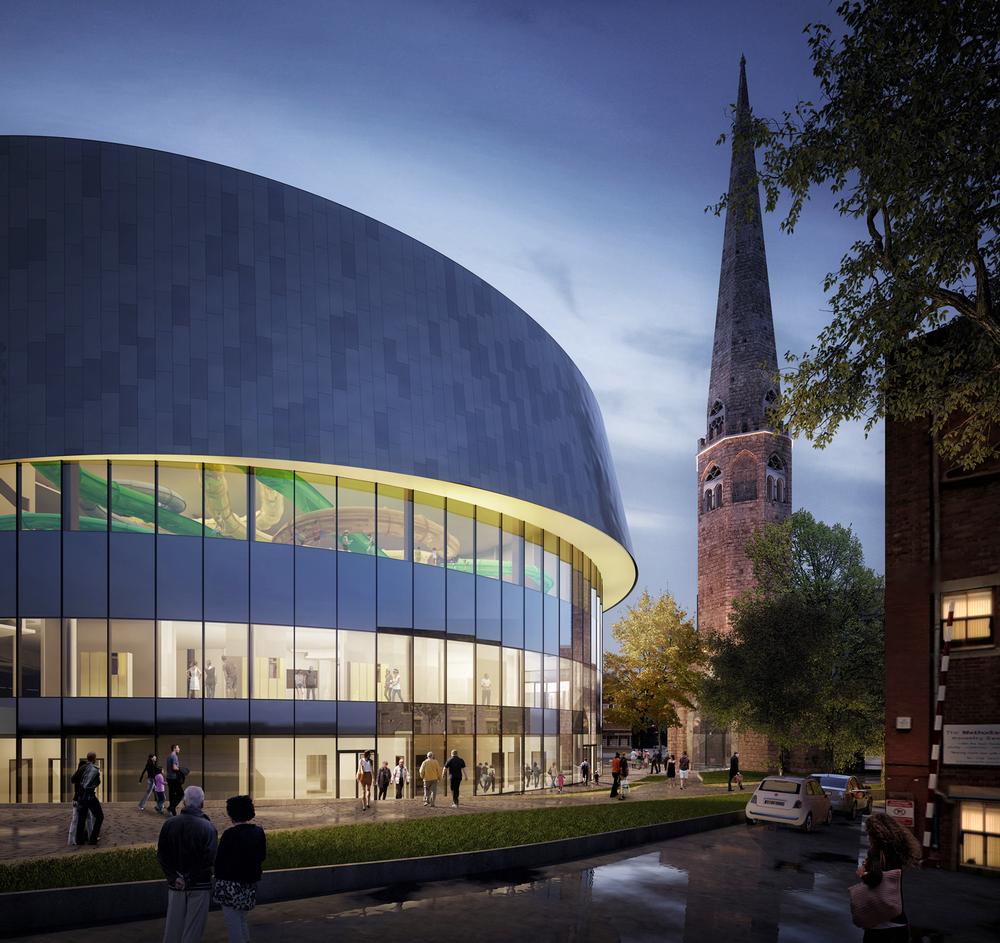
FaulknerBrowns recently submitted plans for an exciting new, high octane waterpark for the city of Coventry. During the process, I couldn’t help but reflect on the parallels between this bold move by the local council and the debate surrounding the remit of the BBC as a public broadcaster in contrast to competing providers in the private sector.
Of the few waterparks built in the UK in the last few years almost all have been investments by the private sector, with holiday destinations such as Center Parcs dominating the landscape. This has raised the question of why a publicly funded local authority would invest in a city centre waterpark and – like the BBC – how will it be able to demonstrate value for money.
Public Benefits Firstly, it’s important to consider the wider regeneration benefits that a destination leisure facility can bring to a city centre. We know that through increased footfall and inspirational placemaking, similar schemes have acted as catalysts for private sector investment, bringing a welcome boost to the economy.
For the last 20 years, much sporting policy and funding in aquatics facilities has been driven by lane swimming, but the reality is that participation covers a wide spectrum of activity, ranging from supervised play through to developing water confidence, swimming for recreation and fitness and competition swimming. The ideal aquatics centre would contain facilities to provide for all these activities.
As well as the characteristic flume rides, the Coventry waterpark proposals contain toddler areas, leisure water to a range of depths and also lane swimming.
From both a social perspective and – in particular – a health standpoint, it’s interesting to examine the concept behind this new waterpark through the viewpoint of changing government policy, because the Sporting Futures strategy places much greater emphasis on a wider, more holistic health and leisure offer which is in tune with this type of facility development.
Health Benefits There’s also a strong argument to suggest that significant ‘incidental’ (non-swimming related) health benefits arise from the leisure water experience, both in terms of the physical movement up and down the levels of the facility and also from the associated feel-good factor.
In our Coventry proposal this vertical movement up through the building is exaggerated by the tight city centre site, which has led us to stack the facilities on top of each other: the main pools and the ride hall are stacked three stories above the 25m pool, the wet changing and the spa, with access provided by a generous spiral ramp up through the building.
Strong Public Sector Role Like the BBC, there is a strong role that the public sector can play, alongside the private sector, in providing high quality entertainment. In this case the added public value is provided through strong health and wellbeing benefits, in much the same way the BBC focuses on providing an educational offer.
In the post-Olympic landscape, schemes to promote health and wellbeing need to be conceived and delivered through innovative delivery mechanisms. As in the case of the BBC, change is needed, but the public sector is capable of championing innovative thinking.
See more on sport in Coventry on page 34
Read about the ASA’s initiative to prove the health benefits of swimming on page 8
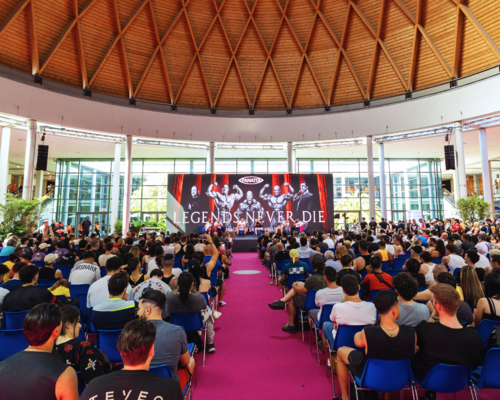
Panatta brought together four of the most influential figures in bodybuilding history on the
stage of RiminiWellness 2026: Phil Heath, Lee Haney, Ronnie Coleman and Hany Rambod. [more...]
FaulknerBrowns recently submitted plans for an exciting new, high octane waterpark for the city of Coventry. During the process, I couldn’t help but reflect on the parallels between this bold move by the local council and the debate surrounding the remit of the BBC as a public broadcaster in contrast to competing providers in the private sector.
Of the few waterparks built in the UK in the last few years almost all have been investments by the private sector, with holiday destinations such as Center Parcs dominating the landscape. This has raised the question of why a publicly funded local authority would invest in a city centre waterpark and – like the BBC – how will it be able to demonstrate value for money.
Public Benefits Firstly, it’s important to consider the wider regeneration benefits that a destination leisure facility can bring to a city centre. We know that through increased footfall and inspirational placemaking, similar schemes have acted as catalysts for private sector investment, bringing a welcome boost to the economy.
For the last 20 years, much sporting policy and funding in aquatics facilities has been driven by lane swimming, but the reality is that participation covers a wide spectrum of activity, ranging from supervised play through to developing water confidence, swimming for recreation and fitness and competition swimming. The ideal aquatics centre would contain facilities to provide for all these activities.
As well as the characteristic flume rides, the Coventry waterpark proposals contain toddler areas, leisure water to a range of depths and also lane swimming.
From both a social perspective and – in particular – a health standpoint, it’s interesting to examine the concept behind this new waterpark through the viewpoint of changing government policy, because the Sporting Futures strategy places much greater emphasis on a wider, more holistic health and leisure offer which is in tune with this type of facility development.
Health Benefits There’s also a strong argument to suggest that significant ‘incidental’ (non-swimming related) health benefits arise from the leisure water experience, both in terms of the physical movement up and down the levels of the facility and also from the associated feel-good factor.
In our Coventry proposal this vertical movement up through the building is exaggerated by the tight city centre site, which has led us to stack the facilities on top of each other: the main pools and the ride hall are stacked three stories above the 25m pool, the wet changing and the spa, with access provided by a generous spiral ramp up through the building.
Strong Public Sector Role Like the BBC, there is a strong role that the public sector can play, alongside the private sector, in providing high quality entertainment. In this case the added public value is provided through strong health and wellbeing benefits, in much the same way the BBC focuses on providing an educational offer.
In the post-Olympic landscape, schemes to promote health and wellbeing need to be conceived and delivered through innovative delivery mechanisms. As in the case of the BBC, change is needed, but the public sector is capable of championing innovative thinking.
See more on sport in Coventry on page 34
Read about the ASA’s initiative to prove the health benefits of swimming on page 8
In response to customer demand, Gymnation has unveiled a muscle thobe and ghutra range
for Saudi men that celebrates Saudi culture as well as the region’s growing interest in fitness.
Italian Exhibition Group – the organiser behind industry events Dubai Active and Dubai Muscle
Show – has been appointed to deliver the Health and Wellness Expo and Fire and Safety Expo at
the 16th World Firefighters Games.
It’s been five years since the fitness industry reopened after the last lockdown – long enough
to look back on the impact the pandemic had on the sector and what might come next.
Wattbike has announced a new integration with EGYM, which enables the bikes to contribute to
the Cardio BioAge score of individuals via a VO2 max result.
Les Mills has launched a reformer Pilates workout. The 45-minute workout blends traditional
reformer movements and more contemporary exercises, choreographed to music.
According to research which tracked more than 147,000 people for 30 years, 90-120 minutes
of strength training a week may deliver some of the biggest long-term health rewards.
The UK's four Chief Medical Officers have published a refreshed edition of Physical activity
guidelines: UK Chief Medical Officers' report, updating the evidence that underpins the nation's
physical activity recommendations and placing greater emphasis on strength, balance, reducing
sedentary behaviour and, for the first time, supporting people taking weight loss medications.
Places Leisure has exchanged contracts to build and operate a flagship £60m water and leisure
destination on behalf of Basingstoke and Deane Borough Council.
Panatta brought together four of the most influential figures in bodybuilding history on the
stage of RiminiWellness 2026: Phil Heath, Lee Haney, Ronnie Coleman and Hany Rambod. [more...]