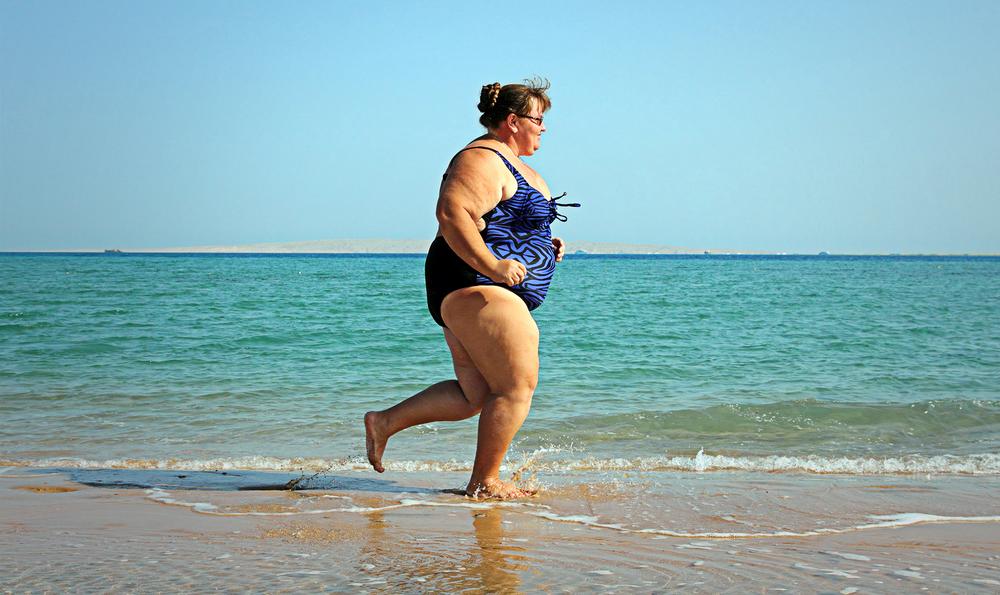
Obese people believed an object 25m away was actually 30m away / shutterstock
Scientists have shed new light on the challenges facing exercise professionals in getting the population moving, after new research has found that obesity causes people to see distances as farther and hills steeper than they actually are.
The findings of the study – which was published in the journal Acta Psychologica* in March 2016 – paint the picture of a vicious circle, whereby various types of exercise are perceived to be more challenging as a person’s weight increases.
Points of view For the study, three researchers – two from Colorado State University and one from Purdue University, US – carried out tests on 66 random volunteers.
In one experiment, the people were asked to judge the distance of a cone that was located 25m away. The researchers found that a 21-stone person saw the distance as 30m, while a 9-stone person saw that same distance as 15m.
In another test, people were asked how steep they thought a nearby hill was. The heavier people thought the incline was greater than their slimmer counterparts – which may be one explanation as to why heavier people are often more likely to take a lift rather than the stairs.
“You’re not seeing the world as it is – you’re seeing the world in terms of your ability to act,” says Dr Jessica Witt, a psychologist at Colorado State University who presented the findings at the American Association for the Advancement of Science in February.
Perceptual bias “We think these perceptual biases can create a vicious circle for people with obesity. It is conscious perception of the world,” adds Witt. “But it’s not based on conscious perception of the body or feelings of laziness.”
The phenomenon is thought to stem from a survival mechanism in early humans, designed to quickly evaluate our ability to tackle testing situations. However, the reflex appears to be counter-productive in persuading overweight people to be more active.
The researchers suggest setting easier targets for obese people who are starting out on exercise regimes, to avoid early discouragement. Using telescopic glasses to change distance perceptions was also mooted.
*Witt, J et al. Perceived distance and obesity: It’s what you weigh, not what you think. Acta Psychologica. Volume 165. March 2016
Panatta brought together four of the most influential figures in bodybuilding history on the
stage of RiminiWellness 2026: Phil Heath, Lee Haney, Ronnie Coleman and Hany Rambod. [more...]
Active Blackpool is deploying Cornerstone Connect, a new digital interface allowing
disparate information from multiple systems to be aggregated into one dataset, to support
its focus on reducing health inequalities and improving healthy life expectancy. [more...]
Obese people believed an object 25m away was actually 30m away / shutterstock
Scientists have shed new light on the challenges facing exercise professionals in getting the population moving, after new research has found that obesity causes people to see distances as farther and hills steeper than they actually are.
The findings of the study – which was published in the journal Acta Psychologica* in March 2016 – paint the picture of a vicious circle, whereby various types of exercise are perceived to be more challenging as a person’s weight increases.
Points of view For the study, three researchers – two from Colorado State University and one from Purdue University, US – carried out tests on 66 random volunteers.
In one experiment, the people were asked to judge the distance of a cone that was located 25m away. The researchers found that a 21-stone person saw the distance as 30m, while a 9-stone person saw that same distance as 15m.
In another test, people were asked how steep they thought a nearby hill was. The heavier people thought the incline was greater than their slimmer counterparts – which may be one explanation as to why heavier people are often more likely to take a lift rather than the stairs.
“You’re not seeing the world as it is – you’re seeing the world in terms of your ability to act,” says Dr Jessica Witt, a psychologist at Colorado State University who presented the findings at the American Association for the Advancement of Science in February.
Perceptual bias “We think these perceptual biases can create a vicious circle for people with obesity. It is conscious perception of the world,” adds Witt. “But it’s not based on conscious perception of the body or feelings of laziness.”
The phenomenon is thought to stem from a survival mechanism in early humans, designed to quickly evaluate our ability to tackle testing situations. However, the reflex appears to be counter-productive in persuading overweight people to be more active.
The researchers suggest setting easier targets for obese people who are starting out on exercise regimes, to avoid early discouragement. Using telescopic glasses to change distance perceptions was also mooted.
*Witt, J et al. Perceived distance and obesity: It’s what you weigh, not what you think. Acta Psychologica. Volume 165. March 2016
The UK's four Chief Medical Officers have published a refreshed edition of Physical activity
guidelines: UK Chief Medical Officers' report, updating the evidence that underpins the nation's
physical activity recommendations and placing greater emphasis on strength, balance, reducing
sedentary behaviour and, for the first time, supporting people taking weight loss medications.
Places Leisure has exchanged contracts to build and operate a flagship £60m water and leisure
destination on behalf of Basingstoke and Deane Borough Council.
The Republic of Ireland will become the latest market in PureGym’s expanding international
portfolio, with the first launch planned for Dublin in 2027.
Anytime Fitness opened more than one club a day in 2025 and is on track to maintain this rate
of growth this year, as parent company Purpose Brands targets further international expansion.
The £33.9 million Leighton Leisure and Community Centre has opened in Leighton Buzzard, UK,
creating a next-generation public leisure, health and wellbeing hub for the local community.
Walnuts Leisure Centre in Orpington, in the London Borough of Bromley, has reopened following
a £17m transformation designed to secure the long-term future of the public leisure asset and
reposition it as a community wellbeing hub.
The Gym Group, has announced that it's sustained positive trading momentum has continued
through the first half of 2026 and the company remains confident about the outlook.
Luxury boutique Pilates and wellness studio, X-Club, officially launches a
4,000sq ft flagship at
Marylebone on 16 July Built around X-Club’s four pillars of wellness – mind,
movement,
nutrition and therapy – the facility features two group exercise studi
Panatta brought together four of the most influential figures in bodybuilding history on the
stage of RiminiWellness 2026: Phil Heath, Lee Haney, Ronnie Coleman and Hany Rambod. [more...]
Active Blackpool is deploying Cornerstone Connect, a new digital interface allowing
disparate information from multiple systems to be aggregated into one dataset, to support
its focus on reducing health inequalities and improving healthy life expectancy. [more...]