Each month a member makes at least one visit to their club, their likelihood of cancellation reduces by 20 per cent compared to members who don’t attend at all / Photo: shutterstock.com
There’s considerable variation in how frequently members use their clubs. A fine balance is required to avoid clubs feeling over-crowded, but at the same time ensure members attend often enough to feel they’re getting value for money.
We’ve previously reported that member attendance is linked to membership retention, with non-attendance in any given month increasing the risk of cancellation in the subsequent month. Using data from the updated TRP 10,000 study of membership retention, we’ll use visit frequency and retention data to examine the financial implications of member usage patterns with the aim of informing club strategy and policies on usage levels.
Frequency of use During the first 12 months of their membership, TRP 10,000 members used their clubs an average of 4.1 times each month. However, this is skewed somewhat by a small number of health club members who visit a lot, and a higher number of visits in the early months.
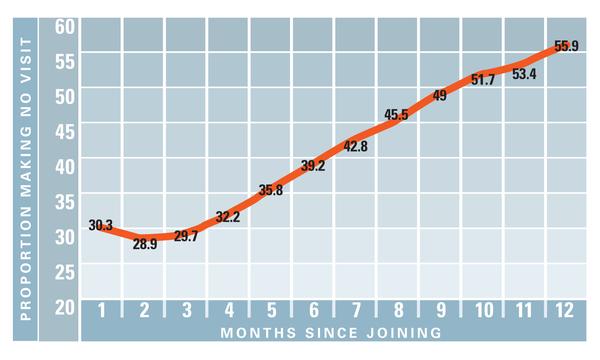
Figure 1 (left) shows the proportion of health club members reporting no visits at all in each month after joining: approximately 30 per cent of members fail to visit their club in each of the first three months of membership, increasing to more than half by month 12.
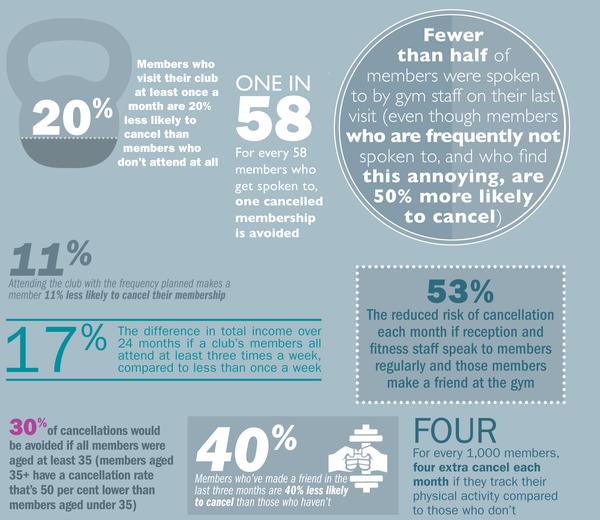
However, this is only important if we show that not visiting in a month increases the risk of cancellation – and our data shows that each month a member makes at least one visit to their club, their likelihood of cancellation reduces by 20 per cent compared to members who don’t attend at all.
For members in the first six months of membership, the benefit of attending is even higher: making at least one visit in a month reduces the risk of cancelling in the next month by 27 per cent.
This suggests that failing to attend the club for a month is more likely to lead to cancellation among newer, rather than the more established, members.
The bottom line A key question is, of course: do more visits translate into more income? One way to estimate the impact of retention on income is to model the retention of 1,000 members over the first 24 months of membership. Assuming all members pay a monthly fee of £50, we can then plot the income for each month by multiplying the £50 monthly fee by 1,000 (the original number of members) and then by the proportion of members who are still paying in any given month.
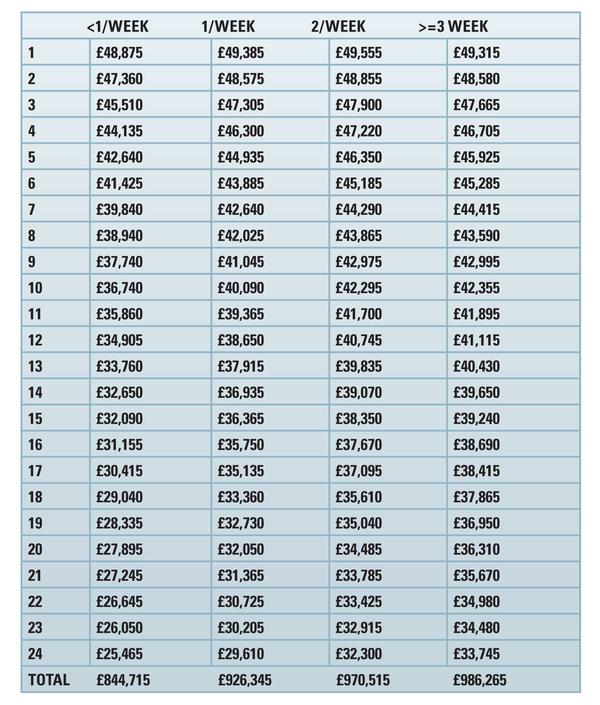
We can then layer visit frequency on top of this. Table 1 displays the income for each month after joining according to frequency of visit. Each column is a separate scenario, each based on 1,000 original members and assuming all retained members attend the same number of times a week. So in month one, the income from an original 1,000-member sample paying £50 a month and all attending less than once a week would be £48,875 [1,000 x 50 x 0.9775 – the latter being the retention rate in the TRP 10,000 study]. In month 18, the income from an original 1,000-member sample paying £50 a month and all attending twice a week would be £35,610 [1,000 x 50 x 0.7122].
Standardising the number of members in each group and the monthly fee paid means we can judge the impact of different attendance levels, and the accompanying retention rates, on total income without the results being skewed by differences in fee or the number of members.
Over 24 months, a difference in total income of 17 per cent is seen between a member base where all members attend less than once a week versus one where all members attend at least three times a week.
Monthly incomes are also higher in each month after joining for every increase in visit frequency: any increase in the average visit frequency of health club members results in increased income from membership dues with immediate effect.
Theory into practice In Table 2, rather than use a simulated sample of club members, we applied the method to the actual members who participated in TRP 10,000.
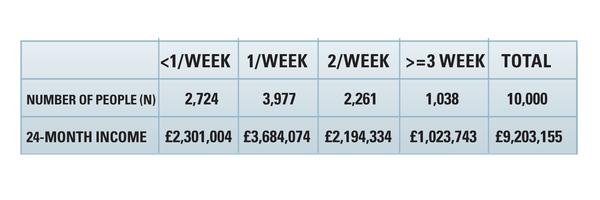
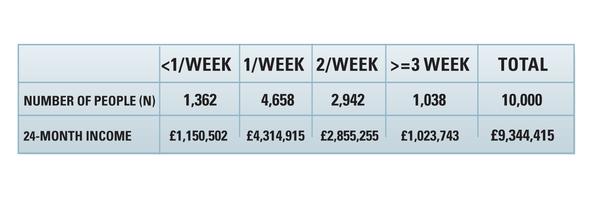
In our sample: 2,724 members attended their club less than once a week on average; 3,977 less than twice a week; 2,261 less than three times a week; and 1,038 at least three times a week.
Assuming they all paid £50 a month, Table 2 shows the 24-month income from each group based on attendance and retention rates observed for them. On this basis, an original 10,000 members paying £50 a month according to their visit frequency would yield just over £9m.
It’s important to note that the highest income comes from the members who visit once a week simply because they represent the largest group and have a higher retention rate than those members who attend less frequently – not because attending only once a week is the most effective attendance pattern.
Changing visit frequency We can repeat this exercise to estimate how a change in visit frequency would alter income over 24-months.
For the purposes of this article, Table 3 (see above left) displays revised incomes based on a 10 per cent upward change (the same 10,000 total, but a revised ‘N’ – the number of people in the group – for each of the groups); the new income numbers for each group are displayed in the second row of the table.
Over 24 months of membership, a 10 per cent increase in average attendances would lead to an increase in revenues of £43,343 from this cohort of 10,000 members.
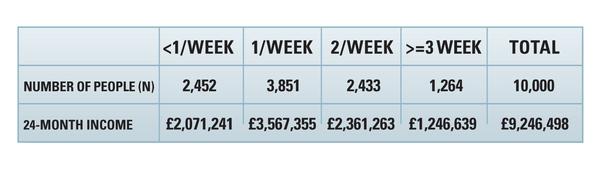
An alternative strategy would be to work harder simply to reduce the number of members attending less than once a week. Table 4 shows what would happen to incomes if the number of members in the lowest attending group were reduced by 50 per cent, with half of them moved to a once a week visit frequency and half moved to twice a week. The second strategy would yield an additional £141, 260 compared to the income displayed in Table 2.
It can be seen that using retention rates and fee rates in this way allows for any combination of events to be modelled for estimates of income.
Summary It’s clear that increasing the average visit frequency of members yields more income from membership dues because of higher retention rates. Although any uplift in average visit frequency will increase income, reducing the proportion of members who visit less than once a week – moving them to an average of once a week – yields more income than increasing the visit frequency of members already visiting regularly.
Also, targeting members in their first six months who fail to attend in a given month will have the greatest impact on reducing premature cancellations.
Ongoing tracking
The TRP 10,000 study initially surveyed 10,000 health and fitness members on their exercise habits and membership behaviour between July and September 2013.
In the next development of this project, this same group of health club members has now been followed for a further two years, tracking cancellation and survival rates up to the end of August 2015.
During the follow-up period, 45 per cent of participating members cancelled their membership. To date, TRP 10,000 club members have an average follow-up period (to their cancellation date or the end of August 2015, whichever comes first) of 20 months from the date that they completed the questionnaire, and 47 months from their original joining date.
Recommendations
• Understand the patterns of attendance and non-attendance, their impact on membership and how this applies to the clubs you run.
• Develop a customer experience strategy to reduce the proportion of members who visit less than once a week.
• Develop a strategy for targeting any members in their first six months of membership who fail to attend for a month – use a range of methods to effectively intervene.
• View all health club attendances as an opportunity for all employees to ‘sell’ another visit – that is, provide an experience that members wish to return for, signpost members to activities they may enjoy, discuss attendance with them, and ask members about their next visit.
FIGURE 1: THE NO-SHOWS The proportion of members reporting no clubs visits (by number of months after joining)
FIGURE 1
TABLE 1:
MORE VISITS = MORE REVENUE? Estimated income per month for 24 months after joining, for four different scenarios – 1,000 original members all attending: (a) less than once a week, (b) once a week, (c) twice a week, or (d) three or more times a week
TABLE 1
TABLE 2: THEORY INTO PRACTICE Estimated 24-month income from TRP 10,000 members based on retention rates for different attendance groups
TABLE 2:
TABLE 3: BOOSTING ATTENDANCE - SCENARIO 1 BOOSTING ATTENDANCE - SCENARIO 1 Estimated 24-month income from TRP 10,000 members based on retention rates for different attendence groups, if attendance in each group were increased by 10%
TABLE 3
TABLE 4: BOOSTING ATTENDANCE - SCENARIO 2 Estimated 24-month income from TRP 10,000 members based on retention rates for different attendance groups, if the number of members in the bottom group were reduced by 50% and these members equally redistributed between 1/week and 2/week
TABLE 4
About the author
Dr Melvyn Hillsdon
Dr Melvyn Hillsdon is associate professor of exercise and health at the University of Exeter, where he researches physical activity and population health. Since his landmark retention report in 2001 (Winning the Retention Battle), he has published numerous reports into the determinants of membership retention.
Member retention - facts & stats
facts & stats
Member retention - facts & stats
facts & stats
Clubs should view all member attendances as a chance to ‘sell’ another visit to those members / Photo: shutterstock.com
Clubs should be working harder to reduce the number of members attending less than once a week / Photo: shutterstock.com
Panatta brought together four of the most influential figures in bodybuilding history on the
stage of RiminiWellness 2026: Phil Heath, Lee Haney, Ronnie Coleman and Hany Rambod. [more...]
Each month a member makes at least one visit to their club, their likelihood of cancellation reduces by 20 per cent compared to members who don’t attend at all / Photo: shutterstock.com
There’s considerable variation in how frequently members use their clubs. A fine balance is required to avoid clubs feeling over-crowded, but at the same time ensure members attend often enough to feel they’re getting value for money.
We’ve previously reported that member attendance is linked to membership retention, with non-attendance in any given month increasing the risk of cancellation in the subsequent month. Using data from the updated TRP 10,000 study of membership retention, we’ll use visit frequency and retention data to examine the financial implications of member usage patterns with the aim of informing club strategy and policies on usage levels.
Frequency of use During the first 12 months of their membership, TRP 10,000 members used their clubs an average of 4.1 times each month. However, this is skewed somewhat by a small number of health club members who visit a lot, and a higher number of visits in the early months.
Figure 1 (left) shows the proportion of health club members reporting no visits at all in each month after joining: approximately 30 per cent of members fail to visit their club in each of the first three months of membership, increasing to more than half by month 12.
However, this is only important if we show that not visiting in a month increases the risk of cancellation – and our data shows that each month a member makes at least one visit to their club, their likelihood of cancellation reduces by 20 per cent compared to members who don’t attend at all.
For members in the first six months of membership, the benefit of attending is even higher: making at least one visit in a month reduces the risk of cancelling in the next month by 27 per cent.
This suggests that failing to attend the club for a month is more likely to lead to cancellation among newer, rather than the more established, members.
The bottom line A key question is, of course: do more visits translate into more income? One way to estimate the impact of retention on income is to model the retention of 1,000 members over the first 24 months of membership. Assuming all members pay a monthly fee of £50, we can then plot the income for each month by multiplying the £50 monthly fee by 1,000 (the original number of members) and then by the proportion of members who are still paying in any given month.
We can then layer visit frequency on top of this. Table 1 displays the income for each month after joining according to frequency of visit. Each column is a separate scenario, each based on 1,000 original members and assuming all retained members attend the same number of times a week. So in month one, the income from an original 1,000-member sample paying £50 a month and all attending less than once a week would be £48,875 [1,000 x 50 x 0.9775 – the latter being the retention rate in the TRP 10,000 study]. In month 18, the income from an original 1,000-member sample paying £50 a month and all attending twice a week would be £35,610 [1,000 x 50 x 0.7122].
Standardising the number of members in each group and the monthly fee paid means we can judge the impact of different attendance levels, and the accompanying retention rates, on total income without the results being skewed by differences in fee or the number of members.
Over 24 months, a difference in total income of 17 per cent is seen between a member base where all members attend less than once a week versus one where all members attend at least three times a week.
Monthly incomes are also higher in each month after joining for every increase in visit frequency: any increase in the average visit frequency of health club members results in increased income from membership dues with immediate effect.
Theory into practice In Table 2, rather than use a simulated sample of club members, we applied the method to the actual members who participated in TRP 10,000.
In our sample: 2,724 members attended their club less than once a week on average; 3,977 less than twice a week; 2,261 less than three times a week; and 1,038 at least three times a week.
Assuming they all paid £50 a month, Table 2 shows the 24-month income from each group based on attendance and retention rates observed for them. On this basis, an original 10,000 members paying £50 a month according to their visit frequency would yield just over £9m.
It’s important to note that the highest income comes from the members who visit once a week simply because they represent the largest group and have a higher retention rate than those members who attend less frequently – not because attending only once a week is the most effective attendance pattern.
Changing visit frequency We can repeat this exercise to estimate how a change in visit frequency would alter income over 24-months.
For the purposes of this article, Table 3 (see above left) displays revised incomes based on a 10 per cent upward change (the same 10,000 total, but a revised ‘N’ – the number of people in the group – for each of the groups); the new income numbers for each group are displayed in the second row of the table.
Over 24 months of membership, a 10 per cent increase in average attendances would lead to an increase in revenues of £43,343 from this cohort of 10,000 members.
An alternative strategy would be to work harder simply to reduce the number of members attending less than once a week. Table 4 shows what would happen to incomes if the number of members in the lowest attending group were reduced by 50 per cent, with half of them moved to a once a week visit frequency and half moved to twice a week. The second strategy would yield an additional £141, 260 compared to the income displayed in Table 2.
It can be seen that using retention rates and fee rates in this way allows for any combination of events to be modelled for estimates of income.
Summary It’s clear that increasing the average visit frequency of members yields more income from membership dues because of higher retention rates. Although any uplift in average visit frequency will increase income, reducing the proportion of members who visit less than once a week – moving them to an average of once a week – yields more income than increasing the visit frequency of members already visiting regularly.
Also, targeting members in their first six months who fail to attend in a given month will have the greatest impact on reducing premature cancellations.
Ongoing tracking
The TRP 10,000 study initially surveyed 10,000 health and fitness members on their exercise habits and membership behaviour between July and September 2013.
In the next development of this project, this same group of health club members has now been followed for a further two years, tracking cancellation and survival rates up to the end of August 2015.
During the follow-up period, 45 per cent of participating members cancelled their membership. To date, TRP 10,000 club members have an average follow-up period (to their cancellation date or the end of August 2015, whichever comes first) of 20 months from the date that they completed the questionnaire, and 47 months from their original joining date.
Recommendations
• Understand the patterns of attendance and non-attendance, their impact on membership and how this applies to the clubs you run.
• Develop a customer experience strategy to reduce the proportion of members who visit less than once a week.
• Develop a strategy for targeting any members in their first six months of membership who fail to attend for a month – use a range of methods to effectively intervene.
• View all health club attendances as an opportunity for all employees to ‘sell’ another visit – that is, provide an experience that members wish to return for, signpost members to activities they may enjoy, discuss attendance with them, and ask members about their next visit.
FIGURE 1: THE NO-SHOWS The proportion of members reporting no clubs visits (by number of months after joining)
FIGURE 1
TABLE 1:
MORE VISITS = MORE REVENUE? Estimated income per month for 24 months after joining, for four different scenarios – 1,000 original members all attending: (a) less than once a week, (b) once a week, (c) twice a week, or (d) three or more times a week
TABLE 1
TABLE 2: THEORY INTO PRACTICE Estimated 24-month income from TRP 10,000 members based on retention rates for different attendance groups
TABLE 2:
TABLE 3: BOOSTING ATTENDANCE - SCENARIO 1 BOOSTING ATTENDANCE - SCENARIO 1 Estimated 24-month income from TRP 10,000 members based on retention rates for different attendence groups, if attendance in each group were increased by 10%
TABLE 3
TABLE 4: BOOSTING ATTENDANCE - SCENARIO 2 Estimated 24-month income from TRP 10,000 members based on retention rates for different attendance groups, if the number of members in the bottom group were reduced by 50% and these members equally redistributed between 1/week and 2/week
TABLE 4
About the author
Dr Melvyn Hillsdon
Dr Melvyn Hillsdon is associate professor of exercise and health at the University of Exeter, where he researches physical activity and population health. Since his landmark retention report in 2001 (Winning the Retention Battle), he has published numerous reports into the determinants of membership retention.
Member retention - facts & stats
facts & stats
Member retention - facts & stats
facts & stats
Clubs should view all member attendances as a chance to ‘sell’ another visit to those members / Photo: shutterstock.com
Clubs should be working harder to reduce the number of members attending less than once a week / Photo: shutterstock.com
Italian Exhibition Group – the organiser behind industry events Dubai Active and Dubai Muscle
Show – has been appointed to deliver the Health and Wellness Expo and Fire and Safety Expo at
the 16th World Firefighters Games.
It’s been five years since the fitness industry reopened after the last lockdown – long enough
to look back on the impact the pandemic had on the sector and what might come next.
Wattbike has announced a new integration with EGYM, which enables the bikes to contribute to
the Cardio BioAge score of individuals via a VO2 max result.
Les Mills has launched a reformer Pilates workout. The 45-minute workout blends traditional
reformer movements and more contemporary exercises, choreographed to music.
According to research which tracked more than 147,000 people for 30 years, 90-120 minutes
of strength training a week may deliver some of the biggest long-term health rewards.
The UK's four Chief Medical Officers have published a refreshed edition of Physical activity
guidelines: UK Chief Medical Officers' report, updating the evidence that underpins the nation's
physical activity recommendations and placing greater emphasis on strength, balance, reducing
sedentary behaviour and, for the first time, supporting people taking weight loss medications.
Places Leisure has exchanged contracts to build and operate a flagship £60m water and leisure
destination on behalf of Basingstoke and Deane Borough Council.
The Republic of Ireland will become the latest market in PureGym’s expanding international
portfolio, with the first launch planned for Dublin in 2027.
Panatta brought together four of the most influential figures in bodybuilding history on the
stage of RiminiWellness 2026: Phil Heath, Lee Haney, Ronnie Coleman and Hany Rambod. [more...]