hen was the last time you, or someone you know well, joined a gym or health club? Can you remember what triggered the event: what made you (or your friend) decide to look around and start your search? What was the process you went through, and why did you make the decision you did?
Chances are, unless this was yesterday, you won’t be able to remember all the points along your path to purchase. Your recall will probably be of a structured, rational and step-wise process that led you to a balanced and well-researched decision. But the reality will have been a fragmented, unstructured process that was influenced in large part by the relatively emotional outpourings of friends and reviewers and how these – and your own observations – made you feel.
If it was a few years ago and you started with some kind of online search, whatever you remember is likely to also be completely out of date.
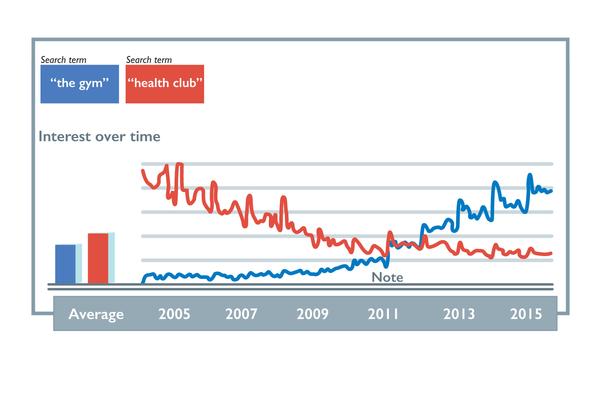
Even the way you started your search will have been different. A quick look at some publicly available Google analytics shows how particular search terms have become more or less popular over the years: for example, the numbers searching for ‘health clubs’ has declined markedly, while searches for ‘the gym’ have increased almost in inverse proportion (see Figure 1 – incidentally, those big spikes are in January of each year and the smaller ones in September).
Our changing vocabulary reflects the changing attitudes towards, and customers’ expectations of, gym and health club memberships.
This in turn affects the paths we take to arrive at the point of purchase – and this should, in turn, affect the online tags we deploy to get our gym’s search engine optimised.
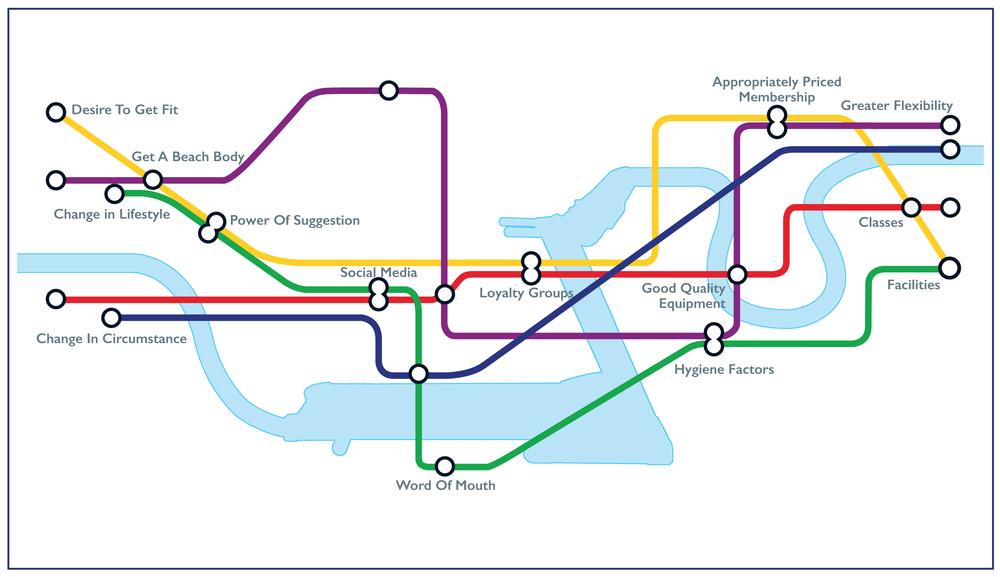
Systems 1 & 2 The details along the path to purchase change with the times, as different influencers become more or less prominent – price is obviously a key influencer at the moment, and gyms have had to work to give good reason to choose them. Even with this pressure, though, there are very successful gyms in the mid and upper end of the market. They are successful because of the way they make their members feel. While the path itself may change, by and large the same elements will trigger the search for a gym (or new gym). These will include dissatisfaction with the current provider, a desire to get fit or get a beach body, the post Christmas hang-over, somebody else suggesting it, a change in lifestyle, a life-changing event, and a change in circumstance.
Once the path has been embarked upon, we have good opportunity to influence decisions along the way. It’s important, though, that we’re prepared at each point where the potential member might be influenced, and that our preparedness focuses us on how members feel about us.
Here’s why it’s important to focus on feelings: we can create rational ‘path to purchase’ models that encompass key points like trigger – aware – evaluate – engage – select – experience, but we can’t expect buyers to act in this rational, structured way as they make choices.
Daniel Kahneman, in his landmark book Thinking, Fast and Slow describes how we operate in two systems – 1 and 2. We spend most of our lives in system 1, where our brains use less processing power by following heuristics (simple ‘rules’ – or assumptions – by which we live our lives) to make our decisions: that orange sign in Sainsbury’s means it’s a bargain, Volvo cars are the safest, Aldi is cheaper, and so on.
System 2 engages when our heuristics are challenged: if all cars are very safe, then we have to explore the other elements of each car before we can make a decision (fuel consumption, tax band, price, servicing costs, interior space, value, features etc). This takes time and energy and, for the most part of our daily lives, we actually don’t need to use system 2. Even if we are in system 2, if another suitable heuristic happens along, then system 1 starts to engage once more: OK, all cars are safe… BMWs are stylish. Or Hyundais are great value.
The engaging power of the heuristic is dependent on the type of person, so the price heuristic acts more strongly on online buyers, while the service heuristic acts more strongly on those who value personal service. If it weren’t for heuristics (and system 1), then marketing would have a much harder time of it.
How do you feel? Why is this important for gyms? Just like any other service, we need to keep members in system 1 for as much of the time as possible. Maya Angelou put it more succinctly: “I’ve learned that people will forget what you said, people will forget what you did, but people will never forget how you made them feel.”
And people tell others how you made them feel. That’s what drives reviews and word of mouth commentary. McKinsey tells us that 70 per cent of buying decisions are based on how the customer feels, but Forbes magazine showed how woefully inadequate most companies are in this area, when it recently reported a CEI survey which said 86 per cent of buyers will pay more for a better customer experience – but only 1 per cent feel companies consistently meet their expectations. This is system 1 stuff.
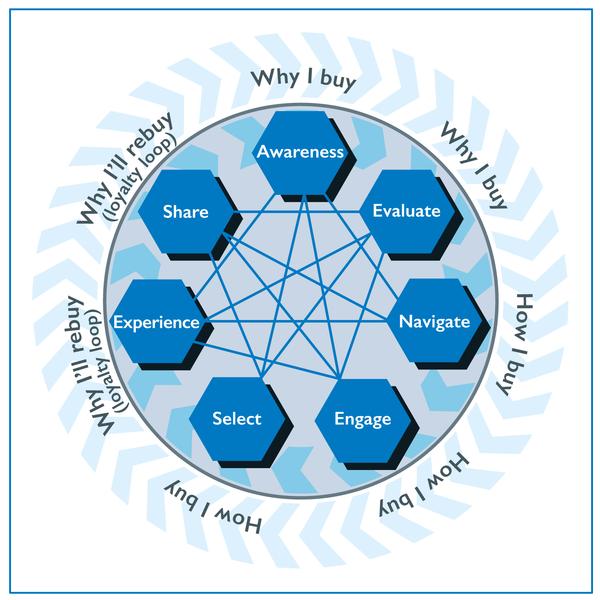
Figure 2 shows a typical path to purchase model. Of course, it’s not so much a straight path as a meandering, circular walkway. The model is really for our benefit, to give some sort of structure to our thinking: in reality, the buyer leaps from one point to another in a somewhat random fashion.
Why I buy These are the triggers. We can promote our gyms at the right times (January and September from the looks of the search data in Figure 1), talking about both the reasons for joining a gym and why it should be our gym in particular. We can also trigger this situation by failing to keep our members feeling happy with us (so activating system 2 for some reason).
It’s at this stage that the potential member is becoming aware of the need to think about gyms, and evaluating what it is they might want. They are contemplating the issue and may not go further. They become more proactive as they move to the next phase.
How I buy Here the member is getting active and exploring the options. Now we should promote ourselves on the differentiating factors we have: we don’t need to persuade them they need a gym, we must persuade them they need our gym.
Social media (TripAdvisor, review sites, Facebook, twitter, etc) is clearly a significant source of information these days. But many people seeking reviews don’t bother looking at the good ones. As they say, what’s the point in reading loads of people saying nice things? They seek out the more negative reviews to see what the issues are, whether they are consistent problems and what you as a business have done about them.
These are conversations, just like in the pub – except you have the opportunity to join in, engage and explain things and put them right. Your response – how you deal with an issue – is what matters. That’s what leaves the lasting feeling. And that’s what a lot of people reading the reviews are looking for: how will you make them feel? These days, it’s increasingly likely that members will join without ever visiting the gym in person: the website and social media are your shop windows and you need to ensure that, as well as covering the hygiene factors (good quality equipment, appropriately priced membership, classes, changing rooms, showers etc), you convey the right feeling about the place in what you say and how you respond.
The perceived need for greater flexibility is a good example of an opportunity for gyms to positively affect the way members feel. Many gyms have not responded well to this change. Chains could easily generate greater loyalty by offering group membership as standard: why should a member be restricted to only one location in a chain, and why should it cost more to use other locations? You don’t need separate loyalty cards for each Costa Coffee you call into.
Independent gyms should, equally, be forming into loyalty groups so the member knows they will find a similar atmosphere to their regular gym. The rise of the likes of payasUgym, ClassPass and MoveGB clearly demonstrates the attraction of flexible options (see p90).
Why I’ll rebuy The first purchase is only the start of the journey. This point is critical. We now have the opportunity to deliver experiences that can make the member feel not just affection but real love for us, so they will share their experiences with others and become an advocate. Word of mouth recommendation from friends is so much more powerful than advertising in generating sales, although advertising is needed to maintain salience.
A well-known airline client I had some years ago discovered that the way it dealt with issues for passengers had a stronger, longer lasting effect on loyalty than any amount of smooth, professional handling. I’d never advocate creating issues just so you can show your problem-handling skills, but problems that will inevitably arise should be seen as opportunities to show you care, and how you’re prepared to act. That’s in large part how my client became the world’s favourite airline.
Why not set yourself the goal of being the town’s/area’s/country’s favourite gym? It’s in these areas that lasting, valuable differentiation can be achieved. But to work, it has to be lived. One final quote for encouragement, this time from Emmet and Mark Murphy in Leading on the Edge of Chaos: “A 2 per cent increase in customer retention has the same effect as decreasing cost by 10 per cent.”
FIGURE 1 GOOGLE SEARCH TERMS
Figure 1
FIGURE 2 PATH TO PURCHASE
Figure 2
About the author
Tim Baker
Tim Baker is chair of Touchstone Partners, a leading research consultancy in the leisure, consumer and shopper sectors. Touchstone’s core expertise is in market exploration (to identify opportunities), pricing, brand equity and proposition development.
CoverMe, the global leader in fitness workforce management, today launches CoverMe PT, an
on-demand personal training platform that connects the right personal trainer to the right
client in under 10 seconds. [more...]
Panatta brought together four of the most influential figures in bodybuilding history on the
stage of RiminiWellness 2026: Phil Heath, Lee Haney, Ronnie Coleman and Hany Rambod. [more...]
+ More featured suppliers
COMPANY PROFILES
PSLT Ltd
PSLT Fitness Solutions manufacture, remanufacture and buy back commercial gym equipment. [more...]
hen was the last time you, or someone you know well, joined a gym or health club? Can you remember what triggered the event: what made you (or your friend) decide to look around and start your search? What was the process you went through, and why did you make the decision you did?
Chances are, unless this was yesterday, you won’t be able to remember all the points along your path to purchase. Your recall will probably be of a structured, rational and step-wise process that led you to a balanced and well-researched decision. But the reality will have been a fragmented, unstructured process that was influenced in large part by the relatively emotional outpourings of friends and reviewers and how these – and your own observations – made you feel.
If it was a few years ago and you started with some kind of online search, whatever you remember is likely to also be completely out of date.
Even the way you started your search will have been different. A quick look at some publicly available Google analytics shows how particular search terms have become more or less popular over the years: for example, the numbers searching for ‘health clubs’ has declined markedly, while searches for ‘the gym’ have increased almost in inverse proportion (see Figure 1 – incidentally, those big spikes are in January of each year and the smaller ones in September).
Our changing vocabulary reflects the changing attitudes towards, and customers’ expectations of, gym and health club memberships.
This in turn affects the paths we take to arrive at the point of purchase – and this should, in turn, affect the online tags we deploy to get our gym’s search engine optimised.
Systems 1 & 2 The details along the path to purchase change with the times, as different influencers become more or less prominent – price is obviously a key influencer at the moment, and gyms have had to work to give good reason to choose them. Even with this pressure, though, there are very successful gyms in the mid and upper end of the market. They are successful because of the way they make their members feel. While the path itself may change, by and large the same elements will trigger the search for a gym (or new gym). These will include dissatisfaction with the current provider, a desire to get fit or get a beach body, the post Christmas hang-over, somebody else suggesting it, a change in lifestyle, a life-changing event, and a change in circumstance.
Once the path has been embarked upon, we have good opportunity to influence decisions along the way. It’s important, though, that we’re prepared at each point where the potential member might be influenced, and that our preparedness focuses us on how members feel about us.
Here’s why it’s important to focus on feelings: we can create rational ‘path to purchase’ models that encompass key points like trigger – aware – evaluate – engage – select – experience, but we can’t expect buyers to act in this rational, structured way as they make choices.
Daniel Kahneman, in his landmark book Thinking, Fast and Slow describes how we operate in two systems – 1 and 2. We spend most of our lives in system 1, where our brains use less processing power by following heuristics (simple ‘rules’ – or assumptions – by which we live our lives) to make our decisions: that orange sign in Sainsbury’s means it’s a bargain, Volvo cars are the safest, Aldi is cheaper, and so on.
System 2 engages when our heuristics are challenged: if all cars are very safe, then we have to explore the other elements of each car before we can make a decision (fuel consumption, tax band, price, servicing costs, interior space, value, features etc). This takes time and energy and, for the most part of our daily lives, we actually don’t need to use system 2. Even if we are in system 2, if another suitable heuristic happens along, then system 1 starts to engage once more: OK, all cars are safe… BMWs are stylish. Or Hyundais are great value.
The engaging power of the heuristic is dependent on the type of person, so the price heuristic acts more strongly on online buyers, while the service heuristic acts more strongly on those who value personal service. If it weren’t for heuristics (and system 1), then marketing would have a much harder time of it.
How do you feel? Why is this important for gyms? Just like any other service, we need to keep members in system 1 for as much of the time as possible. Maya Angelou put it more succinctly: “I’ve learned that people will forget what you said, people will forget what you did, but people will never forget how you made them feel.”
And people tell others how you made them feel. That’s what drives reviews and word of mouth commentary. McKinsey tells us that 70 per cent of buying decisions are based on how the customer feels, but Forbes magazine showed how woefully inadequate most companies are in this area, when it recently reported a CEI survey which said 86 per cent of buyers will pay more for a better customer experience – but only 1 per cent feel companies consistently meet their expectations. This is system 1 stuff.
Figure 2 shows a typical path to purchase model. Of course, it’s not so much a straight path as a meandering, circular walkway. The model is really for our benefit, to give some sort of structure to our thinking: in reality, the buyer leaps from one point to another in a somewhat random fashion.
Why I buy These are the triggers. We can promote our gyms at the right times (January and September from the looks of the search data in Figure 1), talking about both the reasons for joining a gym and why it should be our gym in particular. We can also trigger this situation by failing to keep our members feeling happy with us (so activating system 2 for some reason).
It’s at this stage that the potential member is becoming aware of the need to think about gyms, and evaluating what it is they might want. They are contemplating the issue and may not go further. They become more proactive as they move to the next phase.
How I buy Here the member is getting active and exploring the options. Now we should promote ourselves on the differentiating factors we have: we don’t need to persuade them they need a gym, we must persuade them they need our gym.
Social media (TripAdvisor, review sites, Facebook, twitter, etc) is clearly a significant source of information these days. But many people seeking reviews don’t bother looking at the good ones. As they say, what’s the point in reading loads of people saying nice things? They seek out the more negative reviews to see what the issues are, whether they are consistent problems and what you as a business have done about them.
These are conversations, just like in the pub – except you have the opportunity to join in, engage and explain things and put them right. Your response – how you deal with an issue – is what matters. That’s what leaves the lasting feeling. And that’s what a lot of people reading the reviews are looking for: how will you make them feel? These days, it’s increasingly likely that members will join without ever visiting the gym in person: the website and social media are your shop windows and you need to ensure that, as well as covering the hygiene factors (good quality equipment, appropriately priced membership, classes, changing rooms, showers etc), you convey the right feeling about the place in what you say and how you respond.
The perceived need for greater flexibility is a good example of an opportunity for gyms to positively affect the way members feel. Many gyms have not responded well to this change. Chains could easily generate greater loyalty by offering group membership as standard: why should a member be restricted to only one location in a chain, and why should it cost more to use other locations? You don’t need separate loyalty cards for each Costa Coffee you call into.
Independent gyms should, equally, be forming into loyalty groups so the member knows they will find a similar atmosphere to their regular gym. The rise of the likes of payasUgym, ClassPass and MoveGB clearly demonstrates the attraction of flexible options (see p90).
Why I’ll rebuy The first purchase is only the start of the journey. This point is critical. We now have the opportunity to deliver experiences that can make the member feel not just affection but real love for us, so they will share their experiences with others and become an advocate. Word of mouth recommendation from friends is so much more powerful than advertising in generating sales, although advertising is needed to maintain salience.
A well-known airline client I had some years ago discovered that the way it dealt with issues for passengers had a stronger, longer lasting effect on loyalty than any amount of smooth, professional handling. I’d never advocate creating issues just so you can show your problem-handling skills, but problems that will inevitably arise should be seen as opportunities to show you care, and how you’re prepared to act. That’s in large part how my client became the world’s favourite airline.
Why not set yourself the goal of being the town’s/area’s/country’s favourite gym? It’s in these areas that lasting, valuable differentiation can be achieved. But to work, it has to be lived. One final quote for encouragement, this time from Emmet and Mark Murphy in Leading on the Edge of Chaos: “A 2 per cent increase in customer retention has the same effect as decreasing cost by 10 per cent.”
FIGURE 1 GOOGLE SEARCH TERMS
Figure 1
FIGURE 2 PATH TO PURCHASE
Figure 2
About the author
Tim Baker
Tim Baker is chair of Touchstone Partners, a leading research consultancy in the leisure, consumer and shopper sectors. Touchstone’s core expertise is in market exploration (to identify opportunities), pricing, brand equity and proposition development.
The UK's four Chief Medical Officers have published a refreshed edition of Physical activity
guidelines: UK Chief Medical Officers' report, updating the evidence that underpins the nation's
physical activity recommendations and placing greater emphasis on strength, balance, reducing
sedentary behaviour and, for the first time, supporting people taking weight loss medications.
Places Leisure has exchanged contracts to build and operate a flagship £60m water and leisure
destination on behalf of Basingstoke and Deane Borough Council.
The Republic of Ireland will become the latest market in PureGym’s expanding international
portfolio, with the first launch planned for Dublin in 2027.
Anytime Fitness opened more than one club a day in 2025 and is on track to maintain this rate
of growth this year, as parent company Purpose Brands targets further international expansion.
The £33.9 million Leighton Leisure and Community Centre has opened in Leighton Buzzard, UK,
creating a next-generation public leisure, health and wellbeing hub for the local community.
Walnuts Leisure Centre in Orpington, in the London Borough of Bromley, has reopened following
a £17m transformation designed to secure the long-term future of the public leisure asset and
reposition it as a community wellbeing hub.
The Gym Group, has announced that it's sustained positive trading momentum has continued
through the first half of 2026 and the company remains confident about the outlook.
Luxury boutique Pilates and wellness studio, X-Club, officially launches a
4,000sq ft flagship at
Marylebone on 16 July Built around X-Club’s four pillars of wellness – mind,
movement,
nutrition and therapy – the facility features two group exercise studi
CoverMe, the global leader in fitness workforce management, today launches CoverMe PT, an
on-demand personal training platform that connects the right personal trainer to the right
client in under 10 seconds. [more...]
Panatta brought together four of the most influential figures in bodybuilding history on the
stage of RiminiWellness 2026: Phil Heath, Lee Haney, Ronnie Coleman and Hany Rambod. [more...]
+ More featured suppliers
COMPANY PROFILES
PSLT Ltd PSLT Fitness Solutions manufacture, remanufacture and buy back commercial gym equipment. [more...]