Are reception staff your most undervalued retention
resource? Dr Melvyn Hillsdon looks at the impact
this group of employees can have on member retention
By Dr Melvyn Hillsdon | Published in Health Club Management 2015 issue 9
Previous articles from the Health Club Management / TRP10,000 series of reports have highlighted the value of fitness staff interacting with members, and the considerable impact this has on membership retention. We’ve also given some indication that reception staff have a role to play in member longevity too.
In this article, we will more fully examine the level of interaction between reception staff and members, whether members value reception staff speaking to them, and whether the level of interaction is associated with membership retention and/or attrition.
In our study, members were asked how often reception staff spoke to them, with responses ranging from ‘never’ to ‘always’. They were also asked if reception staff spoke to them on their last visit. Finally, using a four-point scale, they were asked how much they agreed with the statement: ‘I value reception staff speaking to me.’ Questions were asked between July and September 2013, with membership status ascertained between seven and eight months later.
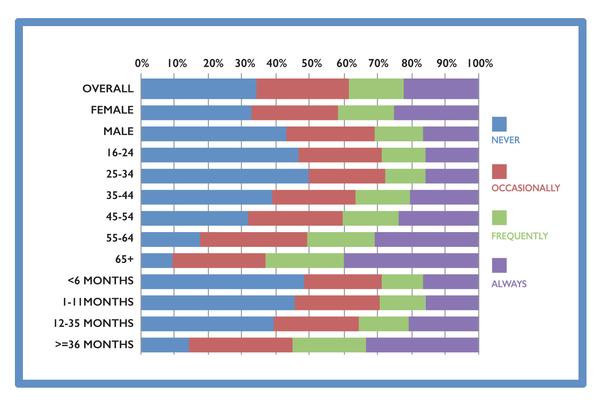
The value of interaction Overall, 22 per cent of members said reception staff always spoke to them – but 35 per cent said they were never spoken to (see Figure 1).
Females were more likely to be spoken to than males, and age had an impact too: reception staff were more likely to speak to older rather than younger members.
Meanwhile, nearly half of new members say they are never spoken to, compared to a third of long-standing members who say they are always spoken to. Members who attend their club more frequently were also more likely to always be spoken to, but the relationship was not that strong (data not shown).
Forty-four per cent of members surveyed reported that reception staff spoke to them at their last visit to their health club; again this was more common among female, older, long-standing and frequent users.
Seventy-four per cent of members agreed or strongly agreed with the statement: ‘I value reception staff speaking to me’ – a sentiment that was slightly higher among females.
Across different age groups, only members aged 55 years and older said they valued reception interaction more than the average. Similarly, only the longest standing members and the highest attending members were more likely to value reception interaction compared to the average.
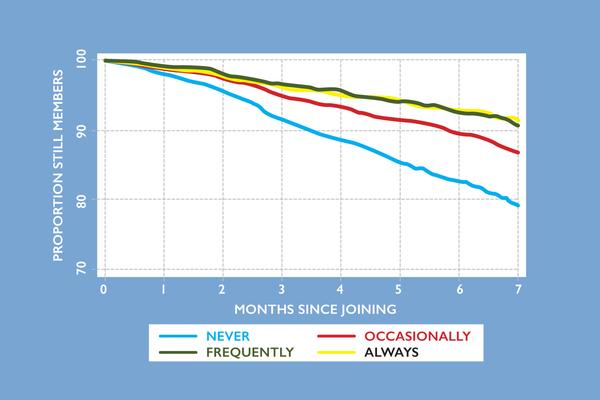
Influencing retention? Figure 2 shows that fewer members retain their membership if reception staff never or only occasionally speak to them. Similarly, 10 per cent more members retained their membership after seven months of follow-up if they reported in 2013 that reception staff spoke to them at their last visit (data not shown).
Compared to members who say they are always spoken to by reception staff and were spoken to at their last visit, members who are never spoken to and were not spoken to at their last visit cancel at a rate 2.8 times higher. This equates to an extra 21 cancelled memberships each month for every 1,000 members.
This difference in cancellation rate widens further if members who say they value reception staff speaking to them never get spoken to. They cancel at a rate 3.4 times higher than members who value reception staff communication and always get spoken to. This equates to a loss of an additional 29 members out of every 1,000 each month.
Even though a higher number of longer-standing members say they value reception staff speaking to them compared to new members, the detrimental effect of reception staff not speaking to them is less than if reception staff do not speak to new members.
New members who are not spoken to cancel at a rate nearly three times higher than established members who are not spoken to. Similarly, younger members who reception staff never speak to have a much higher rate of cancellation than older members who don’t get spoken to.
Although there are differences in the effect of reception communication on retention and attrition according to age, length of membership and visit frequency, in all types of members reception communication equals increased longevity. Independent of age, length of membership and visit frequency, members who report always being spoken to by reception staff are 30 per cent less likely to cancel each month compared to members who say they are never spoken to.
Also, members who say they were spoken to during their last visit are 20 per cent less likely to cancel over the next seven months compared to members who were not spoken to – irrespective of their age, length of membership and how often they use their club.
Summary Over one-third third of members say reception staff never speak to them; as a consequence, they’re twice as likely to cancel their membership each month compared to members who are spoken to at least occasionally. In other words, each time reception staff speak to a member rather than letting them walk by without any communication, the risk of them cancelling next month is halved.
The majority of members say they value reception staff speaking to them – some more than others – but even if they say they don’t value it, research shows they still stay longer when they are spoken to. Indeed, for every 58 members who get spoken to, one membership cancellation is avoided.
The proportion of members who report never being spoken to by reception staff increases among newer, younger members who only use their clubs infrequently – ironically the very members at most risk of cancelling their memberships. Not speaking to these groups of members compounds their already high rate of cancellation.
If reception staff had spoken to all members at least occasionally, we estimate that 30 per cent fewer cancellations would have occurred during the seven-month follow-up period.
Reception staff have the potential to make a significant contribution to retention. At present, the members most likely to be spoken to are those at lowest risk of cancellation; a shift towards speaking to more high risk members would mean even more membership cancellations could be avoided.
Figure 1
Figure 1
Figure 2 RETENTION RATE BY LEVEL OF RECEPTION STAFF INTERACTION
Figure2
6 TIPS ON HOW TO INTERACT WITH YOUR MEMBERS 1 Each visit counts, so reception staff should try to speak to all members when they enter and leave the club.
2 If possible, efforts to talk to members should focus on new members and those who visit infrequently.
Although the exact nature of the conversation was not assessed in this study, reception staff should:
3 At the very least, build rapport and provide both a friendly greeting and a friendly farewell.
4 Engage with the member about their experience during that visit – for example, asking how their workout/swim/class was. Take a genuine interest and listen with care.
5 Discuss the member’s next visit – for example, asking when they will next attend.
6 Support the member to make their next visit – encouraging them to make a booking, for example.
Reception staff should always ask members about their visit
About the author
Dr Melvyn Hillsdon
Dr Melvyn Hillsdon is associate professor of exercise and health at the University of Exeter, where he researches physical activity and population health.
Since his landmark retention report in 2001 (Winning the Retention Battle), his research into retention and attrition has led to the development of appropriate measures of retention, attrition and longevity. In partnership with TRP, Hillsdon has published numerous reports into the determinants of membership retention.
Active Blackpool is deploying Cornerstone Connect, a new digital interface allowing
disparate information from multiple systems to be aggregated into one dataset, to support
its focus on reducing health inequalities and improving healthy life expectancy. [more...]
Panatta brought together four of the most influential figures in bodybuilding history on the
stage of RiminiWellness 2026: Phil Heath, Lee Haney, Ronnie Coleman and Hany Rambod. [more...]
+ More featured suppliers
COMPANY PROFILES
Serco Leisure
Serco Leisure Operating Limited is one of the UK’s leading national operators of leisure centres, de [more...]
PSLT Ltd
PSLT Fitness Solutions manufacture, remanufacture and buy back commercial gym equipment. [more...]
Are reception staff your most undervalued retention
resource? Dr Melvyn Hillsdon looks at the impact
this group of employees can have on member retention
By Dr Melvyn Hillsdon | Published in Health Club Management 2015 issue 9
Previous articles from the Health Club Management / TRP10,000 series of reports have highlighted the value of fitness staff interacting with members, and the considerable impact this has on membership retention. We’ve also given some indication that reception staff have a role to play in member longevity too.
In this article, we will more fully examine the level of interaction between reception staff and members, whether members value reception staff speaking to them, and whether the level of interaction is associated with membership retention and/or attrition.
In our study, members were asked how often reception staff spoke to them, with responses ranging from ‘never’ to ‘always’. They were also asked if reception staff spoke to them on their last visit. Finally, using a four-point scale, they were asked how much they agreed with the statement: ‘I value reception staff speaking to me.’ Questions were asked between July and September 2013, with membership status ascertained between seven and eight months later.
The value of interaction Overall, 22 per cent of members said reception staff always spoke to them – but 35 per cent said they were never spoken to (see Figure 1).
Females were more likely to be spoken to than males, and age had an impact too: reception staff were more likely to speak to older rather than younger members.
Meanwhile, nearly half of new members say they are never spoken to, compared to a third of long-standing members who say they are always spoken to. Members who attend their club more frequently were also more likely to always be spoken to, but the relationship was not that strong (data not shown).
Forty-four per cent of members surveyed reported that reception staff spoke to them at their last visit to their health club; again this was more common among female, older, long-standing and frequent users.
Seventy-four per cent of members agreed or strongly agreed with the statement: ‘I value reception staff speaking to me’ – a sentiment that was slightly higher among females.
Across different age groups, only members aged 55 years and older said they valued reception interaction more than the average. Similarly, only the longest standing members and the highest attending members were more likely to value reception interaction compared to the average.
Influencing retention? Figure 2 shows that fewer members retain their membership if reception staff never or only occasionally speak to them. Similarly, 10 per cent more members retained their membership after seven months of follow-up if they reported in 2013 that reception staff spoke to them at their last visit (data not shown).
Compared to members who say they are always spoken to by reception staff and were spoken to at their last visit, members who are never spoken to and were not spoken to at their last visit cancel at a rate 2.8 times higher. This equates to an extra 21 cancelled memberships each month for every 1,000 members.
This difference in cancellation rate widens further if members who say they value reception staff speaking to them never get spoken to. They cancel at a rate 3.4 times higher than members who value reception staff communication and always get spoken to. This equates to a loss of an additional 29 members out of every 1,000 each month.
Even though a higher number of longer-standing members say they value reception staff speaking to them compared to new members, the detrimental effect of reception staff not speaking to them is less than if reception staff do not speak to new members.
New members who are not spoken to cancel at a rate nearly three times higher than established members who are not spoken to. Similarly, younger members who reception staff never speak to have a much higher rate of cancellation than older members who don’t get spoken to.
Although there are differences in the effect of reception communication on retention and attrition according to age, length of membership and visit frequency, in all types of members reception communication equals increased longevity. Independent of age, length of membership and visit frequency, members who report always being spoken to by reception staff are 30 per cent less likely to cancel each month compared to members who say they are never spoken to.
Also, members who say they were spoken to during their last visit are 20 per cent less likely to cancel over the next seven months compared to members who were not spoken to – irrespective of their age, length of membership and how often they use their club.
Summary Over one-third third of members say reception staff never speak to them; as a consequence, they’re twice as likely to cancel their membership each month compared to members who are spoken to at least occasionally. In other words, each time reception staff speak to a member rather than letting them walk by without any communication, the risk of them cancelling next month is halved.
The majority of members say they value reception staff speaking to them – some more than others – but even if they say they don’t value it, research shows they still stay longer when they are spoken to. Indeed, for every 58 members who get spoken to, one membership cancellation is avoided.
The proportion of members who report never being spoken to by reception staff increases among newer, younger members who only use their clubs infrequently – ironically the very members at most risk of cancelling their memberships. Not speaking to these groups of members compounds their already high rate of cancellation.
If reception staff had spoken to all members at least occasionally, we estimate that 30 per cent fewer cancellations would have occurred during the seven-month follow-up period.
Reception staff have the potential to make a significant contribution to retention. At present, the members most likely to be spoken to are those at lowest risk of cancellation; a shift towards speaking to more high risk members would mean even more membership cancellations could be avoided.
Figure 1
Figure 1
Figure 2 RETENTION RATE BY LEVEL OF RECEPTION STAFF INTERACTION
Figure2
6 TIPS ON HOW TO INTERACT WITH YOUR MEMBERS 1 Each visit counts, so reception staff should try to speak to all members when they enter and leave the club.
2 If possible, efforts to talk to members should focus on new members and those who visit infrequently.
Although the exact nature of the conversation was not assessed in this study, reception staff should:
3 At the very least, build rapport and provide both a friendly greeting and a friendly farewell.
4 Engage with the member about their experience during that visit – for example, asking how their workout/swim/class was. Take a genuine interest and listen with care.
5 Discuss the member’s next visit – for example, asking when they will next attend.
6 Support the member to make their next visit – encouraging them to make a booking, for example.
Reception staff should always ask members about their visit
About the author
Dr Melvyn Hillsdon
Dr Melvyn Hillsdon is associate professor of exercise and health at the University of Exeter, where he researches physical activity and population health.
Since his landmark retention report in 2001 (Winning the Retention Battle), his research into retention and attrition has led to the development of appropriate measures of retention, attrition and longevity. In partnership with TRP, Hillsdon has published numerous reports into the determinants of membership retention.
The UK's four Chief Medical Officers have published a refreshed edition of Physical activity
guidelines: UK Chief Medical Officers' report, updating the evidence that underpins the nation's
physical activity recommendations and placing greater emphasis on strength, balance, reducing
sedentary behaviour and, for the first time, supporting people taking weight loss medications.
Places Leisure has exchanged contracts to build and operate a flagship £60m water and leisure
destination on behalf of Basingstoke and Deane Borough Council.
The Republic of Ireland will become the latest market in PureGym’s expanding international
portfolio, with the first launch planned for Dublin in 2027.
Anytime Fitness opened more than one club a day in 2025 and is on track to maintain this rate
of growth this year, as parent company Purpose Brands targets further international expansion.
The £33.9 million Leighton Leisure and Community Centre has opened in Leighton Buzzard, UK,
creating a next-generation public leisure, health and wellbeing hub for the local community.
Walnuts Leisure Centre in Orpington, in the London Borough of Bromley, has reopened following
a £17m transformation designed to secure the long-term future of the public leisure asset and
reposition it as a community wellbeing hub.
The Gym Group, has announced that it's sustained positive trading momentum has continued
through the first half of 2026 and the company remains confident about the outlook.
Luxury boutique Pilates and wellness studio, X-Club, officially launches a
4,000sq ft flagship at
Marylebone on 16 July Built around X-Club’s four pillars of wellness – mind,
movement,
nutrition and therapy – the facility features two group exercise studi
Active Blackpool is deploying Cornerstone Connect, a new digital interface allowing
disparate information from multiple systems to be aggregated into one dataset, to support
its focus on reducing health inequalities and improving healthy life expectancy. [more...]
Panatta brought together four of the most influential figures in bodybuilding history on the
stage of RiminiWellness 2026: Phil Heath, Lee Haney, Ronnie Coleman and Hany Rambod. [more...]
+ More featured suppliers
COMPANY PROFILES
Serco Leisure Serco Leisure Operating Limited is one of the UK’s leading national operators of leisure centres, de [more...]