An in-depth study of member retention in North America identifies the factors that spell the difference between winning and losing. IHRSA’s Jon Feld reports
By Jon Feld | Published in Health Club Management 2015 issue 9
The research was conducted by
UK-based expert Dr Paul Bedford
A new IHRSA report – IHRSA One Million Strong: An in-depth study of health club member retention in North America – has recently been published and offers a highly detailed, revealing study of member retention in the United States and Canada.
The report is the culmination of an in-depth, 36-month study of the North American fitness industry that reflects the membership experiences of approximately 1.5 million club members. The research was conducted and analysed by UK-based retention expert Dr Paul Bedford.
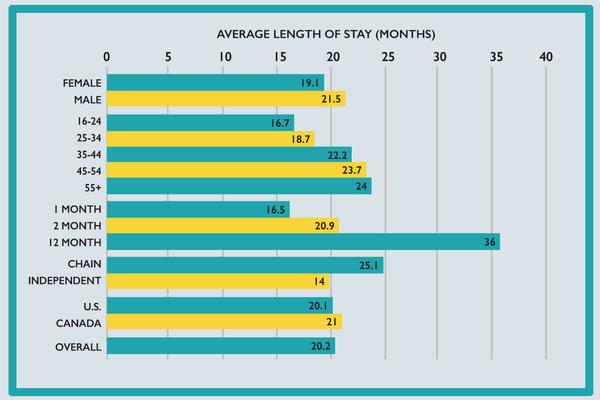
Perhaps the most telling statistics come from the report’s baseline: between 1 January 2012 and 3 February 2015, a total of 722,246 members cancelled their memberships at a rate of 33.6 cancellations per 1,000 members per month. The total loss represented 47.5 per cent of all members. The average length of membership was 20.2 months.
More importantly, though, IHRSA One Million Strong identifies and quantifies the factors that led to those numbers, as well as documenting the impact that member retention has on club revenues, and underscoring the critical need to keep members engaged as long as possible.
Flagging retention The report reveals that retention falls dramatically over time: 67.2 per cent of members retain their membership for at least 12 months, but this drops to 44.4 per cent who stay for at least 24 months. Gender seems to have little impact on the retention rate, but age does, with higher retention rates among older members. The difference is most noticeable at 24 months, when 37 per cent of the 16- to 24-year-olds still belong to their club, compared to 50 per cent of members aged 55 and older.
The other key data point, and one that came as a bit of a surprise: members of independent clubs were 47 per cent more likely to cancel than those belonging to a chain – even after factors such as a member’s age, gender and type of payment were taken into account.
“Conventional wisdom has been that, in general, independent clubs have higher retention rates than chains thanks to a litany of factors, including an enhanced member experience,” observes Brent Darden, owner of Brent Darden Consulting and a former IHRSA chair. IHRSA One Million Strong clearly suggests this isn’t the case.
“The main reason for this disparity may be that chains are more likely to sell 12-month contracts,” Darden continues. “Another explanation may be that health club chains offer multiple locations in a single market, helping these operators to retain transient members within a broader geographic area.”
“Actually, on every measure, the chains are doing better,” adds Bedford.
“This may be because the smaller operators are selling more month-by-month contracts, in order to be competitive with the low-cost operators and boutique facilities, or because they’re just not as sophisticated when it comes to their membership data analytics.”
Attrition factors The factor that seems to have the most significant impact on attrition is the type of payment plan employed. IHRSA One Million Strong found that members who pay on a month-to-month basis are four times more likely to cancel than those on a 12-month minimum term.
What that means in the real world is that, if at the beginning of a month a club had 1,000 one-month members, on average 42 would likely cancel by the end of the month. By way of contrast, if a club had 1,000 12-month members, only 10 would cancel.
Art Curtis, president of consultancy Curtis Club Advisors and a former IHRSA chair, points out that “because longer-term agreements – or 12-month versus month-by-month – have a 35 per cent greater value after 24 months, you can’t ignore the economic impact that selling longer-term agreements could have on overall sales”.
Action items One of the most valuable benefits that IHRSA One Million Strong offers is the opportunity to benchmark your club’s retention data against industry averages.
“If you can’t do this easily because you don’t currently track the data, you should make a commitment to accurately collect and maintain it going forward,” Curtis advises. “Once you’ve done so, you’ll be able to recognise the critical times when your various member segments are most likely to cancel their membership, and be better able to monitor the effectiveness of the different intervention tools you have at your disposal to intervene effectively.”
“Use the report as a checklist, and compare its findings to the results your club’s practices are producing,” says Molly Kemmer, regional director of MediFit Community Services and IHRSA’s current chair. “It can help you decide what you need to measure, what you should start doing, and what you need to stop doing to improve member retention, increase your club’s profitability and grow your business.”
FIGURE 1 The average length of membership overall and by gender, age group, contract type, CLUB TYPE and country
FIGURE 1
About IHRSA
Founded in 1981, IHRSA – the International Health, Racquet & Sportsclub Association – is the only global trade association, representing more than 10,000 health and fitness facilities and suppliers worldwide.
To learn how IHRSA can help your business thrive, visit www.ihrsa.org
IHRSA One Million Strong: An in-depth study of health club member retention in North America is available for purchase at www.ihrsa.org/one-million-strong – priced at US$99.95 for IHRSA members and US$199.95 for non-members
The gender of members makes little difference to their retention rates
CoverMe, the global leader in fitness workforce management, today launches CoverMe PT, an
on-demand personal training platform that connects the right personal trainer to the right
client in under 10 seconds. [more...]
Active Blackpool is deploying Cornerstone Connect, a new digital interface allowing
disparate information from multiple systems to be aggregated into one dataset, to support
its focus on reducing health inequalities and improving healthy life expectancy. [more...]
+ More featured suppliers
COMPANY PROFILES
Precor
Precor promises precision-quality products with steadfast reliability that are inspired by exerciser [more...]
Safe Space Lockers
We provide a full turn-key solution for clients from design and consultation, through to bespoke man [more...]
An in-depth study of member retention in North America identifies the factors that spell the difference between winning and losing. IHRSA’s Jon Feld reports
By Jon Feld | Published in Health Club Management 2015 issue 9
The research was conducted by
UK-based expert Dr Paul Bedford
A new IHRSA report – IHRSA One Million Strong: An in-depth study of health club member retention in North America – has recently been published and offers a highly detailed, revealing study of member retention in the United States and Canada.
The report is the culmination of an in-depth, 36-month study of the North American fitness industry that reflects the membership experiences of approximately 1.5 million club members. The research was conducted and analysed by UK-based retention expert Dr Paul Bedford.
Perhaps the most telling statistics come from the report’s baseline: between 1 January 2012 and 3 February 2015, a total of 722,246 members cancelled their memberships at a rate of 33.6 cancellations per 1,000 members per month. The total loss represented 47.5 per cent of all members. The average length of membership was 20.2 months.
More importantly, though, IHRSA One Million Strong identifies and quantifies the factors that led to those numbers, as well as documenting the impact that member retention has on club revenues, and underscoring the critical need to keep members engaged as long as possible.
Flagging retention The report reveals that retention falls dramatically over time: 67.2 per cent of members retain their membership for at least 12 months, but this drops to 44.4 per cent who stay for at least 24 months. Gender seems to have little impact on the retention rate, but age does, with higher retention rates among older members. The difference is most noticeable at 24 months, when 37 per cent of the 16- to 24-year-olds still belong to their club, compared to 50 per cent of members aged 55 and older.
The other key data point, and one that came as a bit of a surprise: members of independent clubs were 47 per cent more likely to cancel than those belonging to a chain – even after factors such as a member’s age, gender and type of payment were taken into account.
“Conventional wisdom has been that, in general, independent clubs have higher retention rates than chains thanks to a litany of factors, including an enhanced member experience,” observes Brent Darden, owner of Brent Darden Consulting and a former IHRSA chair. IHRSA One Million Strong clearly suggests this isn’t the case.
“The main reason for this disparity may be that chains are more likely to sell 12-month contracts,” Darden continues. “Another explanation may be that health club chains offer multiple locations in a single market, helping these operators to retain transient members within a broader geographic area.”
“Actually, on every measure, the chains are doing better,” adds Bedford.
“This may be because the smaller operators are selling more month-by-month contracts, in order to be competitive with the low-cost operators and boutique facilities, or because they’re just not as sophisticated when it comes to their membership data analytics.”
Attrition factors The factor that seems to have the most significant impact on attrition is the type of payment plan employed. IHRSA One Million Strong found that members who pay on a month-to-month basis are four times more likely to cancel than those on a 12-month minimum term.
What that means in the real world is that, if at the beginning of a month a club had 1,000 one-month members, on average 42 would likely cancel by the end of the month. By way of contrast, if a club had 1,000 12-month members, only 10 would cancel.
Art Curtis, president of consultancy Curtis Club Advisors and a former IHRSA chair, points out that “because longer-term agreements – or 12-month versus month-by-month – have a 35 per cent greater value after 24 months, you can’t ignore the economic impact that selling longer-term agreements could have on overall sales”.
Action items One of the most valuable benefits that IHRSA One Million Strong offers is the opportunity to benchmark your club’s retention data against industry averages.
“If you can’t do this easily because you don’t currently track the data, you should make a commitment to accurately collect and maintain it going forward,” Curtis advises. “Once you’ve done so, you’ll be able to recognise the critical times when your various member segments are most likely to cancel their membership, and be better able to monitor the effectiveness of the different intervention tools you have at your disposal to intervene effectively.”
“Use the report as a checklist, and compare its findings to the results your club’s practices are producing,” says Molly Kemmer, regional director of MediFit Community Services and IHRSA’s current chair. “It can help you decide what you need to measure, what you should start doing, and what you need to stop doing to improve member retention, increase your club’s profitability and grow your business.”
FIGURE 1 The average length of membership overall and by gender, age group, contract type, CLUB TYPE and country
FIGURE 1
About IHRSA
Founded in 1981, IHRSA – the International Health, Racquet & Sportsclub Association – is the only global trade association, representing more than 10,000 health and fitness facilities and suppliers worldwide.
To learn how IHRSA can help your business thrive, visit www.ihrsa.org
IHRSA One Million Strong: An in-depth study of health club member retention in North America is available for purchase at www.ihrsa.org/one-million-strong – priced at US$99.95 for IHRSA members and US$199.95 for non-members
The gender of members makes little difference to their retention rates
The UK's four Chief Medical Officers have published a refreshed edition of Physical activity
guidelines: UK Chief Medical Officers' report, updating the evidence that underpins the nation's
physical activity recommendations and placing greater emphasis on strength, balance, reducing
sedentary behaviour and, for the first time, supporting people taking weight loss medications.
Places Leisure has exchanged contracts to build and operate a flagship £60m water and leisure
destination on behalf of Basingstoke and Deane Borough Council.
The Republic of Ireland will become the latest market in PureGym’s expanding international
portfolio, with the first launch planned for Dublin in 2027.
Anytime Fitness opened more than one club a day in 2025 and is on track to maintain this rate
of growth this year, as parent company Purpose Brands targets further international expansion.
The £33.9 million Leighton Leisure and Community Centre has opened in Leighton Buzzard, UK,
creating a next-generation public leisure, health and wellbeing hub for the local community.
Walnuts Leisure Centre in Orpington, in the London Borough of Bromley, has reopened following
a £17m transformation designed to secure the long-term future of the public leisure asset and
reposition it as a community wellbeing hub.
The Gym Group, has announced that it's sustained positive trading momentum has continued
through the first half of 2026 and the company remains confident about the outlook.
Luxury boutique Pilates and wellness studio, X-Club, officially launches a
4,000sq ft flagship at
Marylebone on 16 July Built around X-Club’s four pillars of wellness – mind,
movement,
nutrition and therapy – the facility features two group exercise studi
CoverMe, the global leader in fitness workforce management, today launches CoverMe PT, an
on-demand personal training platform that connects the right personal trainer to the right
client in under 10 seconds. [more...]
Active Blackpool is deploying Cornerstone Connect, a new digital interface allowing
disparate information from multiple systems to be aggregated into one dataset, to support
its focus on reducing health inequalities and improving healthy life expectancy. [more...]
+ More featured suppliers
COMPANY PROFILES
Precor Precor promises precision-quality products with steadfast reliability that are inspired by exerciser [more...]