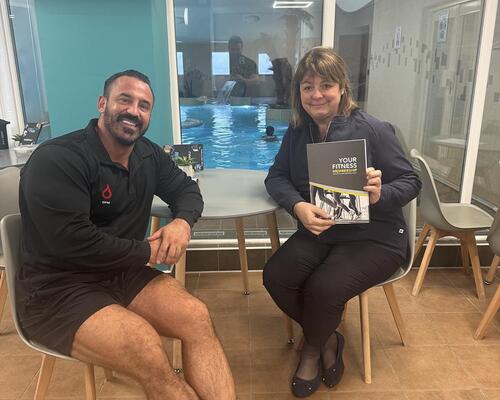
We know society is ageing. We know exercise offers the potential of a healthier – as well as a longer – life. The problem is, by classifying anyone over the age of 50 as ‘old, the fitness industry is missing a trick.
Because the decades after 50 can constitute half of a person’s life, and encompass everything from full mental and physical fitness through to muscle loss and dementia. So where are the clubs that cater for the truly old and frail? The answer: they’re few and far between, and even where they do exist, the focus is often on the physical – mainly falls prevention – and the social, offering companionship and community.
But what about the direct mental impact of exercise? One topic that’s getting a lot of attention among the scientific community is dementia, and the positive impact exercise can have on this devastating condition – we review some of the latest research on page 124.
But as yet, few fitness facilities have focused on this wonderful benefit of exercise. Step forward UK-based community interest company LiveWire, which has just had plans approved for a £16m neighbourhood leisure, culture, health and wellbeing hub in Warrington. Set to open in Q3 2016, it will be LiveWire’s first dementia-friendly facility.
Locklynne Hall, LiveWire’s innovation and leadership manager, explains what that means: “The person with dementia has difficulty remembering things, so you can’t rely on them building up a familiarity with where things are – you need appropriate signage. Their more recent memories are lost first, so if your toilet signs are a variation on the stick man that became common in the 60s, it might be meaningless to someone whose memory stops before then.
“You need appropriate fittings too, because the person with dementia also has difficulty working things out. They may not understand how to use clinical-style taps and mixer faucets in toilets. Unfamiliar plumbing will cause delays and confusion that could lead to incontinence and distress.
“You also need a well thought-out colour and décor scheme. If someone has developed problems with depth perception and visual processing, a pattern on the floor may appear to be a trip hazard: this momentary confusion can cause them to stumble and fall.”
Equally importantly, LiveWire trains its staff – and members of the local community – to understand the condition. It’s piloting a number of programmes too: early onset dementia groups, for example, offering healthy walking classes and tai chi. “We’re also developing a ‘lessen your chances’ programme of activities,” adds Hall.
There are lessons to learn from other sectors too, with evidence to suggest that environments which stimulate longer-term memories can be beneficial. For example, the Jamtli museum in Sweden has created the environment of a 1970s house, designed to jog dementia sufferers’ memories of happy, younger years. Engagement levels are reportedly high, and the individuals are also calmer and more content in this familiar environment.
As the population gets older, the need to be dementia-friendly will be inescapable. “The big message,” concludes Hall, “is that we’re at the point of no return. We have to act today, because tomorrow’s challenge is already upon us.”
One of the biggest mistakes the fitness industry still makes is advertising almost
exclusively to people who already look and live like gym members. [more...]
Elevate is set to celebrate its 10th anniversary in style this June, with organisers
confirming the event’s largest-ever drinks reception as registrations continue to run more
than 10% ahead of last year. [more...]
+ More featured suppliers
COMPANY PROFILES
Orbit4
With Orbit4, you’ll always have full visibility
of your equipment inventory, the true
market value [more...]
Everyone Active
Everyone Active operates leisure centres in partnership with local councils across the UK. Today, Ev [more...]
We know society is ageing. We know exercise offers the potential of a healthier – as well as a longer – life. The problem is, by classifying anyone over the age of 50 as ‘old, the fitness industry is missing a trick.
Because the decades after 50 can constitute half of a person’s life, and encompass everything from full mental and physical fitness through to muscle loss and dementia. So where are the clubs that cater for the truly old and frail? The answer: they’re few and far between, and even where they do exist, the focus is often on the physical – mainly falls prevention – and the social, offering companionship and community.
But what about the direct mental impact of exercise? One topic that’s getting a lot of attention among the scientific community is dementia, and the positive impact exercise can have on this devastating condition – we review some of the latest research on page 124.
But as yet, few fitness facilities have focused on this wonderful benefit of exercise. Step forward UK-based community interest company LiveWire, which has just had plans approved for a £16m neighbourhood leisure, culture, health and wellbeing hub in Warrington. Set to open in Q3 2016, it will be LiveWire’s first dementia-friendly facility.
Locklynne Hall, LiveWire’s innovation and leadership manager, explains what that means: “The person with dementia has difficulty remembering things, so you can’t rely on them building up a familiarity with where things are – you need appropriate signage. Their more recent memories are lost first, so if your toilet signs are a variation on the stick man that became common in the 60s, it might be meaningless to someone whose memory stops before then.
“You need appropriate fittings too, because the person with dementia also has difficulty working things out. They may not understand how to use clinical-style taps and mixer faucets in toilets. Unfamiliar plumbing will cause delays and confusion that could lead to incontinence and distress.
“You also need a well thought-out colour and décor scheme. If someone has developed problems with depth perception and visual processing, a pattern on the floor may appear to be a trip hazard: this momentary confusion can cause them to stumble and fall.”
Equally importantly, LiveWire trains its staff – and members of the local community – to understand the condition. It’s piloting a number of programmes too: early onset dementia groups, for example, offering healthy walking classes and tai chi. “We’re also developing a ‘lessen your chances’ programme of activities,” adds Hall.
There are lessons to learn from other sectors too, with evidence to suggest that environments which stimulate longer-term memories can be beneficial. For example, the Jamtli museum in Sweden has created the environment of a 1970s house, designed to jog dementia sufferers’ memories of happy, younger years. Engagement levels are reportedly high, and the individuals are also calmer and more content in this familiar environment.
As the population gets older, the need to be dementia-friendly will be inescapable. “The big message,” concludes Hall, “is that we’re at the point of no return. We have to act today, because tomorrow’s challenge is already upon us.”
Global luxury hospitality brand, Six Senses, has partnered with longevity healthcare provider,
HUM2N, to launch a clinic at Six Senses London, at The Whiteley.
Premium London health club, KX Chelsea, will imminently unveil its most significant
redevelopment since its launch in 2002 to create an integrated wellness model combining
training, recovery and relaxation.
Researchers in the US have identified an antibody which could greatly reduce the loss of lean
muscle mass in people who are taking weight-loss medications.
Crunch Fitness has announced the launch of Crunch Reform Pilates – its own reformer concept
designed to bring this fast growing, but rather expensive, modality into the mainstream.
The 20th State of the Industry Report reveals a resilient, expanding and competitive
sector, the
importance of differentiation and the ongoing challenge of tackling inequalities.
Nuffield Health has told HCM that it takes its responsibilities towards its colleagues seriously
and is committed to meeting all legal obligations after news of a tribunal has made national
headlines.
Technogym has announced the launch of the Run X World Treadmill Championship, the first
world championship for running on connected treadmills over five kilometres.
One of the biggest mistakes the fitness industry still makes is advertising almost
exclusively to people who already look and live like gym members. [more...]
Elevate is set to celebrate its 10th anniversary in style this June, with organisers
confirming the event’s largest-ever drinks reception as registrations continue to run more
than 10% ahead of last year. [more...]
+ More featured suppliers
COMPANY PROFILES
Orbit4 With Orbit4, you’ll always have full visibility
of your equipment inventory, the true
market value [more...]