Melissa Rodriguez outlines some of the key findings from the new 2015 IHRSA Global Report: The State of the Industry – from continued growth in leading markets to the potential in emerging markets
By Melissa Rodriguez | Published in Health Club Management 2015 issue 6
IHRSA Global Report: The State of the Industry / www.shutterstock.com/Stokkete
The global health club industry generated US$84bn in revenue in 2014, with more than 180,000 clubs attracting 144 million members worldwide.
Leading fitness markets in the Americas, Europe and Asia Pacific continued to show their strength, while emerging markets in Asia – as well as the global economic leaders India and China – showed potential further growth.
The Americas In the US, the health club industry continued its strong performance. Revenue and total number of health club consumers increased significantly, while club count grew at a slower rate. Revenue grew to US$24.2bn from US$22.4bn in 2013, and club count increased to 32,460 from 32,150. More than 54 million Americans belonged to a health club.
According to The IHRSA Canadian Health Club Report, club operators serve nearly 6 million members at roughly 6,000 facilities in Canada. IBISWorld, an independent industry research firm, projects that revenue from gyms and health clubs in Canada will increase each year to 2019. Consumer demand for health and fitness programmes for active ageing, proper nutrition and sports performance, and to help address obesity, will help drive growth for health and fitness clubs.
Leading markets continue to perform well in Latin America. Roughly 15 million members in 16 Latin American markets belong to one of 55,000 clubs and studios. Brazil, Mexico and Argentina combined serve more than 13 million members in the region. The IHRSA Latin American Report shows that opportunities for growth remain in Latin America, as member penetration rates are still low in comparison with developed health club markets worldwide.
Europe The fitness industry in Europe serves nearly 48 million members. Roughly 51,000 health clubs generate US$35bn in annual revenue.
Europe represents the fitness industry’s most profitable region: it has the greatest revenue and is second only to North America in terms of total memberships. The United Kingdom and Germany lead all markets in Europe in terms of revenue.
Germany attracts nine million members to 8,000 clubs and studios (source: DSSV). The health club landscape in Germany is shaped by a variety of club models: traditional full-service centres, women-only franchises, medical/wellness facilities, low-cost clubs, micro-gyms and more.
In the UK, according to research by The Leisure Database Company, roughly 8.3 million members belong to more than 6,000 health clubs and facilities. Private clubs – including full-service, low-cost and studio concepts – attract the majority of members; public health and fitness facilities in the UK cater for some 3.3 million members.
The health club industry in Norway and Poland is also robust. According to VIRKE, the Norwegian health club association, Norway generates roughly US$730m in revenue from nearly 1,000 clubs, with one million members. The Polish health club market totals US$491m in revenue from more than 2,000 health clubs and their one million members.
Asia Pacific The Asia Pacific region serves 17 million members at 29,000 health clubs across 14 markets (excluding the Middle East). Health club industry revenue totals US$14.5bn in this region.
According to the recently released IHRSA Asia Pacific Health Club Report, there’s room for growth in the Asia Pacific region, as the average member penetration rate for the region is just 3.8 per cent. Australia and New Zealand lead all Asia Pacific markets, with penetration rates at 14.8 per cent and 11.4 per cent respectively. Larger cities in Asia – including Beijing, Shanghai, Kuala Lumpur and Jakarta – are home to maturing industries, while future growth is anticipated in growing cities as well as the overall Asia Pacific region.
Opportunities for the fitness industry abound in the global economic powerhouses of China and India, which currently have penetration rates of only 0.4 per cent and 0.12 per cent respectively. China is home to roughly 2,700 health clubs with a total of 3.9 million members. The health club industry in India has roughly 3,800 health club facilities and nearly one million members.
About IHRSA
Founded in 1981, IHRSA – the International Health, Racquet & Sportsclub Association – is the only global trade association, representing more than 10,000 health and fitness facilities and suppliers worldwide. To learn how IHRSA can help your business thrive, visit www.ihrsa.org. Locate an IHRSA club at www.healthclubs.com
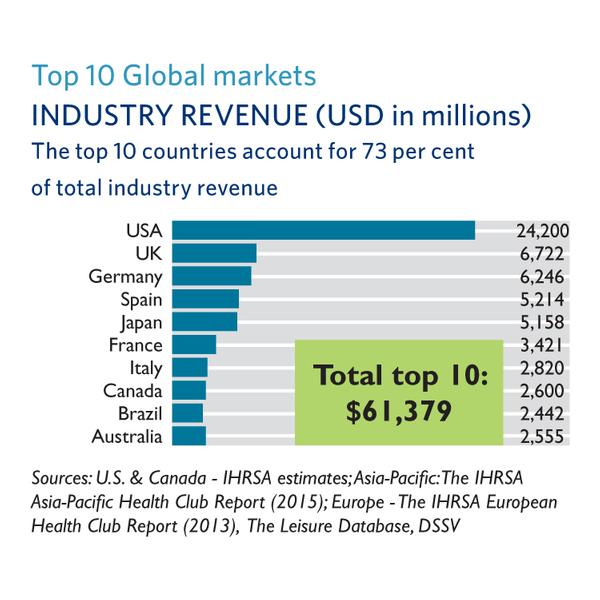
Top 10 Global markets INDUSTRY REVENUE (USD in millions)
INDUSTRY REVENUE
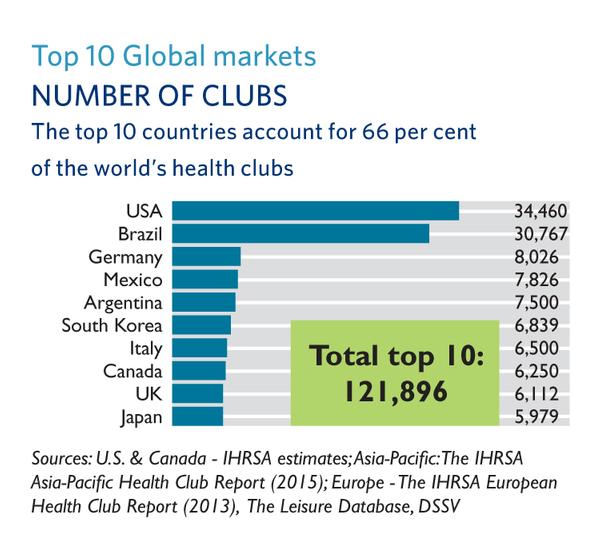
Top 10 Global markets NUMBER OF CLUBS
NUMBER OF CLUBS
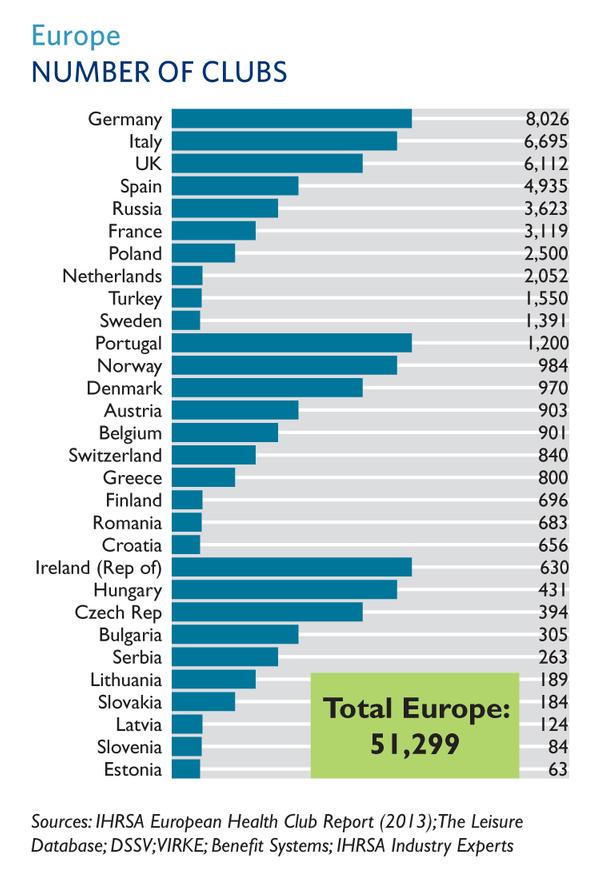
Europe NUMBER OF CLUBS
Europe
NUMBER OF CLUBS
Want more detail?
Melissa Rodriguez is IHRSA’s senior research manager and can be reached via email at [email protected]
Published in May, The 2015 IHRSA Global Report is the most up-to-date publication on the global fitness business. It is available at www.ihrsa.org/ihrsa-global-report in print or as a PDF.
Bright future: As leading economies improve, the health club industry is expected to thrive in the global marketplace / www.shutterstock.com/Stokkete
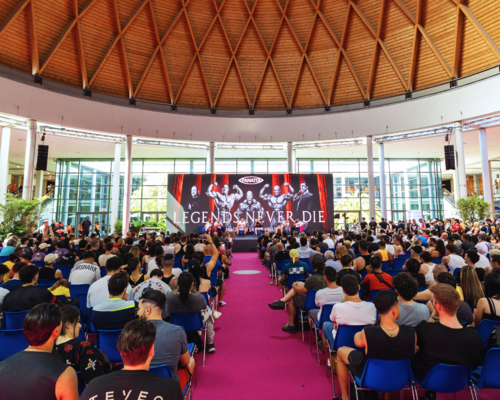
Panatta brought together four of the most influential figures in bodybuilding history on the
stage of RiminiWellness 2026: Phil Heath, Lee Haney, Ronnie Coleman and Hany Rambod. [more...]
Active Blackpool is deploying Cornerstone Connect, a new digital interface allowing
disparate information from multiple systems to be aggregated into one dataset, to support
its focus on reducing health inequalities and improving healthy life expectancy. [more...]
+ More featured suppliers
COMPANY PROFILES
IndigoFitness
At IndigoFitness, we create intelligent training spaces that elevate fitness facilities across indus [more...]
Safe Space Lockers
We provide a full turn-key solution for clients from design and consultation, through to bespoke man [more...]
Melissa Rodriguez outlines some of the key findings from the new 2015 IHRSA Global Report: The State of the Industry – from continued growth in leading markets to the potential in emerging markets
By Melissa Rodriguez | Published in Health Club Management 2015 issue 6
IHRSA Global Report: The State of the Industry / www.shutterstock.com/Stokkete
The global health club industry generated US$84bn in revenue in 2014, with more than 180,000 clubs attracting 144 million members worldwide.
Leading fitness markets in the Americas, Europe and Asia Pacific continued to show their strength, while emerging markets in Asia – as well as the global economic leaders India and China – showed potential further growth.
The Americas In the US, the health club industry continued its strong performance. Revenue and total number of health club consumers increased significantly, while club count grew at a slower rate. Revenue grew to US$24.2bn from US$22.4bn in 2013, and club count increased to 32,460 from 32,150. More than 54 million Americans belonged to a health club.
According to The IHRSA Canadian Health Club Report, club operators serve nearly 6 million members at roughly 6,000 facilities in Canada. IBISWorld, an independent industry research firm, projects that revenue from gyms and health clubs in Canada will increase each year to 2019. Consumer demand for health and fitness programmes for active ageing, proper nutrition and sports performance, and to help address obesity, will help drive growth for health and fitness clubs.
Leading markets continue to perform well in Latin America. Roughly 15 million members in 16 Latin American markets belong to one of 55,000 clubs and studios. Brazil, Mexico and Argentina combined serve more than 13 million members in the region. The IHRSA Latin American Report shows that opportunities for growth remain in Latin America, as member penetration rates are still low in comparison with developed health club markets worldwide.
Europe The fitness industry in Europe serves nearly 48 million members. Roughly 51,000 health clubs generate US$35bn in annual revenue.
Europe represents the fitness industry’s most profitable region: it has the greatest revenue and is second only to North America in terms of total memberships. The United Kingdom and Germany lead all markets in Europe in terms of revenue.
Germany attracts nine million members to 8,000 clubs and studios (source: DSSV). The health club landscape in Germany is shaped by a variety of club models: traditional full-service centres, women-only franchises, medical/wellness facilities, low-cost clubs, micro-gyms and more.
In the UK, according to research by The Leisure Database Company, roughly 8.3 million members belong to more than 6,000 health clubs and facilities. Private clubs – including full-service, low-cost and studio concepts – attract the majority of members; public health and fitness facilities in the UK cater for some 3.3 million members.
The health club industry in Norway and Poland is also robust. According to VIRKE, the Norwegian health club association, Norway generates roughly US$730m in revenue from nearly 1,000 clubs, with one million members. The Polish health club market totals US$491m in revenue from more than 2,000 health clubs and their one million members.
Asia Pacific The Asia Pacific region serves 17 million members at 29,000 health clubs across 14 markets (excluding the Middle East). Health club industry revenue totals US$14.5bn in this region.
According to the recently released IHRSA Asia Pacific Health Club Report, there’s room for growth in the Asia Pacific region, as the average member penetration rate for the region is just 3.8 per cent. Australia and New Zealand lead all Asia Pacific markets, with penetration rates at 14.8 per cent and 11.4 per cent respectively. Larger cities in Asia – including Beijing, Shanghai, Kuala Lumpur and Jakarta – are home to maturing industries, while future growth is anticipated in growing cities as well as the overall Asia Pacific region.
Opportunities for the fitness industry abound in the global economic powerhouses of China and India, which currently have penetration rates of only 0.4 per cent and 0.12 per cent respectively. China is home to roughly 2,700 health clubs with a total of 3.9 million members. The health club industry in India has roughly 3,800 health club facilities and nearly one million members.
About IHRSA
Founded in 1981, IHRSA – the International Health, Racquet & Sportsclub Association – is the only global trade association, representing more than 10,000 health and fitness facilities and suppliers worldwide. To learn how IHRSA can help your business thrive, visit www.ihrsa.org. Locate an IHRSA club at www.healthclubs.com
Top 10 Global markets INDUSTRY REVENUE (USD in millions)
INDUSTRY REVENUE
Top 10 Global markets NUMBER OF CLUBS
NUMBER OF CLUBS
Europe NUMBER OF CLUBS
Europe
NUMBER OF CLUBS
Want more detail?
Melissa Rodriguez is IHRSA’s senior research manager and can be reached via email at [email protected]
Published in May, The 2015 IHRSA Global Report is the most up-to-date publication on the global fitness business. It is available at www.ihrsa.org/ihrsa-global-report in print or as a PDF.
Bright future: As leading economies improve, the health club industry is expected to thrive in the global marketplace / www.shutterstock.com/Stokkete
The UK's four Chief Medical Officers have published a refreshed edition of Physical activity
guidelines: UK Chief Medical Officers' report, updating the evidence that underpins the nation's
physical activity recommendations and placing greater emphasis on strength, balance, reducing
sedentary behaviour and, for the first time, supporting people taking weight loss medications.
Places Leisure has exchanged contracts to build and operate a flagship £60m water and leisure
destination on behalf of Basingstoke and Deane Borough Council.
The Republic of Ireland will become the latest market in PureGym’s expanding international
portfolio, with the first launch planned for Dublin in 2027.
Anytime Fitness opened more than one club a day in 2025 and is on track to maintain this rate
of growth this year, as parent company Purpose Brands targets further international expansion.
The £33.9 million Leighton Leisure and Community Centre has opened in Leighton Buzzard, UK,
creating a next-generation public leisure, health and wellbeing hub for the local community.
Walnuts Leisure Centre in Orpington, in the London Borough of Bromley, has reopened following
a £17m transformation designed to secure the long-term future of the public leisure asset and
reposition it as a community wellbeing hub.
The Gym Group, has announced that it's sustained positive trading momentum has continued
through the first half of 2026 and the company remains confident about the outlook.
Luxury boutique Pilates and wellness studio, X-Club, officially launches a
4,000sq ft flagship at
Marylebone on 16 July Built around X-Club’s four pillars of wellness – mind,
movement,
nutrition and therapy – the facility features two group exercise studi
Panatta brought together four of the most influential figures in bodybuilding history on the
stage of RiminiWellness 2026: Phil Heath, Lee Haney, Ronnie Coleman and Hany Rambod. [more...]
Active Blackpool is deploying Cornerstone Connect, a new digital interface allowing
disparate information from multiple systems to be aggregated into one dataset, to support
its focus on reducing health inequalities and improving healthy life expectancy. [more...]
+ More featured suppliers
COMPANY PROFILES
IndigoFitness At IndigoFitness, we create intelligent training spaces that elevate fitness facilities across indus [more...]