Younger members are more likely to use a tracking device / photo: www.shutterstock.com/Syda Productions
Wearable devices and phone-based applications (apps) for self-monitoring of physical activity are becoming increasingly common. However, the level of use and their effectiveness among health club members is still unknown.
Using data collected as part of the TRP 10,000 study, this article will report on what proportion of members track their physical activity using technology and whether the use of such technology is associated with motivation, visit frequency, progress and ultimately membership retention.
Data and analysis Between July and September 2013, members completed an online questionnaire that asked them if they were using any product, app or system to track their physical activity, either inside or outside their club. Members who ticked the box to say they used an app were asked to list the app they used.
Who tracks, and with what? Overall, 27 per cent of members reported using some tracking device, with the majority saying they used a phone or web app (15 per cent).
Slightly more males than females reported tracking their physical activity (30 per cent versus 26 per cent) and levels of tracking declined with age (40 per cent of 16- to 24-year-olds compared to 7 per cent of members aged 55 years and older). Long-standing members were also less likely to report using tracking technology compared to newer members.
Members reported an incredibly broad range of systems for tracking, but the most commonly cited was MyFitnessPal, an internet- and app-based programme designed to help people track their food and physical activity to assist with weight loss. All other tracking systems listed were used by fewer than 1 per cent of members.
Higher motivation? So is there a difference in exercise motivation between members who do and don’t track their physical activity?
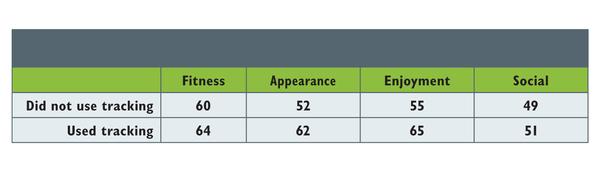
Members’ motivation for exercise was classified into four types: fitness motivation, appearance motivation, enjoyment motivation and social motivation (see also HCM July 14, p48). For each motivation type – which were not mutually exclusive – members’ level of motivation was then classed as high or not. Table 1 shows the percentage of members with high levels of motivation, broken down by type of motivation and according to whether they reported tracking their physical activity. So, for example, 62 per cent of members who used a tracker said they were highly motivated by appearance; among those who didn’t use a tracker, only 52 per cent were motivated by appearance.
In general, members who tracked their physical activity reported stronger motivation than members who did not track. But when considered together, only two types of motivation were significantly higher among members who tracked their activity: appearance and enjoyment motivation.
Visit frequency The average visit frequency per month was 6.7 visits for members who reported using tracking technology and 6.7 for members who did not, so there is no association between tracking of physical activity and club visits.
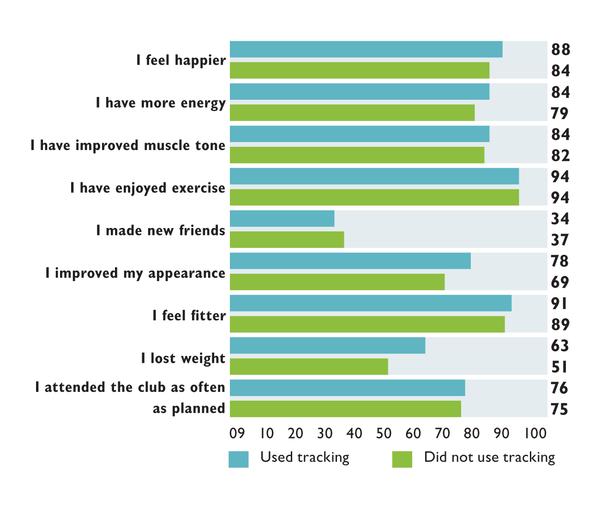
Tracking technology & progress Figure 1 shows the percentage of members who report they have made progress in the last three months in nine areas, according to whether they reported tracking their activity or not.
Apart from making friends, all outcomes are in favour of tracking, although differences in reported progress between members who track their activity and those who don’t is quite small. The largest difference is in weight loss, with 9 per cent more members reporting weight loss if they also reported tracking their activity. This isn’t entirely surprising given the most common method of tracking reported is MyFitnessPal – specifically designed to help people with weight loss.
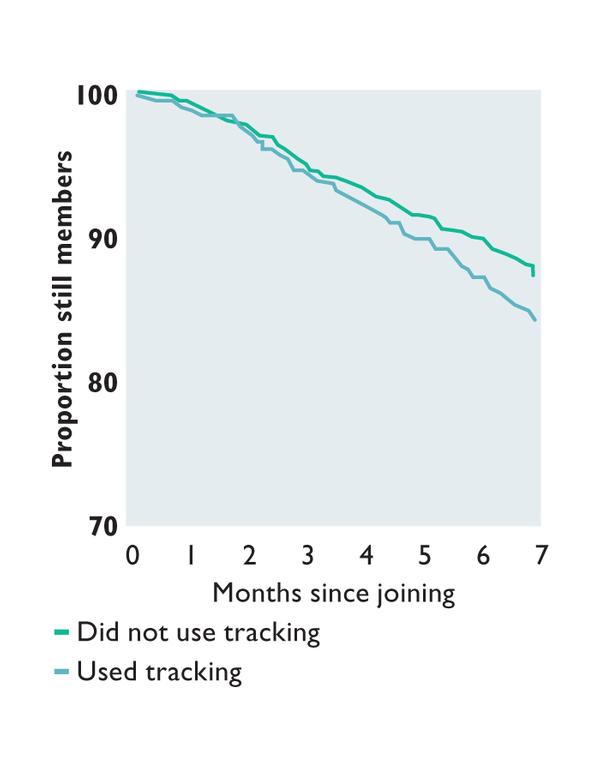
Activity tracking & retention So does tracking activity impact a member’s likelihood of retaining membership? Figure 2 shows that a lower proportion of members retain their membership over seven months of follow-up if they report tracking their physical activity compared to members who do not: 87 per cent of members who didn’t track their physical activity retained their membership at seven months, compared to 83 per cent of members who did track their activity.
The risk of cancelling during the seven-month follow-up period was 25 per cent higher in the tracking members compared to the non-tracking members.
Members who track their physical activity are younger than members who do not, so it’s possible this age difference accounts for the difference in risk of cancelling rather than the use of tracking technology – being younger and/or a more recent club joiner are characteristics that increase this risk.
However, although the additional risk of cancelling among tracking members reduces to 7 per cent when we take account of differences in age between tracking and non-tracking members, this is still statistically significant.
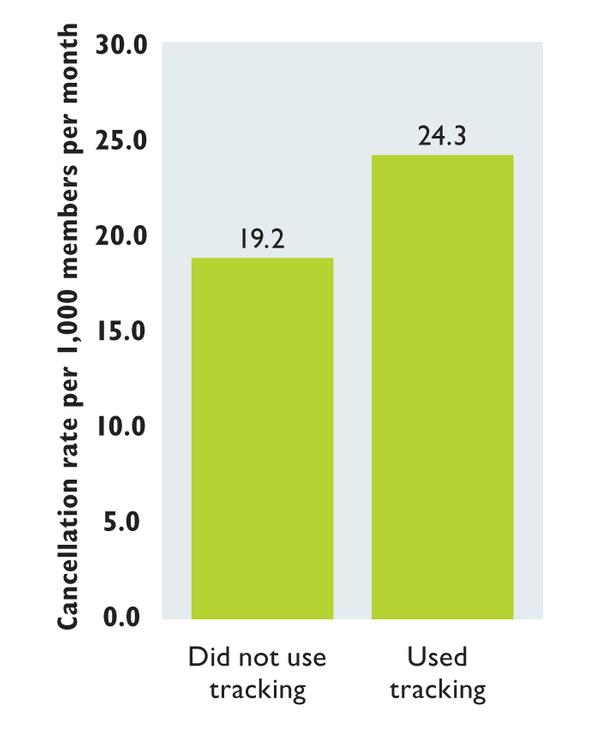
Further, for every 1,000 members, four extra cancel each month if they track their physical activity compared to those who don’t (see Figure 3).
Proceed with caution Wearable technology for tracking personal behaviour attracts considerable press coverage and its use is likely to increase. It’s possible that club operators will believe that either providing their own or encouraging the use of tracking technology will have an effect on their membership retention. This is intuitively appealing.
However, the results of this study suggest operators should be cautious. Even though members who choose to use tracking systems to monitor their behaviour report slightly higher levels of exercise motivation and recent progress on appearance and weight loss, this doesn’t translate into changes in club usage or retention. At best there’s no effect; at worst it actually increases the risk of cancellation.
We’ve previously reported that progress on weight and appearance do not increase membership retention, whereas perceived social and enjoyment benefits do. There is a danger, therefore, that a focus on tracking systems may detract from a greater focus on interpersonal relationships within the club – something we have shown are strongly and consistently associated with higher retention rates in health club members of all types.
While some members will find tracking their behaviour helpful in making progress on appearance and weight loss, this alone will not improve membership retention.
Table 1 Level of motivation by use of tracking and type of motivation (row %)
Table 1
Figure 1 Proportion of members reporting recent progress by use of tracking technology
Figure 1
Figure 2 Retention rate by use of tracking technology
Figure 2
Figure 3 Rate of cancellation (per 1,000 members per month) by use of tracking technology
Figure 3
Tracking & retention – the key findings • 27 per cent of members report using some means of self-monitoring their physical activity, with the majority using a phone-based app or website.
• The most commonly cited means of tracking physical activity was MyFitnessPal.
• Tracking physical activity was more frequently reported by newer, younger members and less so by the older and longer-standing members.
• Members who tracked their physical activity reported higher levels of motivation for exercise, particularly with regards to enjoyment and appearance, but less so for social motivation.
• Despite higher motivation levels, there was no difference in club usage between tracking and non-tracking members, suggesting that reported motivation for exercise doesn’t translate into behaviour change (it’s possible that behaviour changes away from the club).
• Small differences in recent progress were reported between tracking and non-tracking members, with greater progress reported for weight loss and appearance by tracking members – possibly reflecting the widespread use of weight loss-focused MyFitnessPal.
• Although members who reported tracking their physical activity had slightly higher motivation and reported a little more progress in some areas, they didn’t retain their membership for any longer than those who didn’t use tracking; they actually had slightly lower retention rates than members who didn’t track.
• When we adjust our analysis for differences in age and length of membership, tracking members still have an increased risk of cancellation, albeit the difference in risk is slightly reduced.
ABOUT THE AUTHOR
Since his landmark retention report in 2001 (Winning the Retention Battle), Dr Melvyn Hillsdon’s research into retention and attrition has led to the development of appropriate measures of retention, attrition and longevity that provide data for operators that can directly inform business decisions.
He will be presenting at the inaugural Retention Convention, which takes place on 14 May 2015. The event is sold out, but virtual tickets can still be purchased to join a live streaming of the convention. For more information, visit retentionguru.cleeng.com
More people made new friends at the gym if they didn’t use tracking devices / shutterstock.com/wavebreakmediaProductions
Tracking does not appear to change average visit frequency / www.shutterstock.com/
Nine per cent more members reported weight loss if they also reported tracking
MyFitnessPal is the most commonly cited means of tracking / photo: www.shutterstock.com/Bloomua
CoverMe, the global leader in fitness workforce management, today launches CoverMe PT, an
on-demand personal training platform that connects the right personal trainer to the right
client in under 10 seconds. [more...]
Panatta brought together four of the most influential figures in bodybuilding history on the
stage of RiminiWellness 2026: Phil Heath, Lee Haney, Ronnie Coleman and Hany Rambod. [more...]
+ More featured suppliers
COMPANY PROFILES
PSLT Ltd
PSLT Fitness Solutions manufacture, remanufacture and buy back commercial gym equipment. [more...]
Younger members are more likely to use a tracking device / photo: www.shutterstock.com/Syda Productions
Wearable devices and phone-based applications (apps) for self-monitoring of physical activity are becoming increasingly common. However, the level of use and their effectiveness among health club members is still unknown.
Using data collected as part of the TRP 10,000 study, this article will report on what proportion of members track their physical activity using technology and whether the use of such technology is associated with motivation, visit frequency, progress and ultimately membership retention.
Data and analysis Between July and September 2013, members completed an online questionnaire that asked them if they were using any product, app or system to track their physical activity, either inside or outside their club. Members who ticked the box to say they used an app were asked to list the app they used.
Who tracks, and with what? Overall, 27 per cent of members reported using some tracking device, with the majority saying they used a phone or web app (15 per cent).
Slightly more males than females reported tracking their physical activity (30 per cent versus 26 per cent) and levels of tracking declined with age (40 per cent of 16- to 24-year-olds compared to 7 per cent of members aged 55 years and older). Long-standing members were also less likely to report using tracking technology compared to newer members.
Members reported an incredibly broad range of systems for tracking, but the most commonly cited was MyFitnessPal, an internet- and app-based programme designed to help people track their food and physical activity to assist with weight loss. All other tracking systems listed were used by fewer than 1 per cent of members.
Higher motivation? So is there a difference in exercise motivation between members who do and don’t track their physical activity?
Members’ motivation for exercise was classified into four types: fitness motivation, appearance motivation, enjoyment motivation and social motivation (see also HCM July 14, p48). For each motivation type – which were not mutually exclusive – members’ level of motivation was then classed as high or not. Table 1 shows the percentage of members with high levels of motivation, broken down by type of motivation and according to whether they reported tracking their physical activity. So, for example, 62 per cent of members who used a tracker said they were highly motivated by appearance; among those who didn’t use a tracker, only 52 per cent were motivated by appearance.
In general, members who tracked their physical activity reported stronger motivation than members who did not track. But when considered together, only two types of motivation were significantly higher among members who tracked their activity: appearance and enjoyment motivation.
Visit frequency The average visit frequency per month was 6.7 visits for members who reported using tracking technology and 6.7 for members who did not, so there is no association between tracking of physical activity and club visits.
Tracking technology & progress Figure 1 shows the percentage of members who report they have made progress in the last three months in nine areas, according to whether they reported tracking their activity or not.
Apart from making friends, all outcomes are in favour of tracking, although differences in reported progress between members who track their activity and those who don’t is quite small. The largest difference is in weight loss, with 9 per cent more members reporting weight loss if they also reported tracking their activity. This isn’t entirely surprising given the most common method of tracking reported is MyFitnessPal – specifically designed to help people with weight loss.
Activity tracking & retention So does tracking activity impact a member’s likelihood of retaining membership? Figure 2 shows that a lower proportion of members retain their membership over seven months of follow-up if they report tracking their physical activity compared to members who do not: 87 per cent of members who didn’t track their physical activity retained their membership at seven months, compared to 83 per cent of members who did track their activity.
The risk of cancelling during the seven-month follow-up period was 25 per cent higher in the tracking members compared to the non-tracking members.
Members who track their physical activity are younger than members who do not, so it’s possible this age difference accounts for the difference in risk of cancelling rather than the use of tracking technology – being younger and/or a more recent club joiner are characteristics that increase this risk.
However, although the additional risk of cancelling among tracking members reduces to 7 per cent when we take account of differences in age between tracking and non-tracking members, this is still statistically significant.
Further, for every 1,000 members, four extra cancel each month if they track their physical activity compared to those who don’t (see Figure 3).
Proceed with caution Wearable technology for tracking personal behaviour attracts considerable press coverage and its use is likely to increase. It’s possible that club operators will believe that either providing their own or encouraging the use of tracking technology will have an effect on their membership retention. This is intuitively appealing.
However, the results of this study suggest operators should be cautious. Even though members who choose to use tracking systems to monitor their behaviour report slightly higher levels of exercise motivation and recent progress on appearance and weight loss, this doesn’t translate into changes in club usage or retention. At best there’s no effect; at worst it actually increases the risk of cancellation.
We’ve previously reported that progress on weight and appearance do not increase membership retention, whereas perceived social and enjoyment benefits do. There is a danger, therefore, that a focus on tracking systems may detract from a greater focus on interpersonal relationships within the club – something we have shown are strongly and consistently associated with higher retention rates in health club members of all types.
While some members will find tracking their behaviour helpful in making progress on appearance and weight loss, this alone will not improve membership retention.
Table 1 Level of motivation by use of tracking and type of motivation (row %)
Table 1
Figure 1 Proportion of members reporting recent progress by use of tracking technology
Figure 1
Figure 2 Retention rate by use of tracking technology
Figure 2
Figure 3 Rate of cancellation (per 1,000 members per month) by use of tracking technology
Figure 3
Tracking & retention – the key findings • 27 per cent of members report using some means of self-monitoring their physical activity, with the majority using a phone-based app or website.
• The most commonly cited means of tracking physical activity was MyFitnessPal.
• Tracking physical activity was more frequently reported by newer, younger members and less so by the older and longer-standing members.
• Members who tracked their physical activity reported higher levels of motivation for exercise, particularly with regards to enjoyment and appearance, but less so for social motivation.
• Despite higher motivation levels, there was no difference in club usage between tracking and non-tracking members, suggesting that reported motivation for exercise doesn’t translate into behaviour change (it’s possible that behaviour changes away from the club).
• Small differences in recent progress were reported between tracking and non-tracking members, with greater progress reported for weight loss and appearance by tracking members – possibly reflecting the widespread use of weight loss-focused MyFitnessPal.
• Although members who reported tracking their physical activity had slightly higher motivation and reported a little more progress in some areas, they didn’t retain their membership for any longer than those who didn’t use tracking; they actually had slightly lower retention rates than members who didn’t track.
• When we adjust our analysis for differences in age and length of membership, tracking members still have an increased risk of cancellation, albeit the difference in risk is slightly reduced.
ABOUT THE AUTHOR
Since his landmark retention report in 2001 (Winning the Retention Battle), Dr Melvyn Hillsdon’s research into retention and attrition has led to the development of appropriate measures of retention, attrition and longevity that provide data for operators that can directly inform business decisions.
He will be presenting at the inaugural Retention Convention, which takes place on 14 May 2015. The event is sold out, but virtual tickets can still be purchased to join a live streaming of the convention. For more information, visit retentionguru.cleeng.com
More people made new friends at the gym if they didn’t use tracking devices / shutterstock.com/wavebreakmediaProductions
Tracking does not appear to change average visit frequency / www.shutterstock.com/
Nine per cent more members reported weight loss if they also reported tracking
MyFitnessPal is the most commonly cited means of tracking / photo: www.shutterstock.com/Bloomua
The UK's four Chief Medical Officers have published a refreshed edition of Physical activity
guidelines: UK Chief Medical Officers' report, updating the evidence that underpins the nation's
physical activity recommendations and placing greater emphasis on strength, balance, reducing
sedentary behaviour and, for the first time, supporting people taking weight loss medications.
Places Leisure has exchanged contracts to build and operate a flagship £60m water and leisure
destination on behalf of Basingstoke and Deane Borough Council.
The Republic of Ireland will become the latest market in PureGym’s expanding international
portfolio, with the first launch planned for Dublin in 2027.
Anytime Fitness opened more than one club a day in 2025 and is on track to maintain this rate
of growth this year, as parent company Purpose Brands targets further international expansion.
The £33.9 million Leighton Leisure and Community Centre has opened in Leighton Buzzard, UK,
creating a next-generation public leisure, health and wellbeing hub for the local community.
Walnuts Leisure Centre in Orpington, in the London Borough of Bromley, has reopened following
a £17m transformation designed to secure the long-term future of the public leisure asset and
reposition it as a community wellbeing hub.
The Gym Group, has announced that it's sustained positive trading momentum has continued
through the first half of 2026 and the company remains confident about the outlook.
Luxury boutique Pilates and wellness studio, X-Club, officially launches a
4,000sq ft flagship at
Marylebone on 16 July Built around X-Club’s four pillars of wellness – mind,
movement,
nutrition and therapy – the facility features two group exercise studi
CoverMe, the global leader in fitness workforce management, today launches CoverMe PT, an
on-demand personal training platform that connects the right personal trainer to the right
client in under 10 seconds. [more...]
Panatta brought together four of the most influential figures in bodybuilding history on the
stage of RiminiWellness 2026: Phil Heath, Lee Haney, Ronnie Coleman and Hany Rambod. [more...]
+ More featured suppliers
COMPANY PROFILES
PSLT Ltd PSLT Fitness Solutions manufacture, remanufacture and buy back commercial gym equipment. [more...]