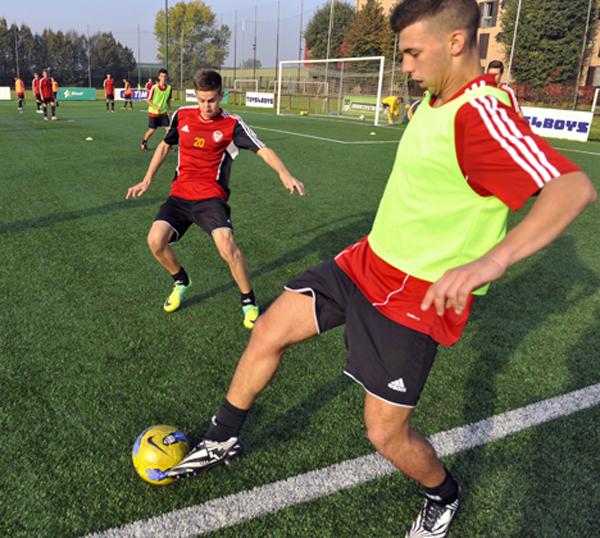
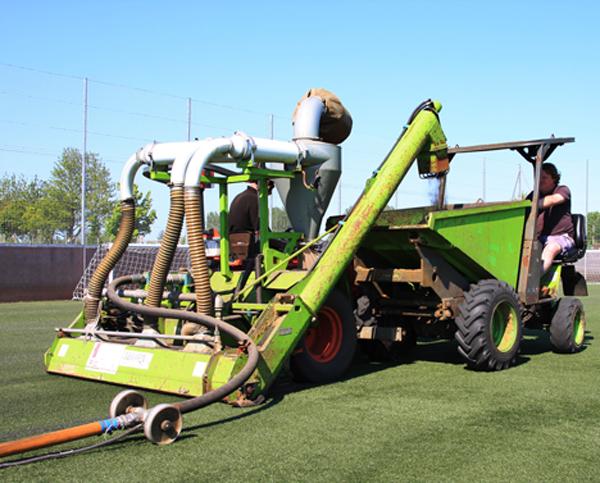
De-compacting and increasing the porosity of a 3G pitch will create a safer surface for the players
Artificial turf pitches are not maintenance free. In recent years the industry has woken up to the need to provide best practice advice on the benefits of proper, appropriate and regular maintenance – and its impact on performance and the safety of the playing surface. The requirement to maintain standards which meet those laid out by global governing body certificates – such as the ones for FIFA and IRB – is also driving a much more robust approach to maintenance. Some football leagues insist on annual certification via pitch registration schemes.
The importance of having properly maintained artificial surfaces has also been hightened due to the increasing popularity of 3G surfaces at all levels and sports. Artificial surfaces are now the first choice at most community clubs and facilities, mainly due to the many more hours of use an artificial surface offers when compared with a grass pitch. Meanwhile, as turf technology advances, many professional leagues and clubs are looking at changing rules which currently prevent elite level competition from taking place on non-grass pitches. One of the latest examples is the Football Conference – the fifth tier of English football – which decided to allow 3G pitches in all three divisions from the beginning of the 2015-16 season. The women’s FIFA World Cup will also take advantage of artificial pitches when it is held in Canada next year.
Paul Langford, managing director at TigerTurf UK, says the Conference’s decision represents a landmark for English Football and is a sign of the growing predominance of synthetic turf. “The decision to permit the use of synthetic turf has wider benefits for the community,” he says.
“Not only will local people enjoy the frequency of matches as less games are postponed, but there may also be the opportunity for the pitch to be used at community level. With the Premier League, government and FA committing £102m to improving grassroots football for three years from the beginning of 2014, this decision may have implications for new funding opportunities.”
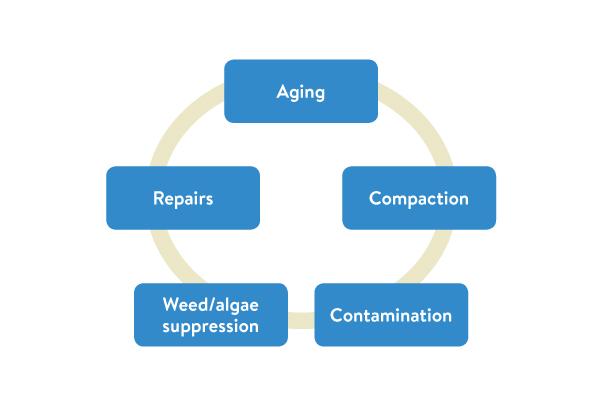
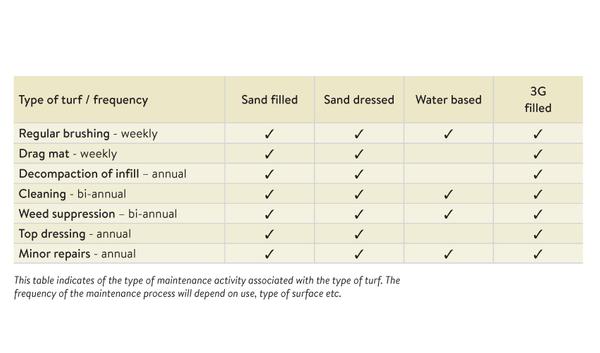
The art of maintenance Ultimately the aims of maintenance are obvious – to retain as far as possible the performance and safety of the playing surface. Without proper maintenance all artificial pitches deteriorate; first performance is compromised, then life expectancy can be severely affected. The maintenance processes used to combat deterioration of the pitch are illustrated in figure 1 and maintenance types in table 1.
Third generation (3G) pitches form a significant part of the market for artificial pitches globally and warrant special attention when it comes to maintenance practices. It isn’t just the surface which needs to be considered though, as the types of construction materials used will also affect maintenance. The construction of the artificial turf and the type and manner of infill materials used means that a number of maintenance procedures are required to retain the characteristics of the artificial pitch. Other types of artificial pitches such as sand filled/dressed or water-based pitches call up some, or all, of the same procedures.
One of the businesses providing services that aim to prolong the life of a pitch is Replay Maintenance. The company specialises in maintaining synthetic sports surfaces – such as 3G pitches – and has seen an increasing number of facilities who are appreciating the value of maintaining their sports surfaces. According to Garry Martin, Replay’s director, an artificial pitch which is constantly in use has different maintenance needs to a natural grass pitch, which can only take a few hours’ use a week.
“Artificial turf pitches, over time, become contaminated and compacted,” Martin says.
“Playing on the pitch becomes more difficult and more dangerous, particularly if there is surface water on the pitch that won’t drain away.
“The types of services we offer not only improve the playing performance but will create a safer surface for the players by de-compacting the surface and increasing the porosity of the pitch.”
The intensity of use and footfall is by far the most critical factor to take into account when considering how much and what type of maintenance a pitch will require. Other factors, however, are important – for example, the quality of the turf product can have a significant affect on how a pitch responds to maintenance. Further, contamination and aging will affect pitch maintenance especially as the pitch reaches maturity.
Keep it simple The most appropriate type of maintenance is fairly simple to carry out. A simple tractor unit with a drag brush and a drag mat, when properly used, is all that is required to keep a pitch in good condition. Weed suppression is also important. Additional fill materials should be applied infrequently, based on use and the relative amount of free pile exposed when assessed against the manufacturers recommendations.
A specialist maintenance company should be employed to carry out specialist maintenance such as decompaction and decontamination. In all circumstances the manufacturer’s recommendations should be followed. Often, the issue of drainage becomes a priority following heavy rainfall or flooding – as in the case of Repton School in Derby, UK where a local river flooded both of its water-based and sand-dressed surfaces. Replay Maintenance responded to an urgent call from the school after severe damage to the facilities completely stopped play.
Darryl Parkinson, grounds manager at Repton School, said: “We suffered from severe flood damage from contaminated water, but the equipment, speed of reply and speed with which Replay were able to assess and repair the damage was very impressive. It all ran very smoothly and is definitely an avenue we would like to go down on an annual basis.”
Unmaintained – unworkable If a pitch is not maintained then it does not take long for the negative effects to become apparent. The fill materials will become uneven and the distribution will be poor. Compaction will occur and the free pile level may exceed the design parameters resulting in the pile becoming flat. If left the situation may become difficult to remediate. Loss of fill and contamination occur making the pitch firm and fast in terms of ball surface interaction. A pitch which lacks maintenance can fail NGB requirements and become somewhat unsafe.
Ground staff can perform rudimentary testing to index the performance of a pitch to assess the need for maintenance and can be used to assess the effects of maintenance processes. The ball roll and ball bounce tests are very effective at assessing the condition of a playing surface and can be carried out quite easily by trained ground staff. During inspection of surfaces, the most common problems observed are compaction of infill – characterized by the pitch being firm under foot – can cause pile flattening. This is sometimes caused by loss of infill, which occurs under normal use from players and environmental conditions. Seam failures – in lines, penalty spots and seams – and wear and tear in the goal areas are other problems sometimes associated with artificial surfaces.
End game In an increasingly litigious society, maintaining a pitch in a safe condition is fundamentally important. What more, certification rules which require cyclic (annual or bi-annual) testing effectively provide an audit of the facility. These directly measure the effectiveness of maintenance procedures – bringing increasing focus to the issue.
Evidence suggests that the average owner hasn’t yet grasped that maintenance is an essential part of post-construction responsibilities. Brushing ‘little and often’ and top dressing can result in a lot less intervention work by specialists early in the lifecycle of a pitch facility.
The following formula characterises the maintenance requirements of a pitch:
Aging [a] + Contamination [b] + ability to sustain use [c] x intensity of use [d] = maintenance factor [e] a = age in years 1-10 b = level of contamination 1-5 c = quality of product 1-5 d = 10–60 hours of use
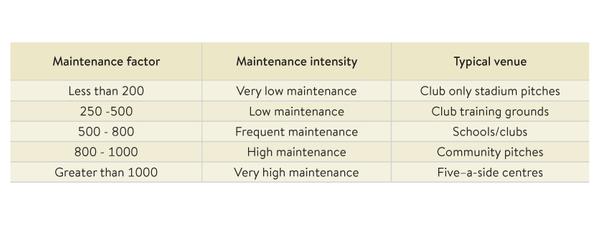
The maintenance factor MF [e] is expressed in units of 100s. The MF indicates the approach to maintenance and whether low of high frequency intensive maintenance is required.
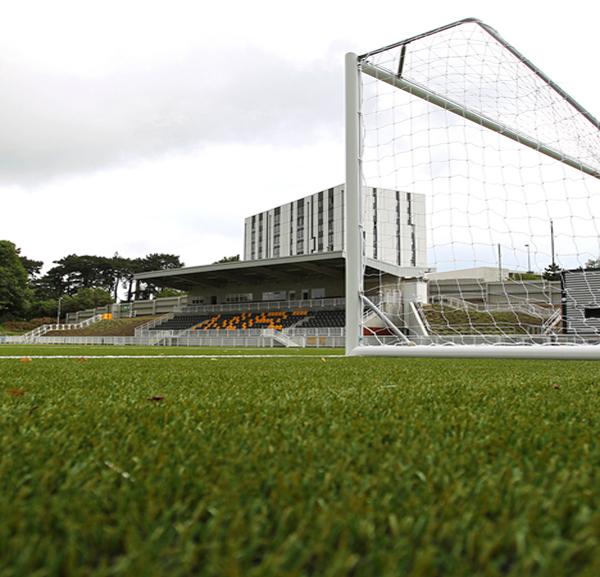
Maidstone United, one of the first top English clubs to invest in a 3G pitch
Figure 1: maintenance is used to combat the affects of the following issues
Table 1: Artificial turf by type and its relevant maintenance
Replay Maintenance at work at Repton School, which suffered flood damage from contaminated water
Table 2: Maintenance factors for different pitches
As healthcare continues to shift towards prevention, there’s a growing focus on helping
people stay active, independent and feeling good for longer. [more...]
CoverMe, the global leader in fitness workforce management, today launches CoverMe PT, an
on-demand personal training platform that connects the right personal trainer to the right
client in under 10 seconds. [more...]
De-compacting and increasing the porosity of a 3G pitch will create a safer surface for the players
Artificial turf pitches are not maintenance free. In recent years the industry has woken up to the need to provide best practice advice on the benefits of proper, appropriate and regular maintenance – and its impact on performance and the safety of the playing surface. The requirement to maintain standards which meet those laid out by global governing body certificates – such as the ones for FIFA and IRB – is also driving a much more robust approach to maintenance. Some football leagues insist on annual certification via pitch registration schemes.
The importance of having properly maintained artificial surfaces has also been hightened due to the increasing popularity of 3G surfaces at all levels and sports. Artificial surfaces are now the first choice at most community clubs and facilities, mainly due to the many more hours of use an artificial surface offers when compared with a grass pitch. Meanwhile, as turf technology advances, many professional leagues and clubs are looking at changing rules which currently prevent elite level competition from taking place on non-grass pitches. One of the latest examples is the Football Conference – the fifth tier of English football – which decided to allow 3G pitches in all three divisions from the beginning of the 2015-16 season. The women’s FIFA World Cup will also take advantage of artificial pitches when it is held in Canada next year.
Paul Langford, managing director at TigerTurf UK, says the Conference’s decision represents a landmark for English Football and is a sign of the growing predominance of synthetic turf. “The decision to permit the use of synthetic turf has wider benefits for the community,” he says.
“Not only will local people enjoy the frequency of matches as less games are postponed, but there may also be the opportunity for the pitch to be used at community level. With the Premier League, government and FA committing £102m to improving grassroots football for three years from the beginning of 2014, this decision may have implications for new funding opportunities.”
The art of maintenance Ultimately the aims of maintenance are obvious – to retain as far as possible the performance and safety of the playing surface. Without proper maintenance all artificial pitches deteriorate; first performance is compromised, then life expectancy can be severely affected. The maintenance processes used to combat deterioration of the pitch are illustrated in figure 1 and maintenance types in table 1.
Third generation (3G) pitches form a significant part of the market for artificial pitches globally and warrant special attention when it comes to maintenance practices. It isn’t just the surface which needs to be considered though, as the types of construction materials used will also affect maintenance. The construction of the artificial turf and the type and manner of infill materials used means that a number of maintenance procedures are required to retain the characteristics of the artificial pitch. Other types of artificial pitches such as sand filled/dressed or water-based pitches call up some, or all, of the same procedures.
One of the businesses providing services that aim to prolong the life of a pitch is Replay Maintenance. The company specialises in maintaining synthetic sports surfaces – such as 3G pitches – and has seen an increasing number of facilities who are appreciating the value of maintaining their sports surfaces. According to Garry Martin, Replay’s director, an artificial pitch which is constantly in use has different maintenance needs to a natural grass pitch, which can only take a few hours’ use a week.
“Artificial turf pitches, over time, become contaminated and compacted,” Martin says.
“Playing on the pitch becomes more difficult and more dangerous, particularly if there is surface water on the pitch that won’t drain away.
“The types of services we offer not only improve the playing performance but will create a safer surface for the players by de-compacting the surface and increasing the porosity of the pitch.”
The intensity of use and footfall is by far the most critical factor to take into account when considering how much and what type of maintenance a pitch will require. Other factors, however, are important – for example, the quality of the turf product can have a significant affect on how a pitch responds to maintenance. Further, contamination and aging will affect pitch maintenance especially as the pitch reaches maturity.
Keep it simple The most appropriate type of maintenance is fairly simple to carry out. A simple tractor unit with a drag brush and a drag mat, when properly used, is all that is required to keep a pitch in good condition. Weed suppression is also important. Additional fill materials should be applied infrequently, based on use and the relative amount of free pile exposed when assessed against the manufacturers recommendations.
A specialist maintenance company should be employed to carry out specialist maintenance such as decompaction and decontamination. In all circumstances the manufacturer’s recommendations should be followed. Often, the issue of drainage becomes a priority following heavy rainfall or flooding – as in the case of Repton School in Derby, UK where a local river flooded both of its water-based and sand-dressed surfaces. Replay Maintenance responded to an urgent call from the school after severe damage to the facilities completely stopped play.
Darryl Parkinson, grounds manager at Repton School, said: “We suffered from severe flood damage from contaminated water, but the equipment, speed of reply and speed with which Replay were able to assess and repair the damage was very impressive. It all ran very smoothly and is definitely an avenue we would like to go down on an annual basis.”
Unmaintained – unworkable If a pitch is not maintained then it does not take long for the negative effects to become apparent. The fill materials will become uneven and the distribution will be poor. Compaction will occur and the free pile level may exceed the design parameters resulting in the pile becoming flat. If left the situation may become difficult to remediate. Loss of fill and contamination occur making the pitch firm and fast in terms of ball surface interaction. A pitch which lacks maintenance can fail NGB requirements and become somewhat unsafe.
Ground staff can perform rudimentary testing to index the performance of a pitch to assess the need for maintenance and can be used to assess the effects of maintenance processes. The ball roll and ball bounce tests are very effective at assessing the condition of a playing surface and can be carried out quite easily by trained ground staff. During inspection of surfaces, the most common problems observed are compaction of infill – characterized by the pitch being firm under foot – can cause pile flattening. This is sometimes caused by loss of infill, which occurs under normal use from players and environmental conditions. Seam failures – in lines, penalty spots and seams – and wear and tear in the goal areas are other problems sometimes associated with artificial surfaces.
End game In an increasingly litigious society, maintaining a pitch in a safe condition is fundamentally important. What more, certification rules which require cyclic (annual or bi-annual) testing effectively provide an audit of the facility. These directly measure the effectiveness of maintenance procedures – bringing increasing focus to the issue.
Evidence suggests that the average owner hasn’t yet grasped that maintenance is an essential part of post-construction responsibilities. Brushing ‘little and often’ and top dressing can result in a lot less intervention work by specialists early in the lifecycle of a pitch facility.
The following formula characterises the maintenance requirements of a pitch:
Aging [a] + Contamination [b] + ability to sustain use [c] x intensity of use [d] = maintenance factor [e] a = age in years 1-10 b = level of contamination 1-5 c = quality of product 1-5 d = 10–60 hours of use
The maintenance factor MF [e] is expressed in units of 100s. The MF indicates the approach to maintenance and whether low of high frequency intensive maintenance is required.
Maidstone United, one of the first top English clubs to invest in a 3G pitch
Figure 1: maintenance is used to combat the affects of the following issues
Table 1: Artificial turf by type and its relevant maintenance
Replay Maintenance at work at Repton School, which suffered flood damage from contaminated water
Table 2: Maintenance factors for different pitches
Global luxury hospitality brand, Six Senses, has partnered with longevity healthcare provider,
HUM2N, to launch a clinic at Six Senses London, at The Whiteley.
Premium London health club, KX Chelsea, will imminently unveil its most significant
redevelopment since its launch in 2002 to create an integrated wellness model combining
training, recovery and relaxation.
Researchers in the US have identified an antibody which could greatly reduce the loss of lean
muscle mass in people who are taking weight-loss medications.
Crunch Fitness has announced the launch of Crunch Reform Pilates – its own reformer concept
designed to bring this fast growing, but rather expensive, modality into the mainstream.
The 20th State of the Industry Report reveals a resilient, expanding and competitive
sector, the
importance of differentiation and the ongoing challenge of tackling inequalities.
Nuffield Health has told HCM that it takes its responsibilities towards its colleagues seriously
and is committed to meeting all legal obligations after news of a tribunal has made national
headlines.
Technogym has announced the launch of the Run X World Treadmill Championship, the first
world championship for running on connected treadmills over five kilometres.
As healthcare continues to shift towards prevention, there’s a growing focus on helping
people stay active, independent and feeling good for longer. [more...]
CoverMe, the global leader in fitness workforce management, today launches CoverMe PT, an
on-demand personal training platform that connects the right personal trainer to the right
client in under 10 seconds. [more...]