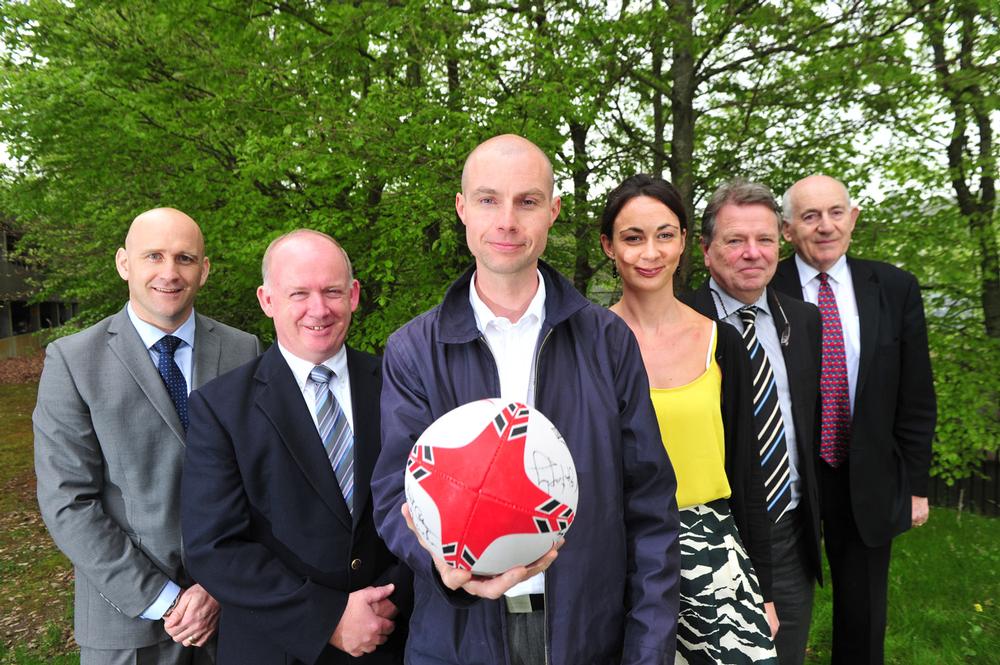
Dr Paul Cotter (centre) with co-researchers (left to right): Dr Eanna Falvey, Declan Kidney, Dr Eileen Murphy, Prof Fergus Shanahan and Dr Michael Molly
The health of our gut is garnering much attention of late, with a growing number of studies highlighting just how important it is to our overall wellbeing: it can have a powerful effect on anything from our mood to our immune system and our ability to fight disease. It’s also believed to be a key factor in tackling obesity.
The gut contains 10 times more bacteria than all of the cells in the entire rest of the body, and the health of gut flora not only aids digestion but also helps to regulate the metabolism. Specifically, a high microbial diversity in the gut has been associated with better overall health, whereas a low diversity of gut microbes has been linked to many diseases and syndromes, including obesity.
Numerous studies have looked at the impact diet has on gut health, and last month, scientists from Ireland revealed how exercise, alongside food intake, can help too. The findings were published in the international journal Gut*.
Researching rugby players Researchers at the Alimentary Pharmabiotic Centre at University College Cork and the Teagasc Food Research Centre based their study on 40 Irish professional rugby players at the peak of training for the 2011 Rugby World Cup. Stool and blood samples were taken to measure the variety of bacteria in their guts. The players also completed a food questionnaire detailing the intake of 187 different items of food over a period of four weeks.
Their results were compared to a control group of 46 men. These men weren’t elite athletes, but they had the same mean age (29) as the rugby players. Half of them had an average BMI of 25 or lower, while the other half had a high BMI of 28 and above.
Exercise and diet impact Researchers found the microbial diversity in the gut was significantly higher in the athletes compared to the control group, especially those with higher BMI scores. The levels of certain types of good bacteria were also greater in the rugby players. This included higher levels of akkermansiaceae – a type of bacteria associated with a lower risk of obesity. Athletes also had lower inflammatory and improved metabolic markers compared to the other men.
These gut microbial results correlated with two other studies: firstly, unsurprisingly, that the athlete group took part in much more physical activity than the control group – indicated by far higher levels of creatine kinase.
Secondly, dietary analysis showed that protein accounted for considerably more of the rugby players’ total energy intake (22 per cent), compared to the low BMI (16 per cent) and high BMI (15 per cent) control groups. The athletes’ fruit and veg intake was higher too.
“The athletes are an exceptional group in terms of their dietary intake, fitness/endurance and now, we know, in relation to their gut microbiota,” reports the Alimentary Pharmabiotic Centre. “This high diversity is linked with exercise and protein consumption and suggests that eating specific proteins and/or exercise can provide a means of increasing microbial diversity in the gut.”
Dr Paul Cotter, the principal research officer at Teagasc Food Research Centre told HCM: “We’re not sure which is more important – diet, exercise, or a combination of both. We hope follow-up studies will make this clearer. We’ll be looking at relatively unfit people to see if we can increase their microbial diversity [and, in turn, their gut health] through exercise and/or protein.
“The precise mechanism through which exercise might impact on the gut microbiota will also require further investigation. It could be related to the impact on the immune system, but it’s too early to say.”
*Clarke SF et al. Exercise and associated dietary extremes impact on gut mircobial diversity. Gut. June 2014
Panatta brought together four of the most influential figures in bodybuilding history on the
stage of RiminiWellness 2026: Phil Heath, Lee Haney, Ronnie Coleman and Hany Rambod. [more...]
Active Blackpool is deploying Cornerstone Connect, a new digital interface allowing
disparate information from multiple systems to be aggregated into one dataset, to support
its focus on reducing health inequalities and improving healthy life expectancy. [more...]
Dr Paul Cotter (centre) with co-researchers (left to right): Dr Eanna Falvey, Declan Kidney, Dr Eileen Murphy, Prof Fergus Shanahan and Dr Michael Molly
The health of our gut is garnering much attention of late, with a growing number of studies highlighting just how important it is to our overall wellbeing: it can have a powerful effect on anything from our mood to our immune system and our ability to fight disease. It’s also believed to be a key factor in tackling obesity.
The gut contains 10 times more bacteria than all of the cells in the entire rest of the body, and the health of gut flora not only aids digestion but also helps to regulate the metabolism. Specifically, a high microbial diversity in the gut has been associated with better overall health, whereas a low diversity of gut microbes has been linked to many diseases and syndromes, including obesity.
Numerous studies have looked at the impact diet has on gut health, and last month, scientists from Ireland revealed how exercise, alongside food intake, can help too. The findings were published in the international journal Gut*.
Researching rugby players Researchers at the Alimentary Pharmabiotic Centre at University College Cork and the Teagasc Food Research Centre based their study on 40 Irish professional rugby players at the peak of training for the 2011 Rugby World Cup. Stool and blood samples were taken to measure the variety of bacteria in their guts. The players also completed a food questionnaire detailing the intake of 187 different items of food over a period of four weeks.
Their results were compared to a control group of 46 men. These men weren’t elite athletes, but they had the same mean age (29) as the rugby players. Half of them had an average BMI of 25 or lower, while the other half had a high BMI of 28 and above.
Exercise and diet impact Researchers found the microbial diversity in the gut was significantly higher in the athletes compared to the control group, especially those with higher BMI scores. The levels of certain types of good bacteria were also greater in the rugby players. This included higher levels of akkermansiaceae – a type of bacteria associated with a lower risk of obesity. Athletes also had lower inflammatory and improved metabolic markers compared to the other men.
These gut microbial results correlated with two other studies: firstly, unsurprisingly, that the athlete group took part in much more physical activity than the control group – indicated by far higher levels of creatine kinase.
Secondly, dietary analysis showed that protein accounted for considerably more of the rugby players’ total energy intake (22 per cent), compared to the low BMI (16 per cent) and high BMI (15 per cent) control groups. The athletes’ fruit and veg intake was higher too.
“The athletes are an exceptional group in terms of their dietary intake, fitness/endurance and now, we know, in relation to their gut microbiota,” reports the Alimentary Pharmabiotic Centre. “This high diversity is linked with exercise and protein consumption and suggests that eating specific proteins and/or exercise can provide a means of increasing microbial diversity in the gut.”
Dr Paul Cotter, the principal research officer at Teagasc Food Research Centre told HCM: “We’re not sure which is more important – diet, exercise, or a combination of both. We hope follow-up studies will make this clearer. We’ll be looking at relatively unfit people to see if we can increase their microbial diversity [and, in turn, their gut health] through exercise and/or protein.
“The precise mechanism through which exercise might impact on the gut microbiota will also require further investigation. It could be related to the impact on the immune system, but it’s too early to say.”
*Clarke SF et al. Exercise and associated dietary extremes impact on gut mircobial diversity. Gut. June 2014
The UK's four Chief Medical Officers have published a refreshed edition of Physical activity
guidelines: UK Chief Medical Officers' report, updating the evidence that underpins the nation's
physical activity recommendations and placing greater emphasis on strength, balance, reducing
sedentary behaviour and, for the first time, supporting people taking weight loss medications.
Places Leisure has exchanged contracts to build and operate a flagship £60m water and leisure
destination on behalf of Basingstoke and Deane Borough Council.
The Republic of Ireland will become the latest market in PureGym’s expanding international
portfolio, with the first launch planned for Dublin in 2027.
Anytime Fitness opened more than one club a day in 2025 and is on track to maintain this rate
of growth this year, as parent company Purpose Brands targets further international expansion.
The £33.9 million Leighton Leisure and Community Centre has opened in Leighton Buzzard, UK,
creating a next-generation public leisure, health and wellbeing hub for the local community.
Walnuts Leisure Centre in Orpington, in the London Borough of Bromley, has reopened following
a £17m transformation designed to secure the long-term future of the public leisure asset and
reposition it as a community wellbeing hub.
The Gym Group, has announced that it's sustained positive trading momentum has continued
through the first half of 2026 and the company remains confident about the outlook.
Luxury boutique Pilates and wellness studio, X-Club, officially launches a
4,000sq ft flagship at
Marylebone on 16 July Built around X-Club’s four pillars of wellness – mind,
movement,
nutrition and therapy – the facility features two group exercise studi
Panatta brought together four of the most influential figures in bodybuilding history on the
stage of RiminiWellness 2026: Phil Heath, Lee Haney, Ronnie Coleman and Hany Rambod. [more...]
Active Blackpool is deploying Cornerstone Connect, a new digital interface allowing
disparate information from multiple systems to be aggregated into one dataset, to support
its focus on reducing health inequalities and improving healthy life expectancy. [more...]