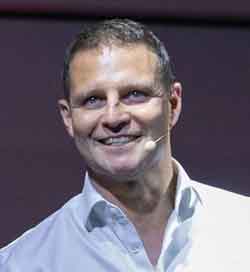
A love of art and the environment led to the creation of two underwater museums, which provide homes for coral and sea life. Eco sculptor Jason deCaires Taylor tells Kathleen Whyman what inspires him
By Kathleen Whyman | Published in Leisure Management 2014 issue 2
The sculptures are designed to
last for hundreds of years, so have to be very well built
What was your inspiration? I’m a sculptor and was mainly working on land and with the landscape. I was creating objects that had no functional purpose other than their artistic value – the world’s cluttered enough, we need more of a reason to make things.
I had the idea that if I worked underwater, these objects would not only discuss the boundaries of art, they’d create habitat space for sea life and be beneficial to the environment. That was the main driving force.
How did you get started? The first museum was in Grenada in 2006. I grew up in Spain, Portugal, Malaysia and the UK and happened to be living and teaching scuba diving in Grenada at the time.
I’d had the idea for the underwater sculptures for a while, so looked into how feasible it was and presented the concept to the local government. They were sceptical, but interested, so I started small with a couple of pieces and added to them. It kept growing and more people started to help and support the project. Over the course of two years I built the first underwater sculpture park, which contains 65 individual works and is called Grenada Underwater Sculpture Park.
The government of Mexico, after seeing this project, invited me to address some of the problems they have with high levels of tourism in Cancun. MUSA (Museo Subacuático de Arte) opened in 2009 and has 510 permanent sculptural works.
How do the museums benefit the environment? Prior to the museum, there was only one good snorkelling area in Grenada. All the boats would congregate in that area and there was damage to the reef from people jumping off boats and kicking corals and it was slowly deteriorating. I created another snorkelling site nearby to relieve some of that pressure – coral grows on the sculptures and fish live around them.
It was a similar objective in Cancun. The area has more than 750,000 visitors each year, so the objective was to try and manage those people and minimise the impact to the reef. The government wanted to start closing sections of the reef down to allow them to rejuvenate and thrive, but the business community threatened to sue the government for closing down their economy and insisted on an alternative offer. It was at that point that they contacted me.
How has the local community benefited? The statistics are amazing. In Cancun, the diving has increased by 30 per cent in a few years and now gets over 80,000 visitors annually. In Grenada, the area never used to have visitors, but now gets 20,000 people a year. Seventy per cent of divers go to the museum site rather than the original reef. It’s in the top three TripAdvisor ratings and got voted by National Geographic as one of the Wonders of the World.
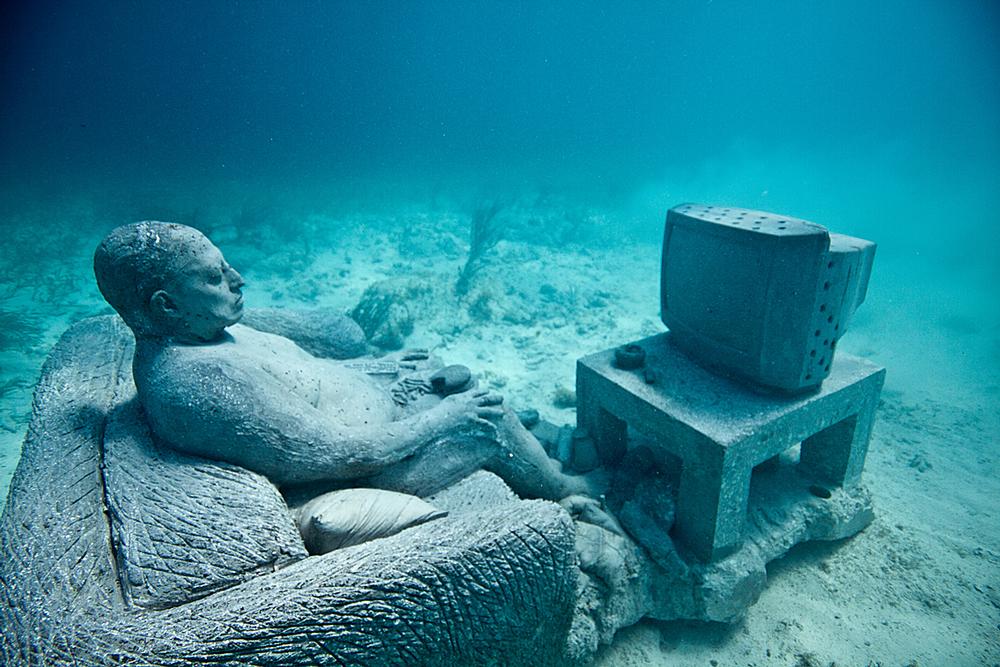
What are the sculptures? Predominantly I use figurative forms, with concepts of humans working in harmony with nature. I strive to bring in themes of the threat to the reef and how we’re oblivious to what happens under water. I’ve sculpted a guy on a sofa watching TV, showing the irony of the way we live and how we’re so focused on our little worlds that we forget the bigger picture.
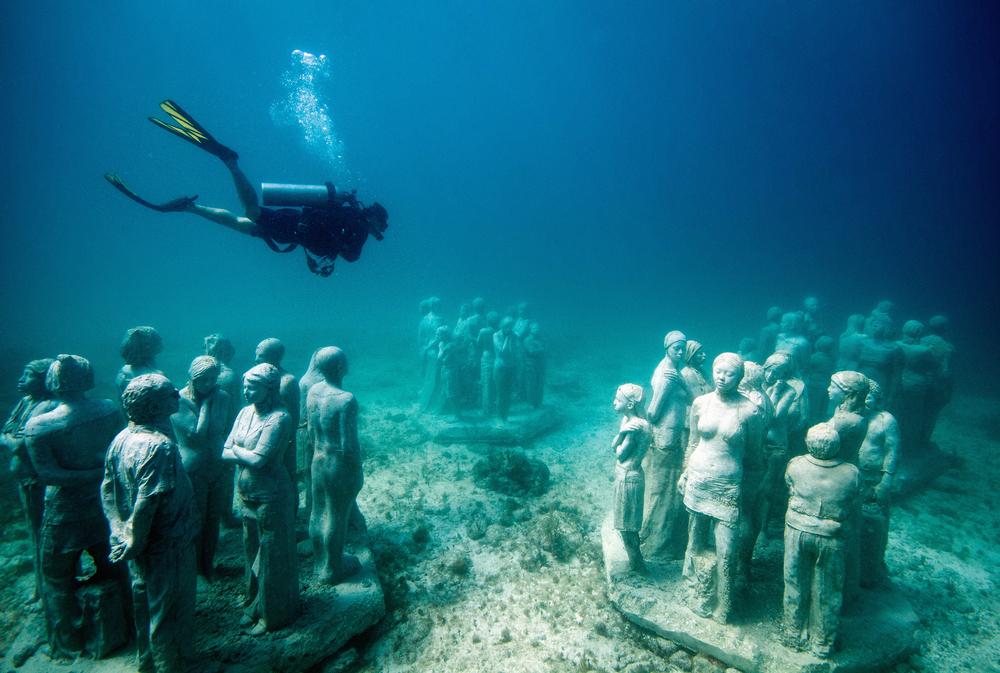
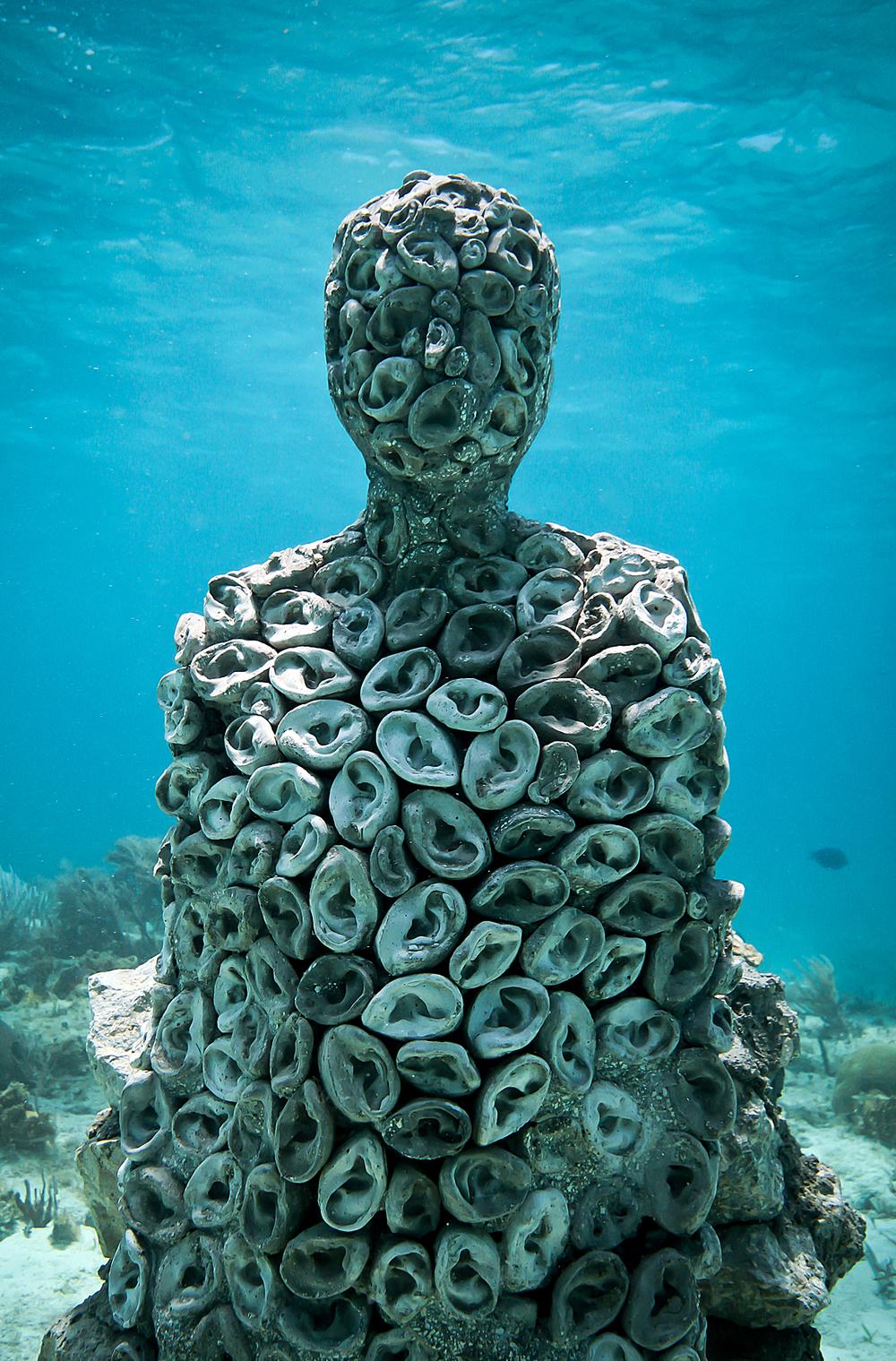
There are hundreds of sculptures ranging from The Silent Evolution – a crowd of 450 people which informs visitors on the various stages of reef evolution; a series of suburban dwellings designed to house individual marine species; The Listener – a lone figure assembled entirely from casts of human ears and a recording device to monitor the reef; and Reclamation, an angelic female form with wings that are propagated with living coral.
One of the large installations – The Silent Evolution – took me two years and an amazing amount of hard work and I was really pleased with it. Then I did a piece called Banker, which is a guy with his head in the sand, and that got just as much response and it only took a month to make and was really easy. I’ve learnt that you can have very potent images that can say just as much as the big, arduous projects.
What’s your message? I hope people have more of an understanding of, and more respect for, all the amazing things that are happening underneath our oceans and have that in the forefront of their minds. Some of our coral reefs could be the first eco systems we lose if we continue with the problems associated with global warming.
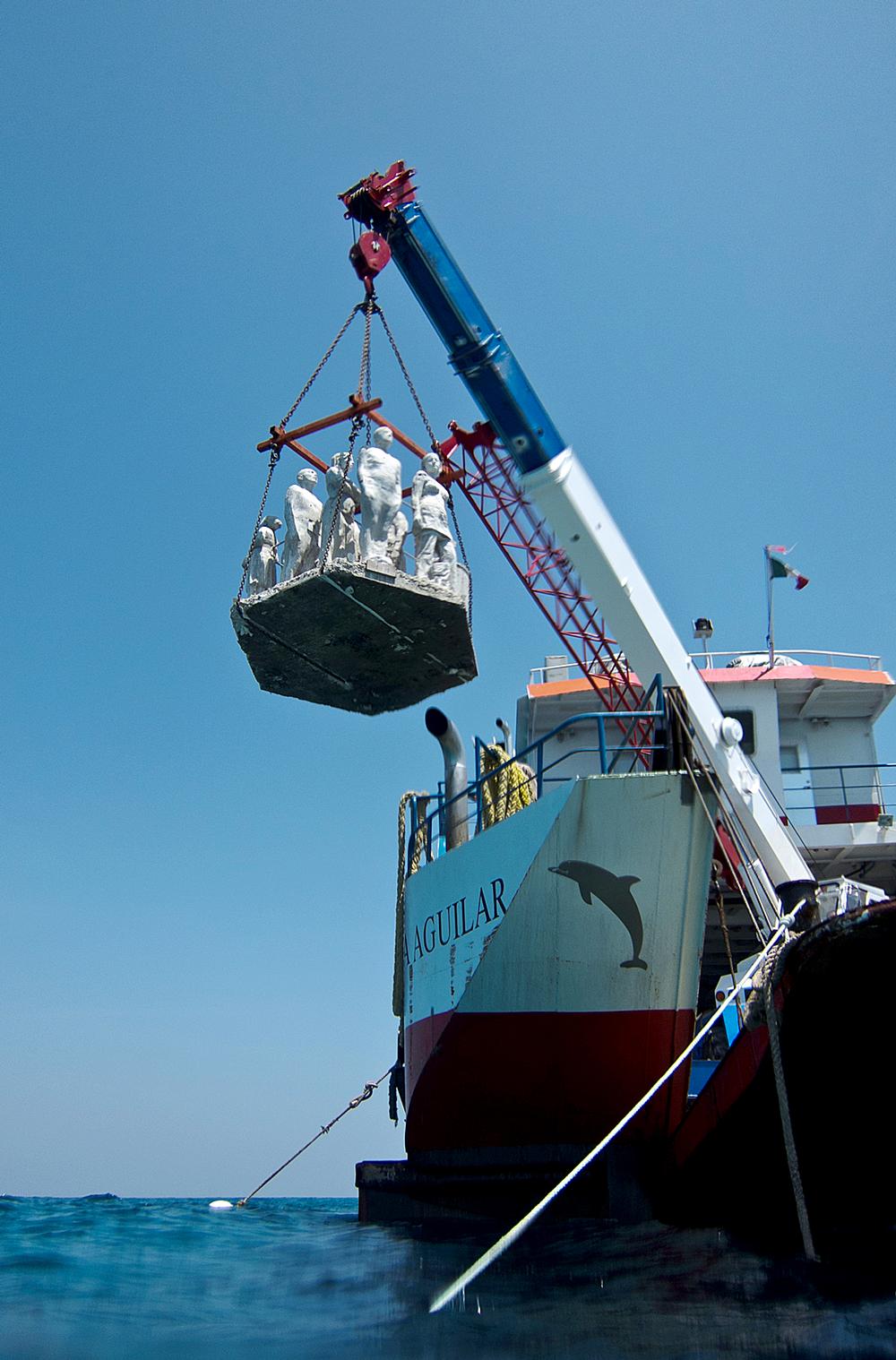
What are the costs? The construction isn’t expensive because the materials aren’t dear, but the installations are costly. We want the sculptures to weigh as much as possible so that they stay in place on the seabed and are very resilient – they’re planned to last for hundreds of years, so need to be very well constructed – but the heavier they are, the more expensive the logistics become. It’s a balance between working the two out so it becomes possible.
How are the sculptures secured? They’re drilled into the ocean floor, but we rely on the weight to help. We have to keep the centre of gravity very low. It’s a new environment to work in and is subject to different forces.
There have been some terrible artificial reef projects where people haven’t fixed things well enough. One project around the coast of Carolina, US used old car tyres. The first storm that came along ripped them out, rolled them over the reef and destroyed all the coral, so it’s really important to ensure they’re fixed.
What are they made from? They’re made out of specialised marine cement that’s 20 times more durable than normal construction cement and impervious to the salt water.
I can’t use metal as it would corrode and break down. Ninety per cent of public sculpture has some kind of metal in the armature or construction, so the challenge is to design objects differently. I use armatures made out of inert fibreglass and geo-textiles.
How do you ensure the sculptures are protected? Mainly through education. We ask the guides to explain that these are artificial reefs and have signs underwater asking people not to touch the sculptures. But nowadays, everything’s a photo opportunity – people stand next to the sculptures and put their arms around them for a photo and then we get a breakage.
What are the challenges? Firstly, it's getting permission. Before starting, I have to do a very strict environmental impact assessment for the government. That’s quite a difficult part of the process, depending upon the location – it’s very difficult to get permits in America, for example.
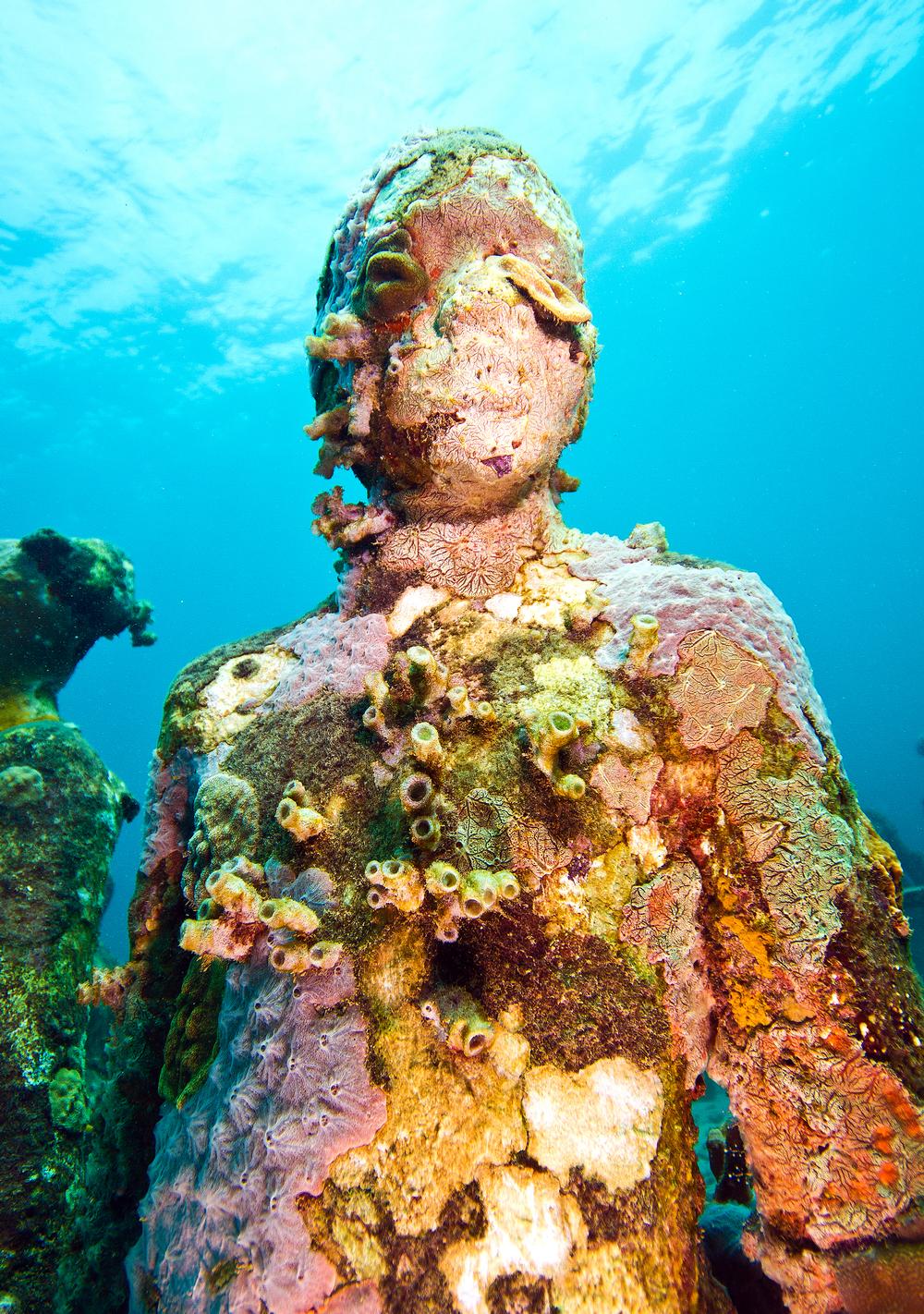
Navigating the weather and scheduling deployment is always difficult. If a dense wind falls it makes it far harder to work. Another challenge is the unpredictable nature of the sea. It can work in my favour – I might find some beautiful pink sponges and amazing coral growing, which is fantastic.
But there can be undesirable effects. We had an issue where we went along one day and all the sculptures were covered in thick algae. We couldn’t see anything at all, which was worrying. We cleaned it off half of them and three months later, the ones we’d cleaned had grown back worse, whereas the algae had started to disappear on the ones we hadn’t touched. That was quite a lesson in not messing with things too much. A year later the algae had gone completely from all of them.
What are you working on now? I’ve just finished working at MUSA and have relocated to Europe. I’m in talks with people in Florida, Malaysia, and the Maldives. It’s fascinating because each place has very different conditions and the works would evolve very differently according to the location.
One of my aims is to advance the technology and research that allows more marine life to colonise the sculptures and create works that are more interactive for visitors. I’m currently devising some installations that start on land and then go into the sea. I’m also doing some pieces that rise out of the water so people can dive off them and others with lights so people can scuba dive at night.
I have plenty of ideas, which I can't reveal yet, but at this moment in time I’ve just begun an exciting project off the coast of Lanzarote. The crystal blue Atlantic waters surrounding the island are home to a completely different marine ecosystem and the project will discuss the topic of climate change and migration. It is supported by the Achenbach Art Foundation and the regional government.
This feature first appeared in Attractions Management Issue 1 2014
Jason deCaires Taylor wants to use his sculptures to educate visitors about ocean ecology
The Listener is made from casts of human ears
The sheer weight of the sculptures makes installation expensive
Inercia depicts a man watching tv, oblivious to the world
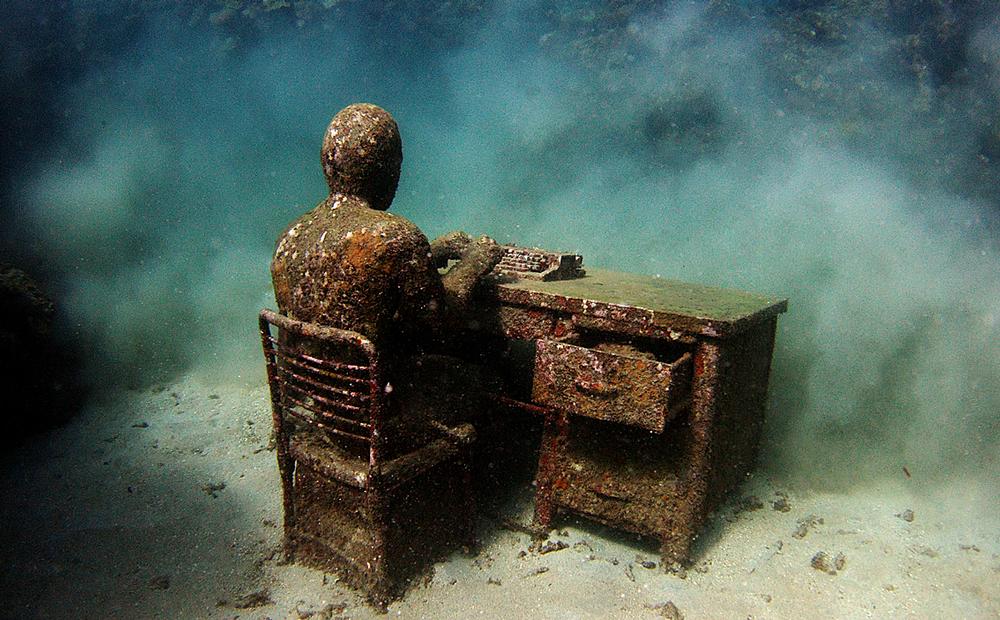
The Lost Correspondent
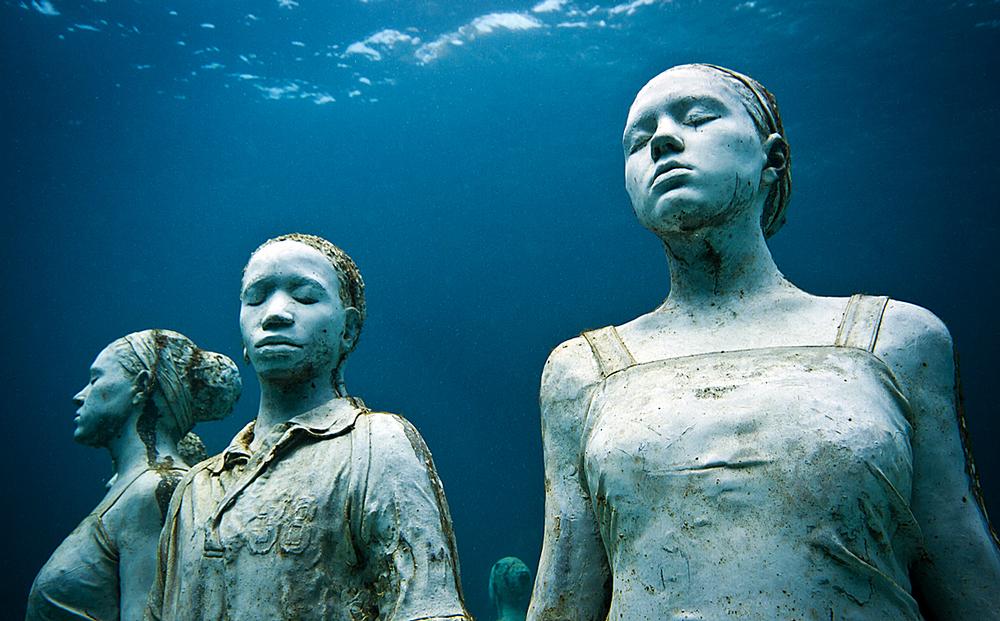
The figures in Viccisitudes were cast from local children
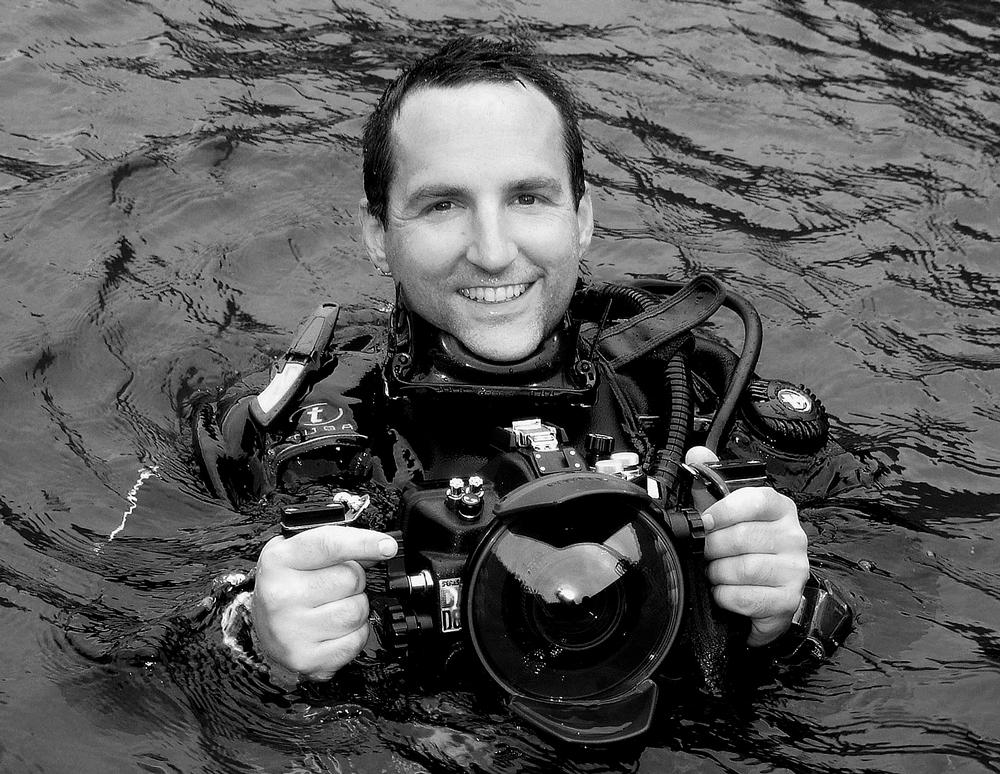
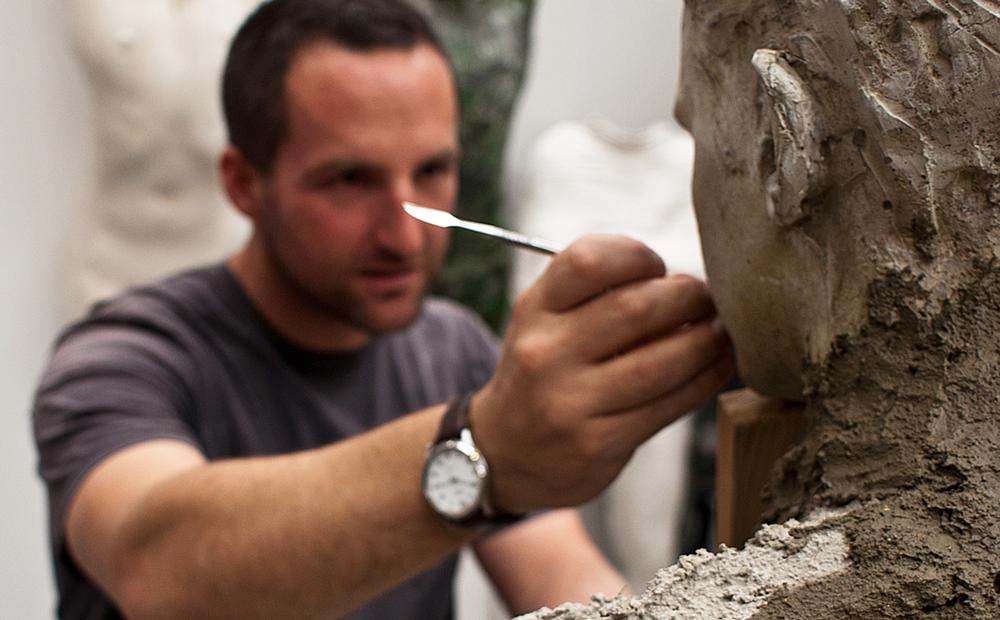
The sculptor at work
The underwater sculptures become a natural home to coral and reef fish, which change their appearance
Elevate is set to celebrate its 10th anniversary in style this June, with organisers
confirming the event’s largest-ever drinks reception as registrations continue to run more
than 10% ahead of last year. [more...]
CoverMe, the global leader in fitness workforce management, today launches CoverMe PT, an
on-demand personal training platform that connects the right personal trainer to the right
client in under 10 seconds. [more...]
A love of art and the environment led to the creation of two underwater museums, which provide homes for coral and sea life. Eco sculptor Jason deCaires Taylor tells Kathleen Whyman what inspires him
By Kathleen Whyman | Published in Leisure Management 2014 issue 2
The sculptures are designed to
last for hundreds of years, so have to be very well built
What was your inspiration? I’m a sculptor and was mainly working on land and with the landscape. I was creating objects that had no functional purpose other than their artistic value – the world’s cluttered enough, we need more of a reason to make things.
I had the idea that if I worked underwater, these objects would not only discuss the boundaries of art, they’d create habitat space for sea life and be beneficial to the environment. That was the main driving force.
How did you get started? The first museum was in Grenada in 2006. I grew up in Spain, Portugal, Malaysia and the UK and happened to be living and teaching scuba diving in Grenada at the time.
I’d had the idea for the underwater sculptures for a while, so looked into how feasible it was and presented the concept to the local government. They were sceptical, but interested, so I started small with a couple of pieces and added to them. It kept growing and more people started to help and support the project. Over the course of two years I built the first underwater sculpture park, which contains 65 individual works and is called Grenada Underwater Sculpture Park.
The government of Mexico, after seeing this project, invited me to address some of the problems they have with high levels of tourism in Cancun. MUSA (Museo Subacuático de Arte) opened in 2009 and has 510 permanent sculptural works.
How do the museums benefit the environment? Prior to the museum, there was only one good snorkelling area in Grenada. All the boats would congregate in that area and there was damage to the reef from people jumping off boats and kicking corals and it was slowly deteriorating. I created another snorkelling site nearby to relieve some of that pressure – coral grows on the sculptures and fish live around them.
It was a similar objective in Cancun. The area has more than 750,000 visitors each year, so the objective was to try and manage those people and minimise the impact to the reef. The government wanted to start closing sections of the reef down to allow them to rejuvenate and thrive, but the business community threatened to sue the government for closing down their economy and insisted on an alternative offer. It was at that point that they contacted me.
How has the local community benefited? The statistics are amazing. In Cancun, the diving has increased by 30 per cent in a few years and now gets over 80,000 visitors annually. In Grenada, the area never used to have visitors, but now gets 20,000 people a year. Seventy per cent of divers go to the museum site rather than the original reef. It’s in the top three TripAdvisor ratings and got voted by National Geographic as one of the Wonders of the World.
What are the sculptures? Predominantly I use figurative forms, with concepts of humans working in harmony with nature. I strive to bring in themes of the threat to the reef and how we’re oblivious to what happens under water. I’ve sculpted a guy on a sofa watching TV, showing the irony of the way we live and how we’re so focused on our little worlds that we forget the bigger picture.
There are hundreds of sculptures ranging from The Silent Evolution – a crowd of 450 people which informs visitors on the various stages of reef evolution; a series of suburban dwellings designed to house individual marine species; The Listener – a lone figure assembled entirely from casts of human ears and a recording device to monitor the reef; and Reclamation, an angelic female form with wings that are propagated with living coral.
One of the large installations – The Silent Evolution – took me two years and an amazing amount of hard work and I was really pleased with it. Then I did a piece called Banker, which is a guy with his head in the sand, and that got just as much response and it only took a month to make and was really easy. I’ve learnt that you can have very potent images that can say just as much as the big, arduous projects.
What’s your message? I hope people have more of an understanding of, and more respect for, all the amazing things that are happening underneath our oceans and have that in the forefront of their minds. Some of our coral reefs could be the first eco systems we lose if we continue with the problems associated with global warming.
What are the costs? The construction isn’t expensive because the materials aren’t dear, but the installations are costly. We want the sculptures to weigh as much as possible so that they stay in place on the seabed and are very resilient – they’re planned to last for hundreds of years, so need to be very well constructed – but the heavier they are, the more expensive the logistics become. It’s a balance between working the two out so it becomes possible.
How are the sculptures secured? They’re drilled into the ocean floor, but we rely on the weight to help. We have to keep the centre of gravity very low. It’s a new environment to work in and is subject to different forces.
There have been some terrible artificial reef projects where people haven’t fixed things well enough. One project around the coast of Carolina, US used old car tyres. The first storm that came along ripped them out, rolled them over the reef and destroyed all the coral, so it’s really important to ensure they’re fixed.
What are they made from? They’re made out of specialised marine cement that’s 20 times more durable than normal construction cement and impervious to the salt water.
I can’t use metal as it would corrode and break down. Ninety per cent of public sculpture has some kind of metal in the armature or construction, so the challenge is to design objects differently. I use armatures made out of inert fibreglass and geo-textiles.
How do you ensure the sculptures are protected? Mainly through education. We ask the guides to explain that these are artificial reefs and have signs underwater asking people not to touch the sculptures. But nowadays, everything’s a photo opportunity – people stand next to the sculptures and put their arms around them for a photo and then we get a breakage.
What are the challenges? Firstly, it's getting permission. Before starting, I have to do a very strict environmental impact assessment for the government. That’s quite a difficult part of the process, depending upon the location – it’s very difficult to get permits in America, for example.
Navigating the weather and scheduling deployment is always difficult. If a dense wind falls it makes it far harder to work. Another challenge is the unpredictable nature of the sea. It can work in my favour – I might find some beautiful pink sponges and amazing coral growing, which is fantastic.
But there can be undesirable effects. We had an issue where we went along one day and all the sculptures were covered in thick algae. We couldn’t see anything at all, which was worrying. We cleaned it off half of them and three months later, the ones we’d cleaned had grown back worse, whereas the algae had started to disappear on the ones we hadn’t touched. That was quite a lesson in not messing with things too much. A year later the algae had gone completely from all of them.
What are you working on now? I’ve just finished working at MUSA and have relocated to Europe. I’m in talks with people in Florida, Malaysia, and the Maldives. It’s fascinating because each place has very different conditions and the works would evolve very differently according to the location.
One of my aims is to advance the technology and research that allows more marine life to colonise the sculptures and create works that are more interactive for visitors. I’m currently devising some installations that start on land and then go into the sea. I’m also doing some pieces that rise out of the water so people can dive off them and others with lights so people can scuba dive at night.
I have plenty of ideas, which I can't reveal yet, but at this moment in time I’ve just begun an exciting project off the coast of Lanzarote. The crystal blue Atlantic waters surrounding the island are home to a completely different marine ecosystem and the project will discuss the topic of climate change and migration. It is supported by the Achenbach Art Foundation and the regional government.
This feature first appeared in Attractions Management Issue 1 2014
Jason deCaires Taylor wants to use his sculptures to educate visitors about ocean ecology
The Listener is made from casts of human ears
The sheer weight of the sculptures makes installation expensive
Inercia depicts a man watching tv, oblivious to the world
The Lost Correspondent
The figures in Viccisitudes were cast from local children
The sculptor at work
The underwater sculptures become a natural home to coral and reef fish, which change their appearance
Global luxury hospitality brand, Six Senses, has partnered with longevity healthcare provider,
HUM2N, to launch a clinic at Six Senses London, at The Whiteley.
Premium London health club, KX Chelsea, will imminently unveil its most significant
redevelopment since its launch in 2002 to create an integrated wellness model combining
training, recovery and relaxation.
Researchers in the US have identified an antibody which could greatly reduce the loss of lean
muscle mass in people who are taking weight-loss medications.
Crunch Fitness has announced the launch of Crunch Reform Pilates – its own reformer concept
designed to bring this fast growing, but rather expensive, modality into the mainstream.
The 20th State of the Industry Report reveals a resilient, expanding and competitive
sector, the
importance of differentiation and the ongoing challenge of tackling inequalities.
Nuffield Health has told HCM that it takes its responsibilities towards its colleagues seriously
and is committed to meeting all legal obligations after news of a tribunal has made national
headlines.
Elevate is set to celebrate its 10th anniversary in style this June, with organisers
confirming the event’s largest-ever drinks reception as registrations continue to run more
than 10% ahead of last year. [more...]
CoverMe, the global leader in fitness workforce management, today launches CoverMe PT, an
on-demand personal training platform that connects the right personal trainer to the right
client in under 10 seconds. [more...]