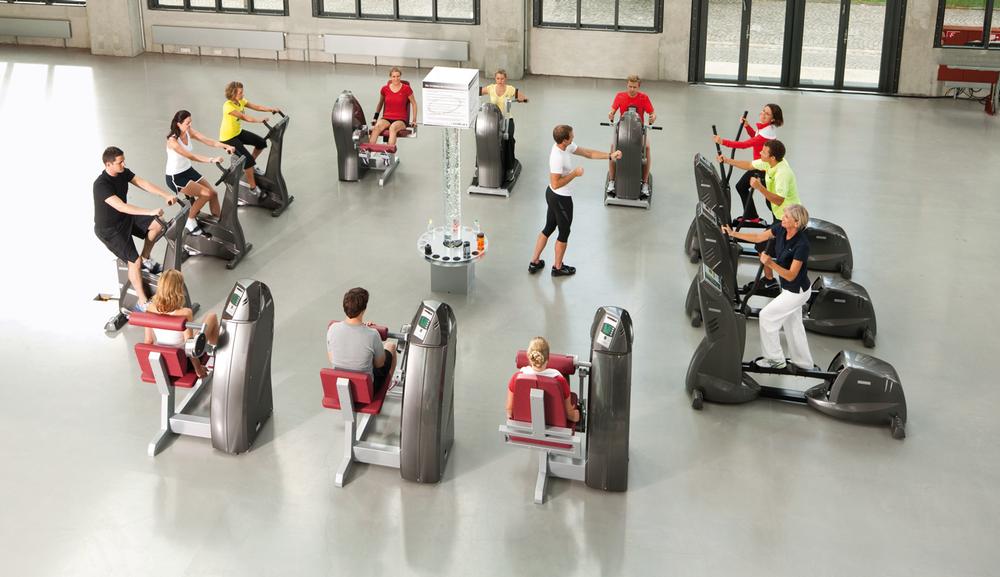
Circuit classes – such as milon (above) and freestyle – are popular in Germany
The German health and fitness market is booming: there were 8.55 million members in 2013 – a rise of 8.1 per cent on 2012, and equating to 10.6 per cent of the total population. The number of clubs was up 4.9 per cent to 7,940, and revenues up 12.1 per cent to €4.55bn (data from DSSV).
This growth is driven primarily by the growth of the budget sector. Surprisingly then, average dues per member per month (including VAT) remains fairly high at around E47 – although as the budget operators take even more market share, this is likely to go down.
And the budget operators do look set to continue their march, offering not only great value for money but also evolution in their product. Market leader McFit, for example, has added studios (three per club) with a stylish Apple-white design, offering a wide range of virtual classes. It has also made its clubs more female-friendly by moving free weights areas into separate rooms.
New challengers in the budget sector even offer instructor-led classes, ladies-only areas and complementary drinks in large (up to 2,800sq m) design-led clubs, manned by increasingly well-educated staff and with convenient joining processes and inductions.
This sector of the market is ‘pulling’ members with its innovation, as opposed to many mid-market operators – lumbered with complicated overhead structures and a flagging quality of offering – who are trying to ‘push’ their products. Unless mid-market clubs offer additional facilities such as pools or large wellness areas, consumers are increasingly questioning why they should pay E50-60 for a monthly membership.
FEMALE FOCUS Women-only clubs are also strong in Germany, comprising around 9 per cent of all clubs – a number that’s remained stable over the last 10 years. Why? First of all, there’s a demand: 50 per cent of women claim not to like their body, and prefer not to be exposed to the other gender while they work out.
Secondly, the successful women-only clubs understand their market, with an offer that’s tailored to their specific needs: there’s a higher focus on communication, motivation and interaction; club interior design is key; and group exercise is high on the agenda, including mind-body classes. Meanwhile, the marketing speaks direct to the women in a language they appreciate, and with a strong emphasis on the values and philosophy of the company.
With many mixed-gender operators failing to meet these demands, there’s still plenty of opportunity for new entrants to the women-only sector: for example, Women’s Gym Jopp & Jopp, a Berlin chain, opened about eight women-only clubs in the last two and a half years, with an average of 2,300 members per club in the otherwise crowded mid-market sector.
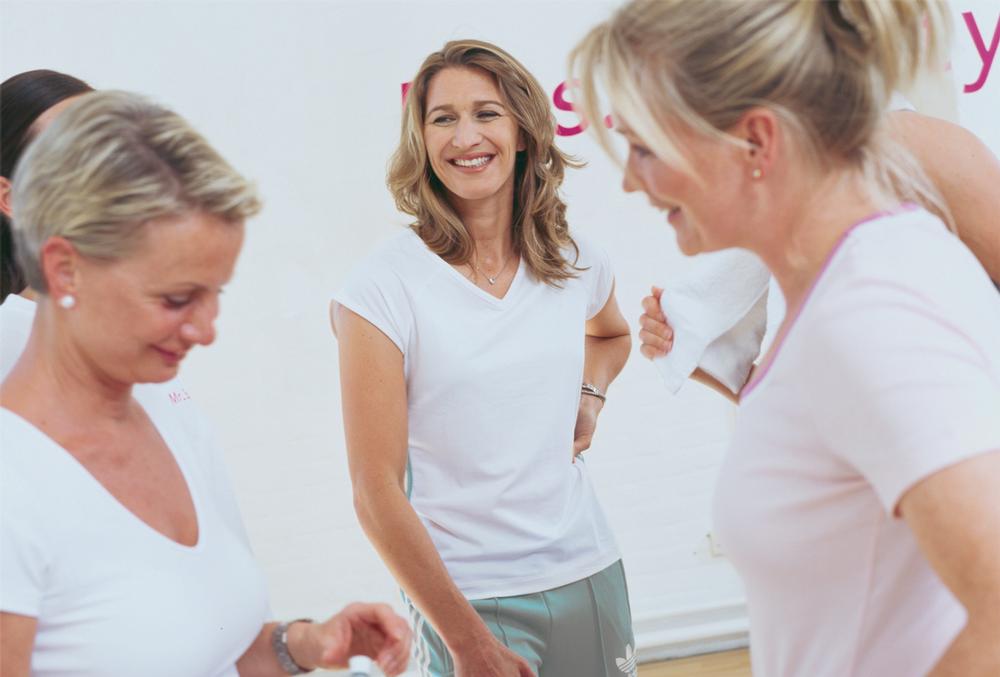
Meanwhile, Mrs.Sporty is an ongoing success story – a German women-only franchise operation that now operates over 550 clubs in eight European markets, but predominantly in Germany. Its recipe for success centres around attracting women over the age of 45 who mostly have never worked out before and who are overweight and out of shape. This market is willing to pay around E45 a month for a simple circuit training and nutritional consultancy offering; if you can meet their needs, they have the money to spend.
Other mixed gender operators are beginning to recognise this and are ‘feminising’ their offering where they can – but really the success stories in this field are those that embrace the female market in all dimensions of the business.
TRENDING NOW As in other markets, functional training is a strong trend. Fitness First, for example, is investing heavily in its ‘freestyle’ offering and making this the core of its marketing campaigns.
Circuit workouts also continue to have wide appeal, from high-end milon circuits through to high-intensity freestyle circuits that appeal predominantly to younger customers.
Clubs purely offering circuits are growing strongly thanks to their small footprint – less than 200sq m – which allows them to operate in convenient locations. PT studios are also developing along the same lines: sites of 200sq m or less represent an affordable way for PTs to start their own business, often based on functional and EMS equipment.
FUTURE OUTLOOK Budget operators will continue to expand, bringing new exercisers into their facilities as well as attracting members from mid-market operators.
At the other end of the scale, more premium clubs will arise, offering additional value in the shape of pools, big wellness areas, outdoor spaces and first-class services. Healthcare will be more prominent, with clubs offering highly educated staff as well as specialist measurement and analysis to guide those with health issues. These clubs will be accepted and able to co-operate more closely with the health sector.
Smaller footprint clubs will become more significant as the trend towards convenience of location gathers momentum. Some will emerge as niche products – whether single-sex, focused on a clear customer proposition like pure muscle training or backcare, or standalone mind-body studios.
Functional training will also drive this small club trend, through CrossFit boxes for example – although more operators will look to build concepts like CrossFit and MMA into their full-service clubs.
Integration of nutritional programmes run by competent staff and based on reward systems / gamification will also become a strong factor. And as everywhere around the world, digital interaction will play a huge role through the likes of apps and wearables – all of which will require new management skills and investment strategies.
New builds and refurbs will be based on more professional data analysis upfront as the market gets more and more saturated. But the German market remains highly attractive: witness new international entrants like Migros (ELEMENTS) and Madonna’s Hard Candy Fitness. I’m sure there’s more to come.
How attractive is the German fitness sector as an employer?
“At first sight, the fitness industry in Germany is a very appealing employer. But in reality there are too few employment contracts that are sufficiently well-paid, and few chances for personal development. Many potential employees often have misconceptions about the job, both in terms of job content and the earning potential; they will consequently often move towards other employers in the service and health sectors.
“The fitness industry has to focus on offering more attractive jobs in order not to lose the qualified human resources they require for their businesses to succeed.”
Nicole Capelan, HR specialist and founder of www.medicpro.de
Dirk Kemmerling is owner and MD of HMC Health Management Company GmbH in Germany. Prior to that, he was the authorised signatory, director of operations and business development for Fitness First Germany. He has also owned and operated several fitness clubs.
Panatta brought together four of the most influential figures in bodybuilding history on the
stage of RiminiWellness 2026: Phil Heath, Lee Haney, Ronnie Coleman and Hany Rambod. [more...]
Active Blackpool is deploying Cornerstone Connect, a new digital interface allowing
disparate information from multiple systems to be aggregated into one dataset, to support
its focus on reducing health inequalities and improving healthy life expectancy. [more...]
Circuit classes – such as milon (above) and freestyle – are popular in Germany
The German health and fitness market is booming: there were 8.55 million members in 2013 – a rise of 8.1 per cent on 2012, and equating to 10.6 per cent of the total population. The number of clubs was up 4.9 per cent to 7,940, and revenues up 12.1 per cent to €4.55bn (data from DSSV).
This growth is driven primarily by the growth of the budget sector. Surprisingly then, average dues per member per month (including VAT) remains fairly high at around E47 – although as the budget operators take even more market share, this is likely to go down.
And the budget operators do look set to continue their march, offering not only great value for money but also evolution in their product. Market leader McFit, for example, has added studios (three per club) with a stylish Apple-white design, offering a wide range of virtual classes. It has also made its clubs more female-friendly by moving free weights areas into separate rooms.
New challengers in the budget sector even offer instructor-led classes, ladies-only areas and complementary drinks in large (up to 2,800sq m) design-led clubs, manned by increasingly well-educated staff and with convenient joining processes and inductions.
This sector of the market is ‘pulling’ members with its innovation, as opposed to many mid-market operators – lumbered with complicated overhead structures and a flagging quality of offering – who are trying to ‘push’ their products. Unless mid-market clubs offer additional facilities such as pools or large wellness areas, consumers are increasingly questioning why they should pay E50-60 for a monthly membership.
FEMALE FOCUS Women-only clubs are also strong in Germany, comprising around 9 per cent of all clubs – a number that’s remained stable over the last 10 years. Why? First of all, there’s a demand: 50 per cent of women claim not to like their body, and prefer not to be exposed to the other gender while they work out.
Secondly, the successful women-only clubs understand their market, with an offer that’s tailored to their specific needs: there’s a higher focus on communication, motivation and interaction; club interior design is key; and group exercise is high on the agenda, including mind-body classes. Meanwhile, the marketing speaks direct to the women in a language they appreciate, and with a strong emphasis on the values and philosophy of the company.
With many mixed-gender operators failing to meet these demands, there’s still plenty of opportunity for new entrants to the women-only sector: for example, Women’s Gym Jopp & Jopp, a Berlin chain, opened about eight women-only clubs in the last two and a half years, with an average of 2,300 members per club in the otherwise crowded mid-market sector.
Meanwhile, Mrs.Sporty is an ongoing success story – a German women-only franchise operation that now operates over 550 clubs in eight European markets, but predominantly in Germany. Its recipe for success centres around attracting women over the age of 45 who mostly have never worked out before and who are overweight and out of shape. This market is willing to pay around E45 a month for a simple circuit training and nutritional consultancy offering; if you can meet their needs, they have the money to spend.
Other mixed gender operators are beginning to recognise this and are ‘feminising’ their offering where they can – but really the success stories in this field are those that embrace the female market in all dimensions of the business.
TRENDING NOW As in other markets, functional training is a strong trend. Fitness First, for example, is investing heavily in its ‘freestyle’ offering and making this the core of its marketing campaigns.
Circuit workouts also continue to have wide appeal, from high-end milon circuits through to high-intensity freestyle circuits that appeal predominantly to younger customers.
Clubs purely offering circuits are growing strongly thanks to their small footprint – less than 200sq m – which allows them to operate in convenient locations. PT studios are also developing along the same lines: sites of 200sq m or less represent an affordable way for PTs to start their own business, often based on functional and EMS equipment.
FUTURE OUTLOOK Budget operators will continue to expand, bringing new exercisers into their facilities as well as attracting members from mid-market operators.
At the other end of the scale, more premium clubs will arise, offering additional value in the shape of pools, big wellness areas, outdoor spaces and first-class services. Healthcare will be more prominent, with clubs offering highly educated staff as well as specialist measurement and analysis to guide those with health issues. These clubs will be accepted and able to co-operate more closely with the health sector.
Smaller footprint clubs will become more significant as the trend towards convenience of location gathers momentum. Some will emerge as niche products – whether single-sex, focused on a clear customer proposition like pure muscle training or backcare, or standalone mind-body studios.
Functional training will also drive this small club trend, through CrossFit boxes for example – although more operators will look to build concepts like CrossFit and MMA into their full-service clubs.
Integration of nutritional programmes run by competent staff and based on reward systems / gamification will also become a strong factor. And as everywhere around the world, digital interaction will play a huge role through the likes of apps and wearables – all of which will require new management skills and investment strategies.
New builds and refurbs will be based on more professional data analysis upfront as the market gets more and more saturated. But the German market remains highly attractive: witness new international entrants like Migros (ELEMENTS) and Madonna’s Hard Candy Fitness. I’m sure there’s more to come.
How attractive is the German fitness sector as an employer?
“At first sight, the fitness industry in Germany is a very appealing employer. But in reality there are too few employment contracts that are sufficiently well-paid, and few chances for personal development. Many potential employees often have misconceptions about the job, both in terms of job content and the earning potential; they will consequently often move towards other employers in the service and health sectors.
“The fitness industry has to focus on offering more attractive jobs in order not to lose the qualified human resources they require for their businesses to succeed.”
Nicole Capelan, HR specialist and founder of www.medicpro.de
Dirk Kemmerling is owner and MD of HMC Health Management Company GmbH in Germany. Prior to that, he was the authorised signatory, director of operations and business development for Fitness First Germany. He has also owned and operated several fitness clubs.
The UK's four Chief Medical Officers have published a refreshed edition of Physical activity
guidelines: UK Chief Medical Officers' report, updating the evidence that underpins the nation's
physical activity recommendations and placing greater emphasis on strength, balance, reducing
sedentary behaviour and, for the first time, supporting people taking weight loss medications.
Places Leisure has exchanged contracts to build and operate a flagship £60m water and leisure
destination on behalf of Basingstoke and Deane Borough Council.
The Republic of Ireland will become the latest market in PureGym’s expanding international
portfolio, with the first launch planned for Dublin in 2027.
Anytime Fitness opened more than one club a day in 2025 and is on track to maintain this rate
of growth this year, as parent company Purpose Brands targets further international expansion.
The £33.9 million Leighton Leisure and Community Centre has opened in Leighton Buzzard, UK,
creating a next-generation public leisure, health and wellbeing hub for the local community.
Walnuts Leisure Centre in Orpington, in the London Borough of Bromley, has reopened following
a £17m transformation designed to secure the long-term future of the public leisure asset and
reposition it as a community wellbeing hub.
The Gym Group, has announced that it's sustained positive trading momentum has continued
through the first half of 2026 and the company remains confident about the outlook.
Luxury boutique Pilates and wellness studio, X-Club, officially launches a
4,000sq ft flagship at
Marylebone on 16 July Built around X-Club’s four pillars of wellness – mind,
movement,
nutrition and therapy – the facility features two group exercise studi
Panatta brought together four of the most influential figures in bodybuilding history on the
stage of RiminiWellness 2026: Phil Heath, Lee Haney, Ronnie Coleman and Hany Rambod. [more...]
Active Blackpool is deploying Cornerstone Connect, a new digital interface allowing
disparate information from multiple systems to be aggregated into one dataset, to support
its focus on reducing health inequalities and improving healthy life expectancy. [more...]