In 2008, UK Sport formed a technology partnership with BAE Systems to support Britain’s Olympic and Paralympic athletes. The contract was renewed in August 2013 and will run until the Rio Games. Tom Walker speaks to Kelvin Davies, BAE’s project leader for the partnership
By Tom Walker | Published in Sports Management 2013 issue 3
Either UK Sport comes to us with a specific need or we explore a sport’s requirements and identify how our facilities can offer solutions
Great Britain’s elite athletes can again look forward to being supported by a world-class engineering programme in the run up to the Sochi and Rio Olympic Games, following the announcement that defence specialist BAE Systems will continue as UK Sport’s official research and innovation partner until 2016.
The partnership will see BAE offering athletes access to its cutting-edge technology and providing scientific innovation in the areas of training, recovery, injury prevention and competition – as well as equipment development.
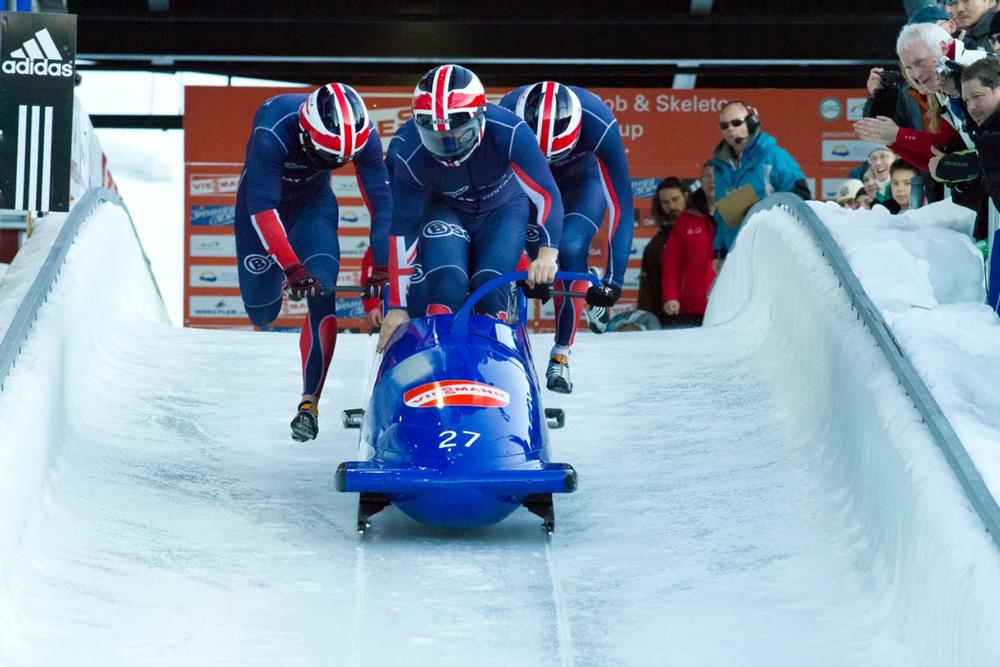
Taekwondo, cycling and pentathlon were among the sports which benefitted directly from BAE’s support ahead of London 2012. Exact details of current projects in the run up to Sochi 2014 remain confidential, but include identifying sports where marginal gains can be achieved through the use of specially-developed materials and research into aerodynamics. BAE’s project leader Kelvin Davies does reveal, however, that the same technology used to develop the world’s most advanced jet fighter – the Eurofighter Typhoon – is being used to improve the racing speed of the Great Britain bobsleigh team.
BIRTH STORIES First launched in 2008, the partnership was, according to Davies, born out of a number of factors. “There were lots of catalysts and a lot of people involved in making it happen,” he says. “A particular driving force was one of our engineers who set himself the challenge of rowing the Atlantic. His involvement in that – a true feat of endurance – led to discussions with rowers and ultimately onto how aerospace technology could be applied to sport,” says Davies. “At the time we were already working on a project for British Cycling, so all of the parts suddenly came together and formed what we see today: a beautiful working relationship with UK Sport.”
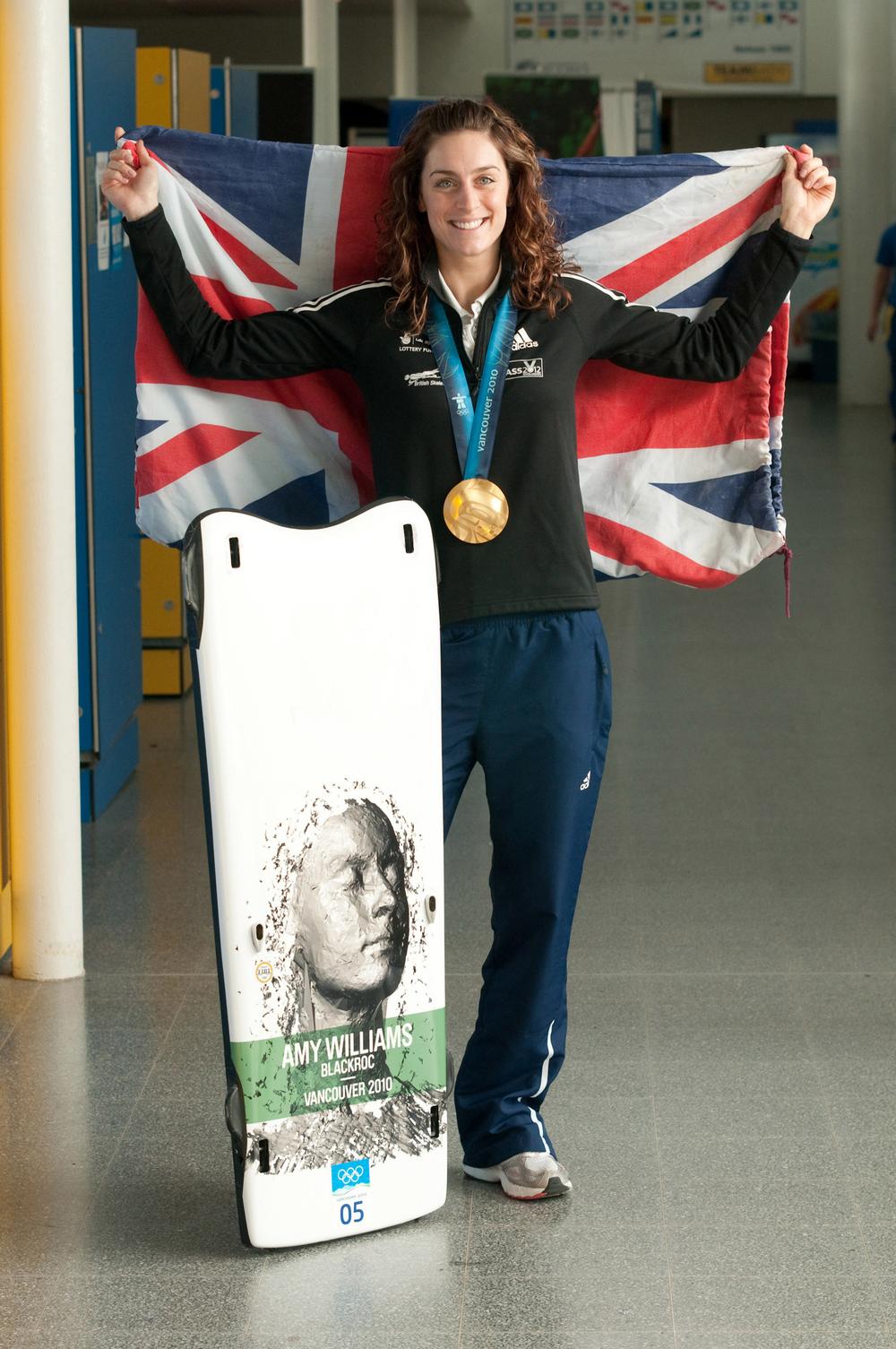
One of the earliest – and still one of most celebrated – successes of the partnership was the creation of ‘Arthur’, the skeleton sled that propelled Amy Williams to a gold medal at Vancouver 2010 – Britain’s first individual gold at a winter Olympics in three decades. Describing the design process, Davies says the involvement of all parties, including athletes, was crucial.
“The first thing we did with the skeleton project was to get Andreas Schmid, head of technical development at British Skeleton, to explain to us the engineering involved in the sport. We looked at a sled, reviewed it, assessed what was good, figured out what was bad and came up with a plan to improve it.
“We then asked the athletes what they wanted from their sleds. The parallels with military equipment are clear – our aircraft are flown by pilots and ships operated by sailors, so we wanted to make sure the skeleton sled did exactly what the athletes wanted. We organised a half-day session with all skeleton athletes – including Amy – and made sure we captured their thoughts. We took their input, combined it with good engineering and came up with a design concept and produced a prototype. The prototype was raced successfully at the World Championships in Lake Placid the year before the Vancouver Games so a decision was made to use the design at the Olympics. The rest – as they say – is history.”
Davies adds that the whole process from concept to end product took nearly two years, making it one of the longer running projects BAE has contributed to. “The objective was to provide the British skeleton team with what we call ‘the sled for life’,” he says. “It was a long project but one that was really rewarding – the sleds we designed, or derivatives of them, are still in use by the team today.”
There is another strand that binds BAE’s sports projects. Most are designed to achieve those crucial, marginal gains that decide whether an athlete makes it to the podium or not. Davies mentions BAE’s work to improve the aerodynamics of the helmets worn by the Team GB bobsleigh team. The difference between a silver medal and seventh place at the World Championships was 0.27 seconds.
work in progress While each project is different, Davies says most are launched in one of two ways. “Either UK Sport comes to us with a specific need – like a new timing system for a velodrome – or we explore a sport’s requirements and identify how our facilities can offer solutions to meet them. An example of the latter could be our work with simulators to find out how we can use them to train Taekwondo athletes.
“Fighter pilots use simulators to help them prepare for a number of scenarios – to understand what’s just happened, what’s happening now and what’s about to happen. Once they get an anticipation of what’s about to happen, we think they’re at their performance best. So we’re looking into how we can give athletes the opportunity to use simulators to get into the same mental state before a bout – to be prepared for every scenario by providing them with a simulation of their toughest opponents and practice against them over and again.”
MUTUAL BENEFITS Listening to Davies describe the company’s impressive facilities and the opportunities they offer, it’s clear to see how athletes and national governing bodies can benefit from the partnership – but what does BAE get from it? “Our intention has never been to develop a commercial stream involved in sports manufacturing,” Davies says. “Rather, we’ve set three objectives we look to achieve. These are to showcase our capability and technology as a company; to inspire young people to consider engineering as an exciting career; and to inspire and energise our engineers.”
He adds that due to the three targets, the success of the partnership – at least for BAE – isn’t measured in the number of medals achieved. “The glory of the medals is part of the message, but really what we’re looking to do is promote engineering internally and externally. “
He admits, however, that measuring the success of the objectives can be hard. “That is one of the frustrations – it being difficult to put a figure on it. We might have inspired 10 or 20 youngsters to take up engineering – but we might just as well have inspired 100 or even 1,000. I guess we just don’t know.”
As for inspiring and energising existing BAE staff by placing them on sports projects, Davies says the ideal team working on a UK Sport taskforce would include young engineers, fresh in their careers, being supervised and mentored by a more experienced engineer – all while delivering something phenomenally useful to a sport.
FUTURE PLANS Since 2008, BAE’s investment in the partnership has exceeded £1.5m. The new, three-year deal until Rio 2016 will see a further £800,000 being spent on sports innovation. Looking ahead, Davies remains secretive about current projects for Sochi and Rio. “We’re still in the very early days of the new partnership, so it’s very much ‘watch this space’ for the Rio projects. For Sochi I don’t really want to say too much, as we’re late in that cycle, so a lot of the technology has already been delivered for the Games next year.”
One future plan Davies doesn’t hide though, is that he can see no reason why the partnership with UK Sport shouldn’t reach way beyond Rio. “In the commercial climate things are always bounded in time, of course, so we agreed the partnership until 2016,” he says. “But I’d hope it would go on well after there.” A sentiment shared, we’re sure, by winning Team GB athletes up and down the country.
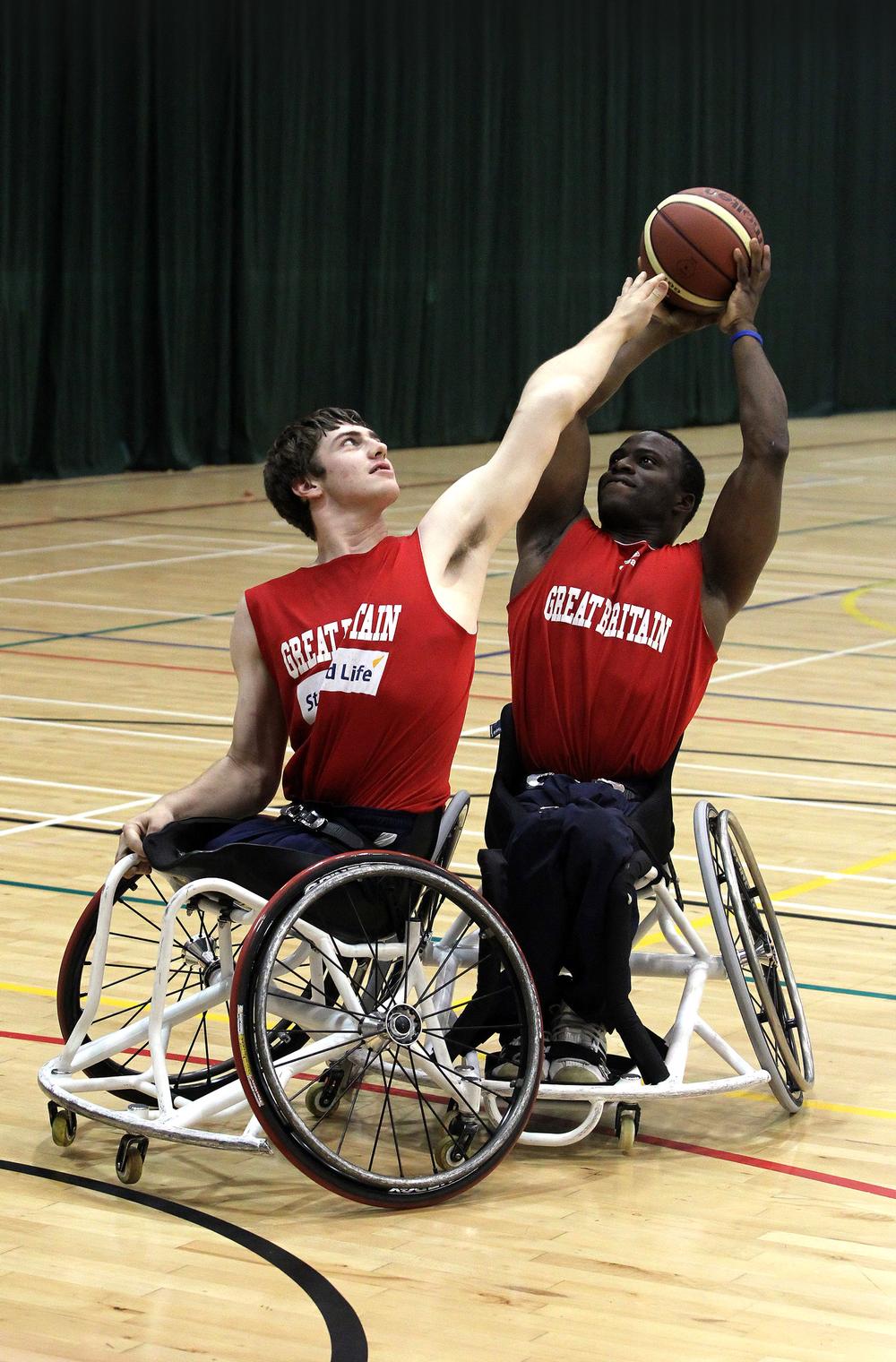
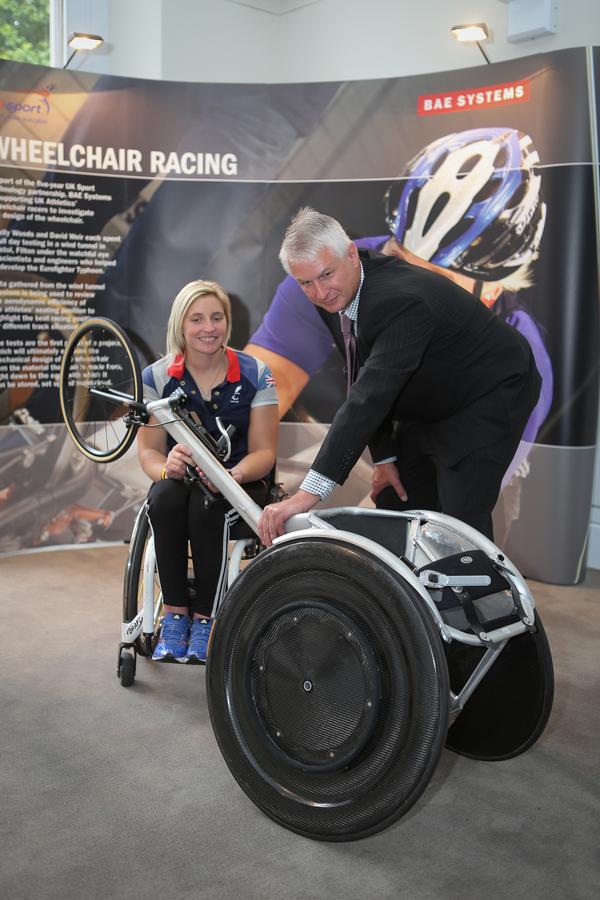
Wheelchair racing BAE used the same technology and thinking behind the Eurofighter Typhoon – one of the world’s most advanced jet fighters – to enhance the aerodynamics of wheelchair racers. Athletes were put through their paces at BAE’s wind tunnel to help find their optimal racing position. The wind tunnel – normally used to test fighter jets at speeds of over 200mph – showed how the wheelchair racers interact with the air around them, simulating racing speeds of over 30mph.
After testing, BAE used computational fluid dynamics data to wheelchair athletes better understand how their body position affects wind resistance, allowing the team to improve the athletes’ seating positions as well as highlight their optimal posture for racing in different track situations. BAE is also helping the British wheelchair athletes by creating a new and improved version of the wheelchair in partnership with aerodynamic specialists TotalSim and DRAFT, a wheelchair manufacturer.
The new wheelchair will have improved rolling resistance in wheel alignment and tyre pressure, as well as the stiffness of the wheelchair frame, and it’s hoped that it will be used in future track and long distance road events to shave precious tenths of seconds off winning times with a stronger, lighter and more aerodynamic design.
The new chair was unveiled in September 2013 to mark the renewal of the partnership
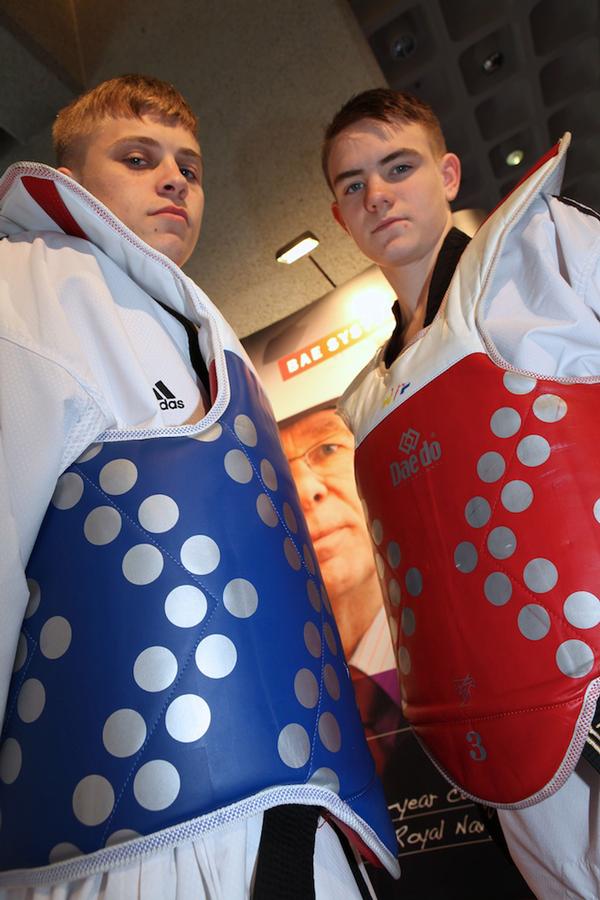
Taekwondo To help GB Taekwondo, BAE implemented techniques used to develop military tanks. Engineers from the company’s Advanced Technology Centre in Bristol helped evaluate the electronic scoring vest used in major international competitions.
The vests are based on fighters wearing special electronic socks that deliver a coded signal when they strike sensors on the opponent’s vest. As the vests were introduced just a few years ago, the sport had never fully understood how to optimise tactics.
To tackle this, BAE spent more than six months testing the vest using sophisticated equipment usually used to test composite materials’ resistance to impact.
As a result of BAE’s work, Team GB members have adjusted their training and competition tactics to reflect the different forces needed to successfully hit certain parts of the vest – maximising the methods needed to score on the vest.
The BAE team has helped GB Taekwondo understand the inner workings of the competition vest
Amy Williams with ‘Arthur the sled’ – a gold medal winning team at Vancouver 2010
One of BAE’s current projects for Sochi is to improve the aerodynamics of the bobsleigh team
One of the biggest mistakes the fitness industry still makes is advertising almost
exclusively to people who already look and live like gym members. [more...]
As healthcare continues to shift towards prevention, there’s a growing focus on helping
people stay active, independent and feeling good for longer. [more...]
+ More featured suppliers
COMPANY PROFILES
Alliance Leisure
Alliance Leisure Services was specifically
established to respond to the changing
development need [more...]
ukactive
ukactive is the UK’s leading trade body for the physical activity sector, bringing together more tha [more...]
In 2008, UK Sport formed a technology partnership with BAE Systems to support Britain’s Olympic and Paralympic athletes. The contract was renewed in August 2013 and will run until the Rio Games. Tom Walker speaks to Kelvin Davies, BAE’s project leader for the partnership
By Tom Walker | Published in Sports Management 2013 issue 3
Either UK Sport comes to us with a specific need or we explore a sport’s requirements and identify how our facilities can offer solutions
Great Britain’s elite athletes can again look forward to being supported by a world-class engineering programme in the run up to the Sochi and Rio Olympic Games, following the announcement that defence specialist BAE Systems will continue as UK Sport’s official research and innovation partner until 2016.
The partnership will see BAE offering athletes access to its cutting-edge technology and providing scientific innovation in the areas of training, recovery, injury prevention and competition – as well as equipment development.
Taekwondo, cycling and pentathlon were among the sports which benefitted directly from BAE’s support ahead of London 2012. Exact details of current projects in the run up to Sochi 2014 remain confidential, but include identifying sports where marginal gains can be achieved through the use of specially-developed materials and research into aerodynamics. BAE’s project leader Kelvin Davies does reveal, however, that the same technology used to develop the world’s most advanced jet fighter – the Eurofighter Typhoon – is being used to improve the racing speed of the Great Britain bobsleigh team.
BIRTH STORIES First launched in 2008, the partnership was, according to Davies, born out of a number of factors. “There were lots of catalysts and a lot of people involved in making it happen,” he says. “A particular driving force was one of our engineers who set himself the challenge of rowing the Atlantic. His involvement in that – a true feat of endurance – led to discussions with rowers and ultimately onto how aerospace technology could be applied to sport,” says Davies. “At the time we were already working on a project for British Cycling, so all of the parts suddenly came together and formed what we see today: a beautiful working relationship with UK Sport.”
One of the earliest – and still one of most celebrated – successes of the partnership was the creation of ‘Arthur’, the skeleton sled that propelled Amy Williams to a gold medal at Vancouver 2010 – Britain’s first individual gold at a winter Olympics in three decades. Describing the design process, Davies says the involvement of all parties, including athletes, was crucial.
“The first thing we did with the skeleton project was to get Andreas Schmid, head of technical development at British Skeleton, to explain to us the engineering involved in the sport. We looked at a sled, reviewed it, assessed what was good, figured out what was bad and came up with a plan to improve it.
“We then asked the athletes what they wanted from their sleds. The parallels with military equipment are clear – our aircraft are flown by pilots and ships operated by sailors, so we wanted to make sure the skeleton sled did exactly what the athletes wanted. We organised a half-day session with all skeleton athletes – including Amy – and made sure we captured their thoughts. We took their input, combined it with good engineering and came up with a design concept and produced a prototype. The prototype was raced successfully at the World Championships in Lake Placid the year before the Vancouver Games so a decision was made to use the design at the Olympics. The rest – as they say – is history.”
Davies adds that the whole process from concept to end product took nearly two years, making it one of the longer running projects BAE has contributed to. “The objective was to provide the British skeleton team with what we call ‘the sled for life’,” he says. “It was a long project but one that was really rewarding – the sleds we designed, or derivatives of them, are still in use by the team today.”
There is another strand that binds BAE’s sports projects. Most are designed to achieve those crucial, marginal gains that decide whether an athlete makes it to the podium or not. Davies mentions BAE’s work to improve the aerodynamics of the helmets worn by the Team GB bobsleigh team. The difference between a silver medal and seventh place at the World Championships was 0.27 seconds.
work in progress While each project is different, Davies says most are launched in one of two ways. “Either UK Sport comes to us with a specific need – like a new timing system for a velodrome – or we explore a sport’s requirements and identify how our facilities can offer solutions to meet them. An example of the latter could be our work with simulators to find out how we can use them to train Taekwondo athletes.
“Fighter pilots use simulators to help them prepare for a number of scenarios – to understand what’s just happened, what’s happening now and what’s about to happen. Once they get an anticipation of what’s about to happen, we think they’re at their performance best. So we’re looking into how we can give athletes the opportunity to use simulators to get into the same mental state before a bout – to be prepared for every scenario by providing them with a simulation of their toughest opponents and practice against them over and again.”
MUTUAL BENEFITS Listening to Davies describe the company’s impressive facilities and the opportunities they offer, it’s clear to see how athletes and national governing bodies can benefit from the partnership – but what does BAE get from it? “Our intention has never been to develop a commercial stream involved in sports manufacturing,” Davies says. “Rather, we’ve set three objectives we look to achieve. These are to showcase our capability and technology as a company; to inspire young people to consider engineering as an exciting career; and to inspire and energise our engineers.”
He adds that due to the three targets, the success of the partnership – at least for BAE – isn’t measured in the number of medals achieved. “The glory of the medals is part of the message, but really what we’re looking to do is promote engineering internally and externally. “
He admits, however, that measuring the success of the objectives can be hard. “That is one of the frustrations – it being difficult to put a figure on it. We might have inspired 10 or 20 youngsters to take up engineering – but we might just as well have inspired 100 or even 1,000. I guess we just don’t know.”
As for inspiring and energising existing BAE staff by placing them on sports projects, Davies says the ideal team working on a UK Sport taskforce would include young engineers, fresh in their careers, being supervised and mentored by a more experienced engineer – all while delivering something phenomenally useful to a sport.
FUTURE PLANS Since 2008, BAE’s investment in the partnership has exceeded £1.5m. The new, three-year deal until Rio 2016 will see a further £800,000 being spent on sports innovation. Looking ahead, Davies remains secretive about current projects for Sochi and Rio. “We’re still in the very early days of the new partnership, so it’s very much ‘watch this space’ for the Rio projects. For Sochi I don’t really want to say too much, as we’re late in that cycle, so a lot of the technology has already been delivered for the Games next year.”
One future plan Davies doesn’t hide though, is that he can see no reason why the partnership with UK Sport shouldn’t reach way beyond Rio. “In the commercial climate things are always bounded in time, of course, so we agreed the partnership until 2016,” he says. “But I’d hope it would go on well after there.” A sentiment shared, we’re sure, by winning Team GB athletes up and down the country.
Wheelchair racing BAE used the same technology and thinking behind the Eurofighter Typhoon – one of the world’s most advanced jet fighters – to enhance the aerodynamics of wheelchair racers. Athletes were put through their paces at BAE’s wind tunnel to help find their optimal racing position. The wind tunnel – normally used to test fighter jets at speeds of over 200mph – showed how the wheelchair racers interact with the air around them, simulating racing speeds of over 30mph.
After testing, BAE used computational fluid dynamics data to wheelchair athletes better understand how their body position affects wind resistance, allowing the team to improve the athletes’ seating positions as well as highlight their optimal posture for racing in different track situations. BAE is also helping the British wheelchair athletes by creating a new and improved version of the wheelchair in partnership with aerodynamic specialists TotalSim and DRAFT, a wheelchair manufacturer.
The new wheelchair will have improved rolling resistance in wheel alignment and tyre pressure, as well as the stiffness of the wheelchair frame, and it’s hoped that it will be used in future track and long distance road events to shave precious tenths of seconds off winning times with a stronger, lighter and more aerodynamic design.
The new chair was unveiled in September 2013 to mark the renewal of the partnership
Taekwondo To help GB Taekwondo, BAE implemented techniques used to develop military tanks. Engineers from the company’s Advanced Technology Centre in Bristol helped evaluate the electronic scoring vest used in major international competitions.
The vests are based on fighters wearing special electronic socks that deliver a coded signal when they strike sensors on the opponent’s vest. As the vests were introduced just a few years ago, the sport had never fully understood how to optimise tactics.
To tackle this, BAE spent more than six months testing the vest using sophisticated equipment usually used to test composite materials’ resistance to impact.
As a result of BAE’s work, Team GB members have adjusted their training and competition tactics to reflect the different forces needed to successfully hit certain parts of the vest – maximising the methods needed to score on the vest.
The BAE team has helped GB Taekwondo understand the inner workings of the competition vest
Amy Williams with ‘Arthur the sled’ – a gold medal winning team at Vancouver 2010
One of BAE’s current projects for Sochi is to improve the aerodynamics of the bobsleigh team
Global luxury hospitality brand, Six Senses, has partnered with longevity healthcare provider,
HUM2N, to launch a clinic at Six Senses London, at The Whiteley.
Premium London health club, KX Chelsea, will imminently unveil its most significant
redevelopment since its launch in 2002 to create an integrated wellness model combining
training, recovery and relaxation.
Researchers in the US have identified an antibody which could greatly reduce the loss of lean
muscle mass in people who are taking weight-loss medications.
Crunch Fitness has announced the launch of Crunch Reform Pilates – its own reformer concept
designed to bring this fast growing, but rather expensive, modality into the mainstream.
The 20th State of the Industry Report reveals a resilient, expanding and competitive
sector, the
importance of differentiation and the ongoing challenge of tackling inequalities.
Nuffield Health has told HCM that it takes its responsibilities towards its colleagues seriously
and is committed to meeting all legal obligations after news of a tribunal has made national
headlines.
Technogym has announced the launch of the Run X World Treadmill Championship, the first
world championship for running on connected treadmills over five kilometres.
One of the biggest mistakes the fitness industry still makes is advertising almost
exclusively to people who already look and live like gym members. [more...]
As healthcare continues to shift towards prevention, there’s a growing focus on helping
people stay active, independent and feeling good for longer. [more...]
+ More featured suppliers
COMPANY PROFILES
Alliance Leisure Alliance Leisure Services was specifically
established to respond to the changing
development need [more...]