The most recent research on UK health club member retention reveals a worrying decline in an already unsatisfactory situation – namely the industry’s ability to retain members.
The first study of this type was conducted as part of the FIA’s (now ukactive) Winning the Retention Battle series, conducted by Dr Melvyn Hillsdon back in 2002. At that time, from a sample of just over 70,000 members, 60 per cent retained membership for 12 months. The subsequent national study in 2008, involving 293,000 members, revealed that 66 per cent of members had retained their membership for 12 months.
But the latest figures have fallen back down – and beyond. Based on 342,759 member records and covering the four-year period from 2009–2012, The National Retention Report (see information panel, p66) indicates that only 52 per cent of members are maintaining membership at their club for 12 months.
Although comparing data from different samples is not the most academic research approach, nevertheless the findings allow us to draw some broad conclusions, as well as allowing us to identify some of the characteristics that defined the market then and now, helping us understand where the key changes have been taking place.
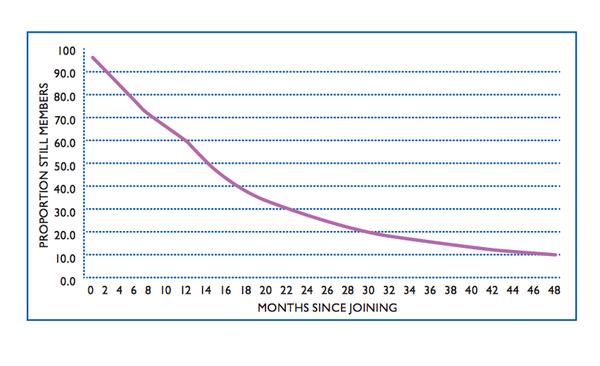
Scores on the doors Our report shows that 51.9 per cent of members retain membership for at least 12 months; 24.4 per cent are still there after 24 months; 14.1 per cent survive to 36 months; and only 10.4 per cent are members to 48 months. (see Figure 1)
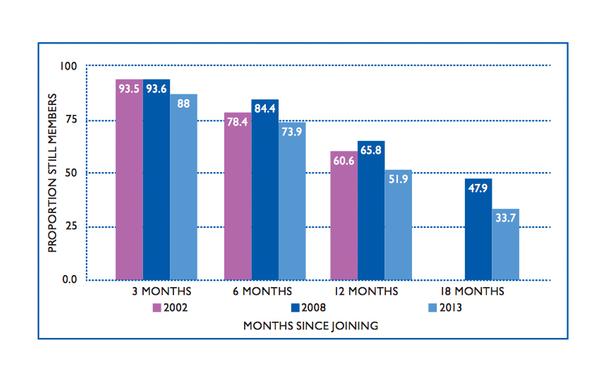
Figure 2 gives an overview of retention rates for specific periods of membership, providing a comparison of our 2013 report with the findings from 2002 and 2008. You can see that at each period, the 2013 results are worse than previous years. In 2002 and 2008, more than six out of 10 members retained their membership for at least 12 months, compared to five out of 10 in 2013.
Within this, there are some interesting variances by age. The latest report identifies that members aged 16–24 years have a 12-month retention rate of 50 per cent compared to those aged over 55, 66 per cent of whom stay for a year. By the end of the study period (48 months), only 5 per cent of the 16–24 group were still members, compared with 22 per cent of those over the age of 55.
Meanwhile, when data is analysed by contract length, 48 per cent of those on one-month agreements complete 12 months of membership, compared to 65 per cent of those on a 12-month contract. This lies at the heart of the difference in retention rates between the public and private sectors: private operators perform significantly better than the public sector for the first 11 months, after which retention rates level out across the board.
Turning to attrition, in 2008 clubs lost members at an average rate of 35 members per thousand members per month. In this new study, they lost them at a rate of 55 per thousand members per month. That’s a loss of an additional 240 members a year that need replacing.
When these figures are scaled up to a national level, the size of the problem really becomes clear. In the 2012 State of the UK Fitness Industry Report, produced by The Leisure Database Company, there were 7,601,114 health club members in the UK. If you extract the 2012 retention figures from The National Retention Report, this would equate to a loss of 3,952,579 members.
Many of these will, of course, have left one gym to join another – it’s not currently possible to track that change (although this could be remedied were the industry to adopt a single, individual membership approach similar to National Insurance numbers, allowing us to track ‘loss to industry’ versus ‘lost to competitor’). However, even acknowledging this, a figure of 3,952,579 annual lapsers is still an unacceptably high number.
Meanwhile, if we look at how long members stay, we can see a wide difference between the best and worst performers. Median length of membership is currently just 12.3 months. However, the worst performing clubs only manage to hold on to members for six months, whereas the best performing clubs keep them for an additional 23.5 months. Based on a club of 1,000 members, each paying £35 a month, that would equate to a difference in income of £595,000 between the best and worst performers.
Customer profile MOSAIC profiling is used to understand characteristics of households and the individuals living there. The essence of the system is that small areas which share similar housing, lifestyle, demographic and socio-economic features will show similar likelihood of using specific services (eg gyms).
If we review the demographics of the members in The National Retention Report sample using MOSAIC profiling, we can see that the health club industry currently attracts the majority of its members from just seven of the 15 MOSAIC groups. The report suggests the industry is dominated by the middle classes, failing to attract the highest or lowest income groups. Rural areas and older people are also under-represented.
This is true across all sectors. Indeed, while previous reports have shown that MOSAIC types differ by public and private sector, the new report suggests this is no longer the case, with types that were previously only seen in more expensive private sector clubs now being found equally in public sector facilities.
Perhaps most worrying in this is the fact that leisure facilities set up to provide opportunities for the least well-off do not seem to be attracting those groups sufficiently to represent their community.
So why is this happening? Certainly the past four years have seen some dramatic changes in the fitness offering being made available to the buying public.
First of all, the variety of offerings has diminished in the sector. Public sector sites have been rejuvenated by refits and rebuilds, and the quality of the product offering improved.
Public sector operators have also been keen to employ sales approaches that mimic the private sector – the sort of approaches that previously set private operators apart – while still maintaining their community values. In short, they have upped their game.
Meanwhile the private sector has experienced challenging times. Health and fitness clubs have often had to maintain an ageing portfolio of facilities in the face of increased competition from the low-cost market – which has boomed in both private and public sectors – as well as a newly invigorated public sector.
Homogenous offering In their book Funky Business, Kjell Nordström and Jonas Ridderstråle offer their thoughts on what they refer to as the ‘surplus society’: “The surplus society has a surplus of similar companies, employing similar people, with similar educational backgrounds, working in similar jobs, coming up with similar ideas, producing similar things, with similar prices and similar quality.”
This could also be said of the fitness industry: we’re seeing similar marketing strategies targeting the same types of members, who are being sold similar types of contracts with similar time periods, which provide access to similar facilities and similar classes and equipment. It’s becoming increasingly difficult to separate public and private by facility design, content or contract type.
However, where facilities do have a clear USP, the financial rewards are huge, as can be seen in the best and worst performing clubs example above.
Of course, not all factors relating to retention are entirely under operators’ control: the regulation of length of membership contracts has had an impact, for example, as have the challenges in the wider economy over the last four years.
However, in general, we really haven’t been very imaginative in our offering, nor in the way we provide support to members, with a focus on PT over service. Larger health clubs – those offering gym, studios, tennis, swimming pools – will routinely generate membership revenues of £260k a month. F&B adds another £45–50k and PT just £18–20k. Yet while large amounts of time and effort are devoted to driving up secondary spend, many operators place little effort on improving retention, which is where the big money remains.
Figure 1. Length of membership retention
Figure 1.
Figure2. Overview of retention rate trends
Figure2
METHODOLOGY
Published in 2013, The National Retention Report (The White Report) – produced by Dr Paul Bedford – offers a valuable insight into the retention and attrition rates of the UK health and fitness market over a four-year period. Not only is it the longest study of its type to date, it’s also the most representative sample.
Data was sourced from 100 sites, with a breakdown – the proportion of chains, independents, trusts, local authority sites and privately managed public facilities – that mirrors the wider UK market.
Within these 100 sites, 38 different club operators were represented, with a total of 729,389 individual member records supplied. After the data was cleaned for irregularities, 342,759 member records remained for analysis.
The measurement methodology from the previous reports (2002 and 2008) was once again used to provide continuity and allow some comparison, offering a definitive way of measuring retention and attrition, as well as enabling participating clubs to compare their own performance against industry benchmarks.
Membership data was extracted to include the period 1 January 2009 to 31 December 2012, thus providing a maximum of 48 months’ follow-up.
About the Aurthor
Paul Bedford PhD has worked in the fitness industry for more than 20 years. His business, Retention Guru, helps health club operators increase retention, reduce attrition and improve member loyalty.
Paul will be presenting on the findings of The National Retention Report at Leisure Industry Week this month – Tuesday 24 September, 1.30pm, in the LIW Keynote Theatre.
Email paul-retentionguru.co.uk Twitter @guru_paul Linkedin Paul Bedford
The best performing clubs hold on to their members for 23.5 months more, on average, than the worst performing sites
Older members are more loyal than younger members – 66 per cent of those aged over 55 maintain membership for a year / photo: shutterstock.com
Improved retention rates will have major impact on a club’s bottom line / photo: shutterstock.com/ Andresr
Panatta brought together four of the most influential figures in bodybuilding history on the
stage of RiminiWellness 2026: Phil Heath, Lee Haney, Ronnie Coleman and Hany Rambod. [more...]
Active Blackpool is deploying Cornerstone Connect, a new digital interface allowing
disparate information from multiple systems to be aggregated into one dataset, to support
its focus on reducing health inequalities and improving healthy life expectancy. [more...]
+ More featured suppliers
COMPANY PROFILES
ukactive
ukactive is the UK’s leading trade body for the physical activity sector, bringing together more tha [more...]
Alliance Leisure
Alliance Leisure Services was specifically
established to respond to the changing
development need [more...]
The most recent research on UK health club member retention reveals a worrying decline in an already unsatisfactory situation – namely the industry’s ability to retain members.
The first study of this type was conducted as part of the FIA’s (now ukactive) Winning the Retention Battle series, conducted by Dr Melvyn Hillsdon back in 2002. At that time, from a sample of just over 70,000 members, 60 per cent retained membership for 12 months. The subsequent national study in 2008, involving 293,000 members, revealed that 66 per cent of members had retained their membership for 12 months.
But the latest figures have fallen back down – and beyond. Based on 342,759 member records and covering the four-year period from 2009–2012, The National Retention Report (see information panel, p66) indicates that only 52 per cent of members are maintaining membership at their club for 12 months.
Although comparing data from different samples is not the most academic research approach, nevertheless the findings allow us to draw some broad conclusions, as well as allowing us to identify some of the characteristics that defined the market then and now, helping us understand where the key changes have been taking place.
Scores on the doors Our report shows that 51.9 per cent of members retain membership for at least 12 months; 24.4 per cent are still there after 24 months; 14.1 per cent survive to 36 months; and only 10.4 per cent are members to 48 months. (see Figure 1)
Figure 2 gives an overview of retention rates for specific periods of membership, providing a comparison of our 2013 report with the findings from 2002 and 2008. You can see that at each period, the 2013 results are worse than previous years. In 2002 and 2008, more than six out of 10 members retained their membership for at least 12 months, compared to five out of 10 in 2013.
Within this, there are some interesting variances by age. The latest report identifies that members aged 16–24 years have a 12-month retention rate of 50 per cent compared to those aged over 55, 66 per cent of whom stay for a year. By the end of the study period (48 months), only 5 per cent of the 16–24 group were still members, compared with 22 per cent of those over the age of 55.
Meanwhile, when data is analysed by contract length, 48 per cent of those on one-month agreements complete 12 months of membership, compared to 65 per cent of those on a 12-month contract. This lies at the heart of the difference in retention rates between the public and private sectors: private operators perform significantly better than the public sector for the first 11 months, after which retention rates level out across the board.
Turning to attrition, in 2008 clubs lost members at an average rate of 35 members per thousand members per month. In this new study, they lost them at a rate of 55 per thousand members per month. That’s a loss of an additional 240 members a year that need replacing.
When these figures are scaled up to a national level, the size of the problem really becomes clear. In the 2012 State of the UK Fitness Industry Report, produced by The Leisure Database Company, there were 7,601,114 health club members in the UK. If you extract the 2012 retention figures from The National Retention Report, this would equate to a loss of 3,952,579 members.
Many of these will, of course, have left one gym to join another – it’s not currently possible to track that change (although this could be remedied were the industry to adopt a single, individual membership approach similar to National Insurance numbers, allowing us to track ‘loss to industry’ versus ‘lost to competitor’). However, even acknowledging this, a figure of 3,952,579 annual lapsers is still an unacceptably high number.
Meanwhile, if we look at how long members stay, we can see a wide difference between the best and worst performers. Median length of membership is currently just 12.3 months. However, the worst performing clubs only manage to hold on to members for six months, whereas the best performing clubs keep them for an additional 23.5 months. Based on a club of 1,000 members, each paying £35 a month, that would equate to a difference in income of £595,000 between the best and worst performers.
Customer profile MOSAIC profiling is used to understand characteristics of households and the individuals living there. The essence of the system is that small areas which share similar housing, lifestyle, demographic and socio-economic features will show similar likelihood of using specific services (eg gyms).
If we review the demographics of the members in The National Retention Report sample using MOSAIC profiling, we can see that the health club industry currently attracts the majority of its members from just seven of the 15 MOSAIC groups. The report suggests the industry is dominated by the middle classes, failing to attract the highest or lowest income groups. Rural areas and older people are also under-represented.
This is true across all sectors. Indeed, while previous reports have shown that MOSAIC types differ by public and private sector, the new report suggests this is no longer the case, with types that were previously only seen in more expensive private sector clubs now being found equally in public sector facilities.
Perhaps most worrying in this is the fact that leisure facilities set up to provide opportunities for the least well-off do not seem to be attracting those groups sufficiently to represent their community.
So why is this happening? Certainly the past four years have seen some dramatic changes in the fitness offering being made available to the buying public.
First of all, the variety of offerings has diminished in the sector. Public sector sites have been rejuvenated by refits and rebuilds, and the quality of the product offering improved.
Public sector operators have also been keen to employ sales approaches that mimic the private sector – the sort of approaches that previously set private operators apart – while still maintaining their community values. In short, they have upped their game.
Meanwhile the private sector has experienced challenging times. Health and fitness clubs have often had to maintain an ageing portfolio of facilities in the face of increased competition from the low-cost market – which has boomed in both private and public sectors – as well as a newly invigorated public sector.
Homogenous offering In their book Funky Business, Kjell Nordström and Jonas Ridderstråle offer their thoughts on what they refer to as the ‘surplus society’: “The surplus society has a surplus of similar companies, employing similar people, with similar educational backgrounds, working in similar jobs, coming up with similar ideas, producing similar things, with similar prices and similar quality.”
This could also be said of the fitness industry: we’re seeing similar marketing strategies targeting the same types of members, who are being sold similar types of contracts with similar time periods, which provide access to similar facilities and similar classes and equipment. It’s becoming increasingly difficult to separate public and private by facility design, content or contract type.
However, where facilities do have a clear USP, the financial rewards are huge, as can be seen in the best and worst performing clubs example above.
Of course, not all factors relating to retention are entirely under operators’ control: the regulation of length of membership contracts has had an impact, for example, as have the challenges in the wider economy over the last four years.
However, in general, we really haven’t been very imaginative in our offering, nor in the way we provide support to members, with a focus on PT over service. Larger health clubs – those offering gym, studios, tennis, swimming pools – will routinely generate membership revenues of £260k a month. F&B adds another £45–50k and PT just £18–20k. Yet while large amounts of time and effort are devoted to driving up secondary spend, many operators place little effort on improving retention, which is where the big money remains.
Figure 1. Length of membership retention
Figure 1.
Figure2. Overview of retention rate trends
Figure2
METHODOLOGY
Published in 2013, The National Retention Report (The White Report) – produced by Dr Paul Bedford – offers a valuable insight into the retention and attrition rates of the UK health and fitness market over a four-year period. Not only is it the longest study of its type to date, it’s also the most representative sample.
Data was sourced from 100 sites, with a breakdown – the proportion of chains, independents, trusts, local authority sites and privately managed public facilities – that mirrors the wider UK market.
Within these 100 sites, 38 different club operators were represented, with a total of 729,389 individual member records supplied. After the data was cleaned for irregularities, 342,759 member records remained for analysis.
The measurement methodology from the previous reports (2002 and 2008) was once again used to provide continuity and allow some comparison, offering a definitive way of measuring retention and attrition, as well as enabling participating clubs to compare their own performance against industry benchmarks.
Membership data was extracted to include the period 1 January 2009 to 31 December 2012, thus providing a maximum of 48 months’ follow-up.
About the Aurthor
Paul Bedford PhD has worked in the fitness industry for more than 20 years. His business, Retention Guru, helps health club operators increase retention, reduce attrition and improve member loyalty.
Paul will be presenting on the findings of The National Retention Report at Leisure Industry Week this month – Tuesday 24 September, 1.30pm, in the LIW Keynote Theatre.
Email paul-retentionguru.co.uk Twitter @guru_paul Linkedin Paul Bedford
The best performing clubs hold on to their members for 23.5 months more, on average, than the worst performing sites
Older members are more loyal than younger members – 66 per cent of those aged over 55 maintain membership for a year / photo: shutterstock.com
Improved retention rates will have major impact on a club’s bottom line / photo: shutterstock.com/ Andresr
The UK's four Chief Medical Officers have published a refreshed edition of Physical activity
guidelines: UK Chief Medical Officers' report, updating the evidence that underpins the nation's
physical activity recommendations and placing greater emphasis on strength, balance, reducing
sedentary behaviour and, for the first time, supporting people taking weight loss medications.
Places Leisure has exchanged contracts to build and operate a flagship £60m water and leisure
destination on behalf of Basingstoke and Deane Borough Council.
The Republic of Ireland will become the latest market in PureGym’s expanding international
portfolio, with the first launch planned for Dublin in 2027.
Anytime Fitness opened more than one club a day in 2025 and is on track to maintain this rate
of growth this year, as parent company Purpose Brands targets further international expansion.
The £33.9 million Leighton Leisure and Community Centre has opened in Leighton Buzzard, UK,
creating a next-generation public leisure, health and wellbeing hub for the local community.
Walnuts Leisure Centre in Orpington, in the London Borough of Bromley, has reopened following
a £17m transformation designed to secure the long-term future of the public leisure asset and
reposition it as a community wellbeing hub.
The Gym Group, has announced that it's sustained positive trading momentum has continued
through the first half of 2026 and the company remains confident about the outlook.
Luxury boutique Pilates and wellness studio, X-Club, officially launches a
4,000sq ft flagship at
Marylebone on 16 July Built around X-Club’s four pillars of wellness – mind,
movement,
nutrition and therapy – the facility features two group exercise studi
Panatta brought together four of the most influential figures in bodybuilding history on the
stage of RiminiWellness 2026: Phil Heath, Lee Haney, Ronnie Coleman and Hany Rambod. [more...]
Active Blackpool is deploying Cornerstone Connect, a new digital interface allowing
disparate information from multiple systems to be aggregated into one dataset, to support
its focus on reducing health inequalities and improving healthy life expectancy. [more...]
+ More featured suppliers
COMPANY PROFILES
ukactive ukactive is the UK’s leading trade body for the physical activity sector, bringing together more tha [more...]