Setting goals with your members, based on an understanding of their underlying motivations, is a vital step in ensuring exercise adherence. Dr Paul Bedford reports
By Dr Paul Bedford PhD | Published in Health Club Management 2013 issue 8
We all talk about setting goals with our members, but how many health club operators sit down with each and every individual to ensure they have clear targets?
This article will focus on understanding the role that goals play in influencing day-to-day behaviour, motivation, values and beliefs – and how health clubs can use this information when it comes to coaching, supporting members and programme design.
Changing behaviours Sustaining exercise as a regular behaviour is not easy. Numerous theories and models of behaviour change exist, but the challenge I’ve always focused on is how to get individuals to maintain new lifestyle behaviours once started.
As a gym instructor, I was always encouraged by the numbers of new people starting to exercise in the club where I worked. Each day I would conduct inductions for those starting out on their new exercise behaviour, as well as spending time chatting to those who were my regulars – people who had already added going to the gym as an activity choice. Over time, however, I realised that many of those who started so enthusiastically just weeks before were unable to maintain this new behaviour. They eventually disappeared from the club.
Having studied exercise psychology, I was aware that many of the new members I spoke to had goals they wished to achieve – but these were rarely the long-term motivators of behaviour. Many of their stated goals I now describe as general aims or outcome goals: things like lose weight, tone up, get fit. These are very general and often require little consideration, because all of the rationalisation as to why they want to exercise has been done before the question is even asked. You could think of it like preparing an answer to a standard question – what’s your favourite colour, your favourite food, your favourite film? – whereby the answer is stored and ready to be rolled out on request.
Although being physically active on a regular basis has obvious health benefits, it’s important to remember that not everyone who joins a gym is actually seeking health as an outcome for their efforts. Indeed, Eccles et al (2002) suggested that the goals individuals select for exercising are influenced and then endorsed by cultural values and social pressures, such as ‘lose weight’ and ‘tone up’ for women, and ‘build muscle’ for men – a stereotypical view I know, but this is his research, not mine.
But whatever the external or internal influences, people coming to the gym know they will be asked questions about their reasons for wanting to exercise, and so prepare an answer they feel is ‘correct’. Yes, they do want the outcome, but little thought goes into what needs to be done on a daily and weekly basis in order to get it, or what the underlying motivator or driver for that outcome might be.
Setting goals If we look at goal-setting theory, we discover that individuals are motivated to change because they want to reduce the perceived gap between their desired state and their actual state – in their own minds, people conduct some form of basic gap analysis between current and desired states. Goal-setting then creates a framework through which an appropriate behaviour can be identified and attached to the goal in order for it to be achieved.
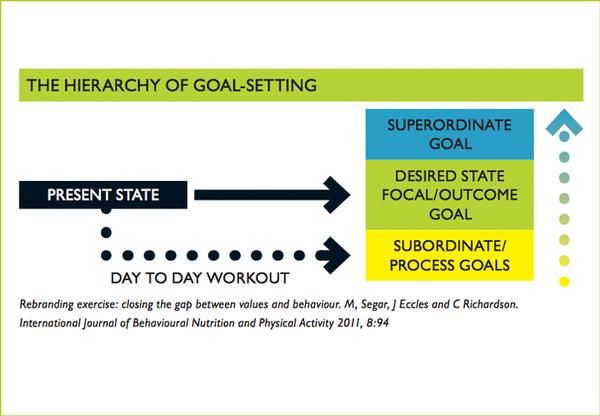
Carver and Scheier (1990) have identified that goals have multiple hierarchical levels – levels they have named the focal goal, superordinate goal and subordinate goal. The focal goal is commonly referred to in the fitness industry as the outcome goal – the result the individual is striving for, such weight loss or muscle growth – and is the type of goal we’re most familiar with.
The subordinate goal is a lower order goal – one we would usually describe as a process goal. Process goals are the day-to-day activities required to reach the outcome goal. For someone looking to lose weight, a subordinate goal might be to get their training kit ready to go the night before, learning how to programme the treadmill without supervision, or identifying a workout goal like adding two minutes of CV time.
Subordinate goals are often overlooked in the fitness industry, but are a vital part of goal achievement. Setting process goals provides an opportunity for celebrating successes well in advance of achieving the outcome goal. These processes goals can also serve to build confidence and self-efficacy, both strongly associated with exercise adherence.
The superordinate goal is more abstract than the previous two, which may be why fitness professionals have avoided making use of it. A variety of names could be attached to the superordinate goal, including ‘motivator’ or ‘driver’, but for the purposes of this article it’s the why. These ‘why’ goals are linked to an individual’s values, beliefs and behaviours. By understanding and delivering on the why – the superordinate goals – we can better help people achieve their outcomes.
Do not confuse asking “why do you want to exercise?” – which so often gives us the bland answers of “to lose weight, tone up, get fit” – with asking “why is that important to you?” or “why is that of value to you?” Both of these ‘why’ questions require a consideration of the superordinate goal, and then a justification of the behaviour, and can be followed by more probing questions like “what will that do for you?”, and then “and what else will that do for you?”
It’s not uncommon at this stage to get a blank stare in response. People will not be expecting this level of questioning, and if you’ve failed to establish and maintain rapport, you will often be given an answer they have already given, but this time repeated with a questioning tone or the blank stare. If you’ve asked the questions with the correct tone of voice, you will get a pause, a glance up and to the left, followed by a glance down to the left, before you get a verbal response. Give the person time and don’t rush to speak if they are obviously thinking about the question you asked.
What does this mean for us? In the time-limited environment of many health club inductions, it can be tricky to complete all of the tasks required and deliver something meaningful to members. However, understanding what motivates them is critical to success and failure – both theirs and ours.
Ask them: What do you want to get from your exercise programme? What will that do for you? What else will it do for you? Why is that important? Why is that of value? Thinking about the future for a minute, when you have reached your goal of [whatever their goal might be], what will life be like?
People exercise on different days for different reasons: on Monday their workout might be motivated by guilt from eating too much at the weekend, or mid-week it might be to create some ‘me time’ away from the office. However, all of the reasons are ultimately driven by a desire to achieve the abstract superordinate goal – the why – and this is what health and fitness clubs must help their members to identify and verbalise.
If we want to increase exercise adherence and goal achievement, we may need to revise the approach we use during the goal-setting process. We need to stop using the restaurant process of order-taking and replace it with an exploration of motivators and drivers of behaviour.
We also need to reconsider where and how these conversations take place. Current research on consumer behaviour is leaning towards asking the questions while individuals are actually consuming or buying the goods and services in question, rather than asking them to predict their behaviour using focus groups or recalling their motives in questionnaires. Given the relatively brief, conversational nature of the questions outlined above, gym-based goal-setting discussions could actually be made much less intrusive, conducted by any member of staff at any point during the club visit. Asking about a behaviour once, in an environment other than the gym floor where the behaviour takes place, will not provide the insight required to support a lasting change.
The Role Of The Superordinate Goal
Many people receiving a gym induction have been drawn into focusing on a limited number of health- and weight-related benefits: research has shown that 75 per cent of outcome goals relate to weight loss and health benefits. Further studies suggest that 40 per cent of women over 45 exercise solely to improve body shape and appearance.
As social pressures have led individuals to have these sorts of health/weight goals, it’s logical that health is frequently cited as a reason for exercising. Yet despite health and shape being a commonly cited value, a growing body of research is suggesting that outcome goals focusing on health and weight are not in fact the optimal goals to drive exercise adherence.
A study by Huberty et al (2008) investigated exercise adherence in two groups of women over a 12-week period. It was found those who did not adhere were motivated solely to lose weight, whereas those who adhered did so for superordinate reasons – not wanting to be judged badly by people at a big upcoming event, for example.
About the Author
Paul Bedford PhD has worked in the fitness industry for more than 20 years. His business, Retention Guru, helps health club operators increase retention, reduce attrition and improve member loyalty.
Email paul-retentionguru.co.uk Twitter @guru_paul Linkedin Paul Bedford
Active Blackpool is deploying Cornerstone Connect, a new digital interface allowing
disparate information from multiple systems to be aggregated into one dataset, to support
its focus on reducing health inequalities and improving healthy life expectancy. [more...]
CoverMe, the global leader in fitness workforce management, today launches CoverMe PT, an
on-demand personal training platform that connects the right personal trainer to the right
client in under 10 seconds. [more...]
+ More featured suppliers
COMPANY PROFILES
Everyone Active
Everyone Active operates leisure centres in partnership with local councils across the UK. Today, Ev [more...]
Setting goals with your members, based on an understanding of their underlying motivations, is a vital step in ensuring exercise adherence. Dr Paul Bedford reports
By Dr Paul Bedford PhD | Published in Health Club Management 2013 issue 8
We all talk about setting goals with our members, but how many health club operators sit down with each and every individual to ensure they have clear targets?
This article will focus on understanding the role that goals play in influencing day-to-day behaviour, motivation, values and beliefs – and how health clubs can use this information when it comes to coaching, supporting members and programme design.
Changing behaviours Sustaining exercise as a regular behaviour is not easy. Numerous theories and models of behaviour change exist, but the challenge I’ve always focused on is how to get individuals to maintain new lifestyle behaviours once started.
As a gym instructor, I was always encouraged by the numbers of new people starting to exercise in the club where I worked. Each day I would conduct inductions for those starting out on their new exercise behaviour, as well as spending time chatting to those who were my regulars – people who had already added going to the gym as an activity choice. Over time, however, I realised that many of those who started so enthusiastically just weeks before were unable to maintain this new behaviour. They eventually disappeared from the club.
Having studied exercise psychology, I was aware that many of the new members I spoke to had goals they wished to achieve – but these were rarely the long-term motivators of behaviour. Many of their stated goals I now describe as general aims or outcome goals: things like lose weight, tone up, get fit. These are very general and often require little consideration, because all of the rationalisation as to why they want to exercise has been done before the question is even asked. You could think of it like preparing an answer to a standard question – what’s your favourite colour, your favourite food, your favourite film? – whereby the answer is stored and ready to be rolled out on request.
Although being physically active on a regular basis has obvious health benefits, it’s important to remember that not everyone who joins a gym is actually seeking health as an outcome for their efforts. Indeed, Eccles et al (2002) suggested that the goals individuals select for exercising are influenced and then endorsed by cultural values and social pressures, such as ‘lose weight’ and ‘tone up’ for women, and ‘build muscle’ for men – a stereotypical view I know, but this is his research, not mine.
But whatever the external or internal influences, people coming to the gym know they will be asked questions about their reasons for wanting to exercise, and so prepare an answer they feel is ‘correct’. Yes, they do want the outcome, but little thought goes into what needs to be done on a daily and weekly basis in order to get it, or what the underlying motivator or driver for that outcome might be.
Setting goals If we look at goal-setting theory, we discover that individuals are motivated to change because they want to reduce the perceived gap between their desired state and their actual state – in their own minds, people conduct some form of basic gap analysis between current and desired states. Goal-setting then creates a framework through which an appropriate behaviour can be identified and attached to the goal in order for it to be achieved.
Carver and Scheier (1990) have identified that goals have multiple hierarchical levels – levels they have named the focal goal, superordinate goal and subordinate goal. The focal goal is commonly referred to in the fitness industry as the outcome goal – the result the individual is striving for, such weight loss or muscle growth – and is the type of goal we’re most familiar with.
The subordinate goal is a lower order goal – one we would usually describe as a process goal. Process goals are the day-to-day activities required to reach the outcome goal. For someone looking to lose weight, a subordinate goal might be to get their training kit ready to go the night before, learning how to programme the treadmill without supervision, or identifying a workout goal like adding two minutes of CV time.
Subordinate goals are often overlooked in the fitness industry, but are a vital part of goal achievement. Setting process goals provides an opportunity for celebrating successes well in advance of achieving the outcome goal. These processes goals can also serve to build confidence and self-efficacy, both strongly associated with exercise adherence.
The superordinate goal is more abstract than the previous two, which may be why fitness professionals have avoided making use of it. A variety of names could be attached to the superordinate goal, including ‘motivator’ or ‘driver’, but for the purposes of this article it’s the why. These ‘why’ goals are linked to an individual’s values, beliefs and behaviours. By understanding and delivering on the why – the superordinate goals – we can better help people achieve their outcomes.
Do not confuse asking “why do you want to exercise?” – which so often gives us the bland answers of “to lose weight, tone up, get fit” – with asking “why is that important to you?” or “why is that of value to you?” Both of these ‘why’ questions require a consideration of the superordinate goal, and then a justification of the behaviour, and can be followed by more probing questions like “what will that do for you?”, and then “and what else will that do for you?”
It’s not uncommon at this stage to get a blank stare in response. People will not be expecting this level of questioning, and if you’ve failed to establish and maintain rapport, you will often be given an answer they have already given, but this time repeated with a questioning tone or the blank stare. If you’ve asked the questions with the correct tone of voice, you will get a pause, a glance up and to the left, followed by a glance down to the left, before you get a verbal response. Give the person time and don’t rush to speak if they are obviously thinking about the question you asked.
What does this mean for us? In the time-limited environment of many health club inductions, it can be tricky to complete all of the tasks required and deliver something meaningful to members. However, understanding what motivates them is critical to success and failure – both theirs and ours.
Ask them: What do you want to get from your exercise programme? What will that do for you? What else will it do for you? Why is that important? Why is that of value? Thinking about the future for a minute, when you have reached your goal of [whatever their goal might be], what will life be like?
People exercise on different days for different reasons: on Monday their workout might be motivated by guilt from eating too much at the weekend, or mid-week it might be to create some ‘me time’ away from the office. However, all of the reasons are ultimately driven by a desire to achieve the abstract superordinate goal – the why – and this is what health and fitness clubs must help their members to identify and verbalise.
If we want to increase exercise adherence and goal achievement, we may need to revise the approach we use during the goal-setting process. We need to stop using the restaurant process of order-taking and replace it with an exploration of motivators and drivers of behaviour.
We also need to reconsider where and how these conversations take place. Current research on consumer behaviour is leaning towards asking the questions while individuals are actually consuming or buying the goods and services in question, rather than asking them to predict their behaviour using focus groups or recalling their motives in questionnaires. Given the relatively brief, conversational nature of the questions outlined above, gym-based goal-setting discussions could actually be made much less intrusive, conducted by any member of staff at any point during the club visit. Asking about a behaviour once, in an environment other than the gym floor where the behaviour takes place, will not provide the insight required to support a lasting change.
The Role Of The Superordinate Goal
Many people receiving a gym induction have been drawn into focusing on a limited number of health- and weight-related benefits: research has shown that 75 per cent of outcome goals relate to weight loss and health benefits. Further studies suggest that 40 per cent of women over 45 exercise solely to improve body shape and appearance.
As social pressures have led individuals to have these sorts of health/weight goals, it’s logical that health is frequently cited as a reason for exercising. Yet despite health and shape being a commonly cited value, a growing body of research is suggesting that outcome goals focusing on health and weight are not in fact the optimal goals to drive exercise adherence.
A study by Huberty et al (2008) investigated exercise adherence in two groups of women over a 12-week period. It was found those who did not adhere were motivated solely to lose weight, whereas those who adhered did so for superordinate reasons – not wanting to be judged badly by people at a big upcoming event, for example.
About the Author
Paul Bedford PhD has worked in the fitness industry for more than 20 years. His business, Retention Guru, helps health club operators increase retention, reduce attrition and improve member loyalty.
Email paul-retentionguru.co.uk Twitter @guru_paul Linkedin Paul Bedford
The UK's four Chief Medical Officers have published a refreshed edition of Physical activity
guidelines: UK Chief Medical Officers' report, updating the evidence that underpins the nation's
physical activity recommendations and placing greater emphasis on strength, balance, reducing
sedentary behaviour and, for the first time, supporting people taking weight loss medications.
Places Leisure has exchanged contracts to build and operate a flagship £60m water and leisure
destination on behalf of Basingstoke and Deane Borough Council.
The Republic of Ireland will become the latest market in PureGym’s expanding international
portfolio, with the first launch planned for Dublin in 2027.
Anytime Fitness opened more than one club a day in 2025 and is on track to maintain this rate
of growth this year, as parent company Purpose Brands targets further international expansion.
The £33.9 million Leighton Leisure and Community Centre has opened in Leighton Buzzard, UK,
creating a next-generation public leisure, health and wellbeing hub for the local community.
Walnuts Leisure Centre in Orpington, in the London Borough of Bromley, has reopened following
a £17m transformation designed to secure the long-term future of the public leisure asset and
reposition it as a community wellbeing hub.
The Gym Group, has announced that it's sustained positive trading momentum has continued
through the first half of 2026 and the company remains confident about the outlook.
Luxury boutique Pilates and wellness studio, X-Club, officially launches a
4,000sq ft flagship at
Marylebone on 16 July Built around X-Club’s four pillars of wellness – mind,
movement,
nutrition and therapy – the facility features two group exercise studi
Active Blackpool is deploying Cornerstone Connect, a new digital interface allowing
disparate information from multiple systems to be aggregated into one dataset, to support
its focus on reducing health inequalities and improving healthy life expectancy. [more...]
CoverMe, the global leader in fitness workforce management, today launches CoverMe PT, an
on-demand personal training platform that connects the right personal trainer to the right
client in under 10 seconds. [more...]
+ More featured suppliers
COMPANY PROFILES
Everyone Active Everyone Active operates leisure centres in partnership with local councils across the UK. Today, Ev [more...]