Ignore absent members at your peril, and use your ex-member database as a prospect list and a resource for feedback, says Guy Griffiths, in the third and final part of his series on retention and the member journey
By Guy Griffiths | Published in Health Club Management 2013 issue 7
Absent and ex-members are two under-used segments in many clubs’ databases. Not only can they provide critical business information on how you could adapt or improve retention, but these member groups can also be a great source of sales.
Fear is the main reason why these members are not contacted: club operators worry about awakening dormant members, and are concerned that they will receive negative feedback from people who have left. But sticking your head in the sand is a much riskier strategy; if all your dormant members cancelled tomorrow, your business would be in serious trouble, and if you don’t know why members are leaving, how can you expect to make people stick around?
In the same way that the member journey should not end after the first few weeks, you need to plan what happens when a member stops visiting, and after they leave.
Pay versus stay Let’s start with measurement. Knowing your average membership length is a good place to start, but ‘length of pay’ is different from ‘length of stay’. Consider a member who stops paying in month 12; it’s no good contacting them in month 11 if they last visited in month seven. At GGFit, we often work with length of stay – ie first to last visit – as it’s a truer identifier of member engagement and allows you to affect retention more directly.
Another useful metric to understand is the average time from the last visit date to cancellation date – this gives you an idea of how long you have to try to re-engage a dormant member.
Who’s going to call? When deciding how to contact absent members, you need to know what’s most effective, but also take into account what’s practical or possible with the resources you have at your club.
Phone conversations are most effective at getting members back, but you will often have to make a lot of phone calls to have a few conversations, and timing is key to success. Some clubs use customer service staff or even a call centre to make these calls, but instructors are best placed, since they have already had face-to-face member contact in the gym. Whether or not they are motivated to call absent members can depend on their own goals, rewards – or, to put it bluntly, job spec. If some of your instructors would prefer to do the cleaning than call absent members, perhaps it’s time to adjust their focus or change their job spec. Properly motivated instructors should be keen to get their members back into the club.
However, if you know that other staff will get the job done, they may prove to be the best route.
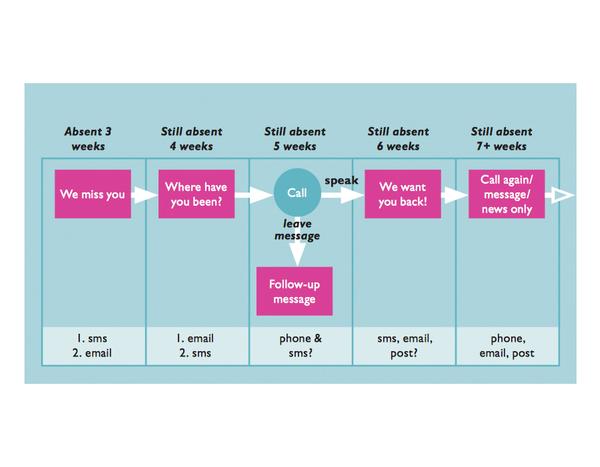
Send a message first A great way to reduce the number of calls required is to text or email members before you call them. This will bring a few members back already, as well as making the calls easier – you can ask them if they received the message as an ice-breaker (see Figure 1 for an example of an absent member communication process).
Some clubs use text/email only for their absent member communication. This is better than nothing, but you can get a much better return rate if you check the reports from your retention communications to determine which members should be prioritised for follow-up calls.
Mixing up your communication channels also keeps the message fresh and means you can reach out to more of your members: you may not have all details for all members, and some may have opted out of certain forms of communication, so a postcard or letter can also be a good option to get in touch with absent members.
Meanwhile guest passes (with a value printed on them) can bring members back with their friends in tow, increasing your prospect list; friends who work out together are also more likely to stay.
If you must offer a PT session as an incentive, don’t say it’s free (anything that is free has little value). Instead, tell the member that the club will pay for a £50 PT session for them if they return.
Just by showing that you care about a member’s visits and fitness, you can extend their membership by another month. For the price of an email, text or postage stamp, it’s a no-brainer.
To get started today, take the 100 or so members who have recently become dormant, say from the last month or two. Don’t begin by contacting members who haven’t visited the club for over a year, as they truly are sleeping dogs. Build a list of members who visited four to eight weeks ago, but who have not visited in the last four weeks. Put a stake in the ground, resolve to get newly absent members back into the club, then repeat weekly.
Ex-members It’s notoriously difficult to leave many clubs, but making it hard to cancel a membership does nothing to improve member retention. You might get another month’s membership from people, but they leave feeling totally disillusioned. Finding out the reason a member wants to leave and offering an alternative or a membership freeze can help, but by the time they want to stop paying, it’s usually too late. This is why you must contact them earlier, when you notice their visit rate dwindling.
If you want to report on reasons for leaving, it’s a good idea to give members a choice of options to explain why they leave – for example, health/ service/ money/ location/ results. You don’t need to make it easy to leave, but the process should be simple and straightforward, just like your joining process.
Leaver’s survey Once they’ve gone, ex-members are largely overlooked. However, if you have good ex-member data, it’s worth regularly contacting them for research and re-sale. Even if you recorded why they left when they cancelled, consider sending a leaver’s survey a month later. This can tell you the real reason they left (rather than the excuse they gave), as well as giving you a chance to see what they’re up to now, or where they’ve gone. All this information can be used to trigger future contacts, as well as collecting feedback to improve the club.
Continue to contact ex-members regularly: a quarterly newsletter and/or survey to ex-members should be a regular communication from your database. The prime focus here is to stay in touch; if an ex-member completes the survey, they should get a voucher to re-visit or re-join. The actual answers to the survey are less important. That said, it’s good to use positive questions rather than reminding them why they left. Ask about current exercise goals and habits, perhaps use the Net Promoter question (how likely they are to recommend your club), and include an open question for comments and feedback.
You will get some interesting comments, possibly even some spiteful ones (these are ex-members after all), and occasionally some ‘unsubscribe’ requests. Focus on the positives: if there’s anything you can change, then do so; respond to positive comments; and track the vouchers or offers redeemed.
Face your fears The complete member journey should run from beginning to end, and if possible beyond. To run a successful club, you need to face your fears and contact absent and ex-members.
When members stop attending your club, do something about it; some may go on to actually leave because of your actions, but you’ll get many more re-engaged and coming back.
And when some of your members do leave, don’t ignore them: learn from them, turn them back into prospects if you can, and try to get them back when the time is right.
FIGURE 1: CONTACTING THE ABSENT MEMBER
FIGURE 1
HOW TO GENERATE £3,000 BY SENDING AN EMAIL
A budget gym chain sent an email survey newsletter to 6,000 ex-members who had left in the previous 12 months. Each person who completed the survey received a special offer to re-join (six months for the price of three).
The survey included four simple questions, with the results analysed– the survey showed, for example, that 63 per cent of ex-members were not currently a member of another club. However, polling ex-members for their views was not the main reason: the main purpose was to simply stay in touch or get them to re-join.
There were around 100 negative replies, which were put to one side and then followed up (or unsubscribed) later.
Around 200 members completed the survey, and 32 went on to use the offer code generated. This created at least £1,440 in revenue. However, returning members at this chain typically stay for around 10 months; with three months free, the projected revenue from this initiative is in fact calculated at £3,360.
Other ex-members may also have joined as a result of the survey, but this was not tracked.
Guy Griffiths works for GG Fit, an independent consultancy that helps clubs improve member retention by working with staff, systems and processes. His new book, Stick Around, is available from all good bookshops and online retailers. Web: www.ggfit.com
CoverMe, the global leader in fitness workforce management, today launches CoverMe PT, an
on-demand personal training platform that connects the right personal trainer to the right
client in under 10 seconds. [more...]
Panatta brought together four of the most influential figures in bodybuilding history on the
stage of RiminiWellness 2026: Phil Heath, Lee Haney, Ronnie Coleman and Hany Rambod. [more...]
+ More featured suppliers
COMPANY PROFILES
Precor
Precor promises precision-quality products with steadfast reliability that are inspired by exerciser [more...]
Ignore absent members at your peril, and use your ex-member database as a prospect list and a resource for feedback, says Guy Griffiths, in the third and final part of his series on retention and the member journey
By Guy Griffiths | Published in Health Club Management 2013 issue 7
Absent and ex-members are two under-used segments in many clubs’ databases. Not only can they provide critical business information on how you could adapt or improve retention, but these member groups can also be a great source of sales.
Fear is the main reason why these members are not contacted: club operators worry about awakening dormant members, and are concerned that they will receive negative feedback from people who have left. But sticking your head in the sand is a much riskier strategy; if all your dormant members cancelled tomorrow, your business would be in serious trouble, and if you don’t know why members are leaving, how can you expect to make people stick around?
In the same way that the member journey should not end after the first few weeks, you need to plan what happens when a member stops visiting, and after they leave.
Pay versus stay Let’s start with measurement. Knowing your average membership length is a good place to start, but ‘length of pay’ is different from ‘length of stay’. Consider a member who stops paying in month 12; it’s no good contacting them in month 11 if they last visited in month seven. At GGFit, we often work with length of stay – ie first to last visit – as it’s a truer identifier of member engagement and allows you to affect retention more directly.
Another useful metric to understand is the average time from the last visit date to cancellation date – this gives you an idea of how long you have to try to re-engage a dormant member.
Who’s going to call? When deciding how to contact absent members, you need to know what’s most effective, but also take into account what’s practical or possible with the resources you have at your club.
Phone conversations are most effective at getting members back, but you will often have to make a lot of phone calls to have a few conversations, and timing is key to success. Some clubs use customer service staff or even a call centre to make these calls, but instructors are best placed, since they have already had face-to-face member contact in the gym. Whether or not they are motivated to call absent members can depend on their own goals, rewards – or, to put it bluntly, job spec. If some of your instructors would prefer to do the cleaning than call absent members, perhaps it’s time to adjust their focus or change their job spec. Properly motivated instructors should be keen to get their members back into the club.
However, if you know that other staff will get the job done, they may prove to be the best route.
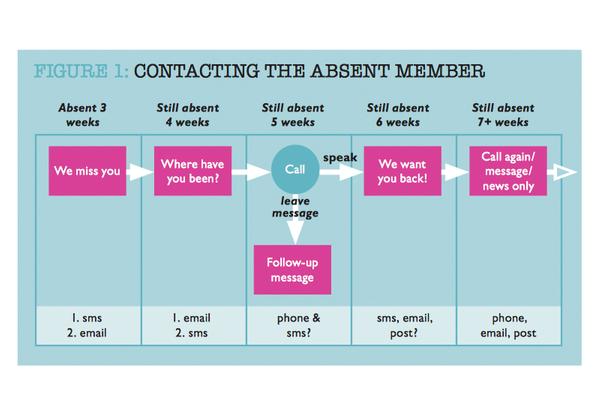
Send a message first A great way to reduce the number of calls required is to text or email members before you call them. This will bring a few members back already, as well as making the calls easier – you can ask them if they received the message as an ice-breaker (see Figure 1 for an example of an absent member communication process).
Some clubs use text/email only for their absent member communication. This is better than nothing, but you can get a much better return rate if you check the reports from your retention communications to determine which members should be prioritised for follow-up calls.
Mixing up your communication channels also keeps the message fresh and means you can reach out to more of your members: you may not have all details for all members, and some may have opted out of certain forms of communication, so a postcard or letter can also be a good option to get in touch with absent members.
Meanwhile guest passes (with a value printed on them) can bring members back with their friends in tow, increasing your prospect list; friends who work out together are also more likely to stay.
If you must offer a PT session as an incentive, don’t say it’s free (anything that is free has little value). Instead, tell the member that the club will pay for a £50 PT session for them if they return.
Just by showing that you care about a member’s visits and fitness, you can extend their membership by another month. For the price of an email, text or postage stamp, it’s a no-brainer.
To get started today, take the 100 or so members who have recently become dormant, say from the last month or two. Don’t begin by contacting members who haven’t visited the club for over a year, as they truly are sleeping dogs. Build a list of members who visited four to eight weeks ago, but who have not visited in the last four weeks. Put a stake in the ground, resolve to get newly absent members back into the club, then repeat weekly.
Ex-members It’s notoriously difficult to leave many clubs, but making it hard to cancel a membership does nothing to improve member retention. You might get another month’s membership from people, but they leave feeling totally disillusioned. Finding out the reason a member wants to leave and offering an alternative or a membership freeze can help, but by the time they want to stop paying, it’s usually too late. This is why you must contact them earlier, when you notice their visit rate dwindling.
If you want to report on reasons for leaving, it’s a good idea to give members a choice of options to explain why they leave – for example, health/ service/ money/ location/ results. You don’t need to make it easy to leave, but the process should be simple and straightforward, just like your joining process.
Leaver’s survey Once they’ve gone, ex-members are largely overlooked. However, if you have good ex-member data, it’s worth regularly contacting them for research and re-sale. Even if you recorded why they left when they cancelled, consider sending a leaver’s survey a month later. This can tell you the real reason they left (rather than the excuse they gave), as well as giving you a chance to see what they’re up to now, or where they’ve gone. All this information can be used to trigger future contacts, as well as collecting feedback to improve the club.
Continue to contact ex-members regularly: a quarterly newsletter and/or survey to ex-members should be a regular communication from your database. The prime focus here is to stay in touch; if an ex-member completes the survey, they should get a voucher to re-visit or re-join. The actual answers to the survey are less important. That said, it’s good to use positive questions rather than reminding them why they left. Ask about current exercise goals and habits, perhaps use the Net Promoter question (how likely they are to recommend your club), and include an open question for comments and feedback.
You will get some interesting comments, possibly even some spiteful ones (these are ex-members after all), and occasionally some ‘unsubscribe’ requests. Focus on the positives: if there’s anything you can change, then do so; respond to positive comments; and track the vouchers or offers redeemed.
Face your fears The complete member journey should run from beginning to end, and if possible beyond. To run a successful club, you need to face your fears and contact absent and ex-members.
When members stop attending your club, do something about it; some may go on to actually leave because of your actions, but you’ll get many more re-engaged and coming back.
And when some of your members do leave, don’t ignore them: learn from them, turn them back into prospects if you can, and try to get them back when the time is right.
FIGURE 1: CONTACTING THE ABSENT MEMBER
FIGURE 1
HOW TO GENERATE £3,000 BY SENDING AN EMAIL
A budget gym chain sent an email survey newsletter to 6,000 ex-members who had left in the previous 12 months. Each person who completed the survey received a special offer to re-join (six months for the price of three).
The survey included four simple questions, with the results analysed– the survey showed, for example, that 63 per cent of ex-members were not currently a member of another club. However, polling ex-members for their views was not the main reason: the main purpose was to simply stay in touch or get them to re-join.
There were around 100 negative replies, which were put to one side and then followed up (or unsubscribed) later.
Around 200 members completed the survey, and 32 went on to use the offer code generated. This created at least £1,440 in revenue. However, returning members at this chain typically stay for around 10 months; with three months free, the projected revenue from this initiative is in fact calculated at £3,360.
Other ex-members may also have joined as a result of the survey, but this was not tracked.
Guy Griffiths works for GG Fit, an independent consultancy that helps clubs improve member retention by working with staff, systems and processes. His new book, Stick Around, is available from all good bookshops and online retailers. Web: www.ggfit.com
The UK's four Chief Medical Officers have published a refreshed edition of Physical activity
guidelines: UK Chief Medical Officers' report, updating the evidence that underpins the nation's
physical activity recommendations and placing greater emphasis on strength, balance, reducing
sedentary behaviour and, for the first time, supporting people taking weight loss medications.
Places Leisure has exchanged contracts to build and operate a flagship £60m water and leisure
destination on behalf of Basingstoke and Deane Borough Council.
The Republic of Ireland will become the latest market in PureGym’s expanding international
portfolio, with the first launch planned for Dublin in 2027.
Anytime Fitness opened more than one club a day in 2025 and is on track to maintain this rate
of growth this year, as parent company Purpose Brands targets further international expansion.
The £33.9 million Leighton Leisure and Community Centre has opened in Leighton Buzzard, UK,
creating a next-generation public leisure, health and wellbeing hub for the local community.
Walnuts Leisure Centre in Orpington, in the London Borough of Bromley, has reopened following
a £17m transformation designed to secure the long-term future of the public leisure asset and
reposition it as a community wellbeing hub.
The Gym Group, has announced that it's sustained positive trading momentum has continued
through the first half of 2026 and the company remains confident about the outlook.
Luxury boutique Pilates and wellness studio, X-Club, officially launches a
4,000sq ft flagship at
Marylebone on 16 July Built around X-Club’s four pillars of wellness – mind,
movement,
nutrition and therapy – the facility features two group exercise studi
CoverMe, the global leader in fitness workforce management, today launches CoverMe PT, an
on-demand personal training platform that connects the right personal trainer to the right
client in under 10 seconds. [more...]
Panatta brought together four of the most influential figures in bodybuilding history on the
stage of RiminiWellness 2026: Phil Heath, Lee Haney, Ronnie Coleman and Hany Rambod. [more...]
+ More featured suppliers
COMPANY PROFILES
Precor Precor promises precision-quality products with steadfast reliability that are inspired by exerciser [more...]