The field of neuroplasticity says thought itself can produce physical changes
For centuries it’s been believed that the brain was a static organ incapable of change. In recent decades, however, it’s been discovered that the brain is dynamic and has the ability to change, heal and renew itself.
Growing research in this field – known as neuroplasticity – has shown that thought itself can actually result in physical as well as mental changes: you use the same sensory programmes in the brain when you imagine an action as you do when you perform that activity.
In gym terms, this means that just thinking about a workout can have benefits. While it’s obviously not recommended that people stop exercising because of this, there’s an argument that more ‘thoughtful exercise’ has the potential to enhance results.
Power of imagination A recent study by the University of South Carolina Upstate* has shown that, when people focus their mind on a muscle during strength training, they increase the output of that muscle significantly.
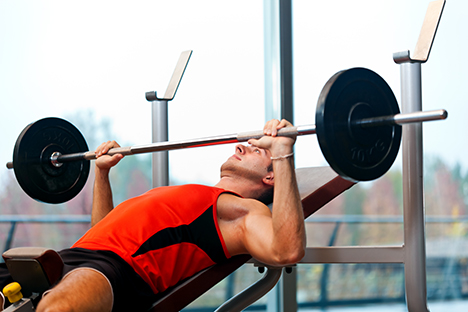
The test was carried out on 11 male footballers who performed three sets of bench presses at 50 per cent capacity while electromyographic (EMG) activity was measured in their pectorals, deltoids and triceps. The first set was performed without any instruction, but in the following sets participants were told to focus on the chest and tricep muscles respectively.
In the set where they were asked to focus on the chest muscle, activity in the pectorals rose by 22 per cent, while activity in other muscle groups was unchanged. Similarly, when instructed to think about the triceps, activity in those muscles rose by 26 per cent.
In a fourth bench press set which was performed at 80 per cent capacity, there was no significant change in muscle activity despite verbal instruction, suggesting that thoughtful exercise might not be as effective during high-intensity workouts.
Thought provoking Meanwhile, an older piece of research from Harvard University** found that thinking about everyday activities as exercise can actually improve fitness.
The four-week study was based on 84 female housekeeping staff working in seven hotels. All of them worked a 32- to 40-hour week cleaning around 15 rooms a day at similar hotels.
The weight, BMI, waist-to-hip ratio and blood pressure was recorded in each participant, who also filled out a questionnaire on whether they thought their work duties were acts of exercise.
Subjects in four hotels (44 people) were told that their daily housekeeping work meant they were meeting the recommendations for an active lifestyle. They were given details about how many calories were used in different activities – 15 minutes of changing linen equated to 40 calories, while 15 minutes cleaning a bathroom used 60 calories, for example.
The remaining 40 participants working in the three other hotels were not given any such information.
After four weeks, subjects in the informed group perceived themselves to be getting more exercise than before. Compared to the control group, their physical health had also significantly improved: their average weight dropped by nearly 2lbs; average BMI decreased from 26.05 to 25.70; and average waist-to-hip ratio fell from 0.834 to 0.826.
The researchers concluded that: “These results support the hypothesis that exercise affects health in part or in whole via the placebo effect.”
Active Blackpool is deploying Cornerstone Connect, a new digital interface allowing
disparate information from multiple systems to be aggregated into one dataset, to support
its focus on reducing health inequalities and improving healthy life expectancy. [more...]
Panatta brought together four of the most influential figures in bodybuilding history on the
stage of RiminiWellness 2026: Phil Heath, Lee Haney, Ronnie Coleman and Hany Rambod. [more...]
The field of neuroplasticity says thought itself can produce physical changes
For centuries it’s been believed that the brain was a static organ incapable of change. In recent decades, however, it’s been discovered that the brain is dynamic and has the ability to change, heal and renew itself.
Growing research in this field – known as neuroplasticity – has shown that thought itself can actually result in physical as well as mental changes: you use the same sensory programmes in the brain when you imagine an action as you do when you perform that activity.
In gym terms, this means that just thinking about a workout can have benefits. While it’s obviously not recommended that people stop exercising because of this, there’s an argument that more ‘thoughtful exercise’ has the potential to enhance results.
Power of imagination A recent study by the University of South Carolina Upstate* has shown that, when people focus their mind on a muscle during strength training, they increase the output of that muscle significantly.
The test was carried out on 11 male footballers who performed three sets of bench presses at 50 per cent capacity while electromyographic (EMG) activity was measured in their pectorals, deltoids and triceps. The first set was performed without any instruction, but in the following sets participants were told to focus on the chest and tricep muscles respectively.
In the set where they were asked to focus on the chest muscle, activity in the pectorals rose by 22 per cent, while activity in other muscle groups was unchanged. Similarly, when instructed to think about the triceps, activity in those muscles rose by 26 per cent.
In a fourth bench press set which was performed at 80 per cent capacity, there was no significant change in muscle activity despite verbal instruction, suggesting that thoughtful exercise might not be as effective during high-intensity workouts.
Thought provoking Meanwhile, an older piece of research from Harvard University** found that thinking about everyday activities as exercise can actually improve fitness.
The four-week study was based on 84 female housekeeping staff working in seven hotels. All of them worked a 32- to 40-hour week cleaning around 15 rooms a day at similar hotels.
The weight, BMI, waist-to-hip ratio and blood pressure was recorded in each participant, who also filled out a questionnaire on whether they thought their work duties were acts of exercise.
Subjects in four hotels (44 people) were told that their daily housekeeping work meant they were meeting the recommendations for an active lifestyle. They were given details about how many calories were used in different activities – 15 minutes of changing linen equated to 40 calories, while 15 minutes cleaning a bathroom used 60 calories, for example.
The remaining 40 participants working in the three other hotels were not given any such information.
After four weeks, subjects in the informed group perceived themselves to be getting more exercise than before. Compared to the control group, their physical health had also significantly improved: their average weight dropped by nearly 2lbs; average BMI decreased from 26.05 to 25.70; and average waist-to-hip ratio fell from 0.834 to 0.826.
The researchers concluded that: “These results support the hypothesis that exercise affects health in part or in whole via the placebo effect.”
The UK's four Chief Medical Officers have published a refreshed edition of Physical activity
guidelines: UK Chief Medical Officers' report, updating the evidence that underpins the nation's
physical activity recommendations and placing greater emphasis on strength, balance, reducing
sedentary behaviour and, for the first time, supporting people taking weight loss medications.
Places Leisure has exchanged contracts to build and operate a flagship £60m water and leisure
destination on behalf of Basingstoke and Deane Borough Council.
The Republic of Ireland will become the latest market in PureGym’s expanding international
portfolio, with the first launch planned for Dublin in 2027.
Anytime Fitness opened more than one club a day in 2025 and is on track to maintain this rate
of growth this year, as parent company Purpose Brands targets further international expansion.
The £33.9 million Leighton Leisure and Community Centre has opened in Leighton Buzzard, UK,
creating a next-generation public leisure, health and wellbeing hub for the local community.
Walnuts Leisure Centre in Orpington, in the London Borough of Bromley, has reopened following
a £17m transformation designed to secure the long-term future of the public leisure asset and
reposition it as a community wellbeing hub.
The Gym Group, has announced that it's sustained positive trading momentum has continued
through the first half of 2026 and the company remains confident about the outlook.
Luxury boutique Pilates and wellness studio, X-Club, officially launches a
4,000sq ft flagship at
Marylebone on 16 July Built around X-Club’s four pillars of wellness – mind,
movement,
nutrition and therapy – the facility features two group exercise studi
Active Blackpool is deploying Cornerstone Connect, a new digital interface allowing
disparate information from multiple systems to be aggregated into one dataset, to support
its focus on reducing health inequalities and improving healthy life expectancy. [more...]
Panatta brought together four of the most influential figures in bodybuilding history on the
stage of RiminiWellness 2026: Phil Heath, Lee Haney, Ronnie Coleman and Hany Rambod. [more...]