After exercise, the women were surprisingly less stimulated by food images
After burning calories during a workout, it’s only natural that you should feel the need to replenish them by eating a big meal, right? Wrong. Exercise may actually reduce people’s motivation to eat food, according to new research by scientists at the Brigham Young University (BYU) in Utah, US.
This is one of the first studies to focus specifically on neurological-derived food motivation after exercise. It was published in Medicine & Science in Sports & Exercise – the official journal of the American College of Sports Medicine – in October.
Appetising subject Headed up by BYU professors James LeCheminant and Michael Larson, the study was based on 35 women. Eighteen of the women were of normal weight, with a BMI score of 25 or less, while 17 were clinically obese, with a BMI of 30 or more.
For the experiment, the women took part in 45 minutes of moderate-to-vigorous exercise one morning (at 8.00am) – a walk on a treadmill at a speed of 3.8mph, with no incline.
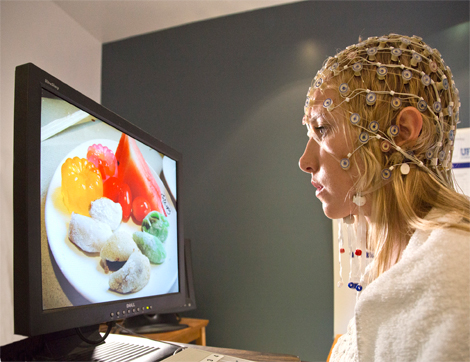
Straight after the exercise, the women looked at 240 images – 120 of plated food and 120 of flowers (for study control purposes). Electrodes on their heads were used to measure their neural activity and how aroused brain waves were in response to the images.
A week later, on the same day of the week and at the same time, the women were shown the pictures again, but without exercising beforehand. As part of the study, they also kept a physical activity log and food consumption diary on the days the experiments took place.
Food for thought In the results, it was found that brain arousal in relation to pictures of food was significantly lower when the women had been exercising. This finding was true regardless of the women’s BMI.
This surprised the scientists for two reasons. Firstly, they expected the women to feel more stimulated by food pictures because of exercise – hence the notion of working up an appetite. And secondly, they expected the obese women to feel more aroused by food in either scenario. LeCheminant says: “We wanted to see if obesity influenced food motivation, but it didn’t. However, it was clear that the exercise bout was playing a role in their neural responses to the pictures of food.”
Also interesting is the fact that, on the exercise day, the women increased their levels of activity generally (not including the 45-minute walk), but didn’t eat any more food than on the non-exercise day to make up for the expended calories. This suggests that burning calories doesn’t necessarily lead to calorie consumption.
This backs up findings from a 2011 study published in Obesity Reviews which found that vigorous exercise reduced levels of ghrelin – a hormone that increases feelings of hunger – while at the same time increasing levels of PYY, a hormone that reduces the appetite.
Both pieces of research suggest that exercise may play more of a role in weight loss than just the amount of calories it burns. LeCheminant says: “This study provides evidence that exercise not only affects energy output, but it also may affect how people respond to food cues.”
The next move will be to investigate for how long exercise may reduce the appetite, and also what effects long-term exercise might have when added into the overall equation. Larson concludes: “The subject of food motivation and weight loss is so complex. There are many things that influence eating, and exercise is just one element.”
Panatta brought together four of the most influential figures in bodybuilding history on the
stage of RiminiWellness 2026: Phil Heath, Lee Haney, Ronnie Coleman and Hany Rambod. [more...]
CoverMe, the global leader in fitness workforce management, today launches CoverMe PT, an
on-demand personal training platform that connects the right personal trainer to the right
client in under 10 seconds. [more...]
After exercise, the women were surprisingly less stimulated by food images
After burning calories during a workout, it’s only natural that you should feel the need to replenish them by eating a big meal, right? Wrong. Exercise may actually reduce people’s motivation to eat food, according to new research by scientists at the Brigham Young University (BYU) in Utah, US.
This is one of the first studies to focus specifically on neurological-derived food motivation after exercise. It was published in Medicine & Science in Sports & Exercise – the official journal of the American College of Sports Medicine – in October.
Appetising subject Headed up by BYU professors James LeCheminant and Michael Larson, the study was based on 35 women. Eighteen of the women were of normal weight, with a BMI score of 25 or less, while 17 were clinically obese, with a BMI of 30 or more.
For the experiment, the women took part in 45 minutes of moderate-to-vigorous exercise one morning (at 8.00am) – a walk on a treadmill at a speed of 3.8mph, with no incline.
Straight after the exercise, the women looked at 240 images – 120 of plated food and 120 of flowers (for study control purposes). Electrodes on their heads were used to measure their neural activity and how aroused brain waves were in response to the images.
A week later, on the same day of the week and at the same time, the women were shown the pictures again, but without exercising beforehand. As part of the study, they also kept a physical activity log and food consumption diary on the days the experiments took place.
Food for thought In the results, it was found that brain arousal in relation to pictures of food was significantly lower when the women had been exercising. This finding was true regardless of the women’s BMI.
This surprised the scientists for two reasons. Firstly, they expected the women to feel more stimulated by food pictures because of exercise – hence the notion of working up an appetite. And secondly, they expected the obese women to feel more aroused by food in either scenario. LeCheminant says: “We wanted to see if obesity influenced food motivation, but it didn’t. However, it was clear that the exercise bout was playing a role in their neural responses to the pictures of food.”
Also interesting is the fact that, on the exercise day, the women increased their levels of activity generally (not including the 45-minute walk), but didn’t eat any more food than on the non-exercise day to make up for the expended calories. This suggests that burning calories doesn’t necessarily lead to calorie consumption.
This backs up findings from a 2011 study published in Obesity Reviews which found that vigorous exercise reduced levels of ghrelin – a hormone that increases feelings of hunger – while at the same time increasing levels of PYY, a hormone that reduces the appetite.
Both pieces of research suggest that exercise may play more of a role in weight loss than just the amount of calories it burns. LeCheminant says: “This study provides evidence that exercise not only affects energy output, but it also may affect how people respond to food cues.”
The next move will be to investigate for how long exercise may reduce the appetite, and also what effects long-term exercise might have when added into the overall equation. Larson concludes: “The subject of food motivation and weight loss is so complex. There are many things that influence eating, and exercise is just one element.”
The UK's four Chief Medical Officers have published a refreshed edition of Physical activity
guidelines: UK Chief Medical Officers' report, updating the evidence that underpins the nation's
physical activity recommendations and placing greater emphasis on strength, balance, reducing
sedentary behaviour and, for the first time, supporting people taking weight loss medications.
Places Leisure has exchanged contracts to build and operate a flagship £60m water and leisure
destination on behalf of Basingstoke and Deane Borough Council.
The Republic of Ireland will become the latest market in PureGym’s expanding international
portfolio, with the first launch planned for Dublin in 2027.
Anytime Fitness opened more than one club a day in 2025 and is on track to maintain this rate
of growth this year, as parent company Purpose Brands targets further international expansion.
The £33.9 million Leighton Leisure and Community Centre has opened in Leighton Buzzard, UK,
creating a next-generation public leisure, health and wellbeing hub for the local community.
Walnuts Leisure Centre in Orpington, in the London Borough of Bromley, has reopened following
a £17m transformation designed to secure the long-term future of the public leisure asset and
reposition it as a community wellbeing hub.
The Gym Group, has announced that it's sustained positive trading momentum has continued
through the first half of 2026 and the company remains confident about the outlook.
Luxury boutique Pilates and wellness studio, X-Club, officially launches a
4,000sq ft flagship at
Marylebone on 16 July Built around X-Club’s four pillars of wellness – mind,
movement,
nutrition and therapy – the facility features two group exercise studi
Panatta brought together four of the most influential figures in bodybuilding history on the
stage of RiminiWellness 2026: Phil Heath, Lee Haney, Ronnie Coleman and Hany Rambod. [more...]
CoverMe, the global leader in fitness workforce management, today launches CoverMe PT, an
on-demand personal training platform that connects the right personal trainer to the right
client in under 10 seconds. [more...]